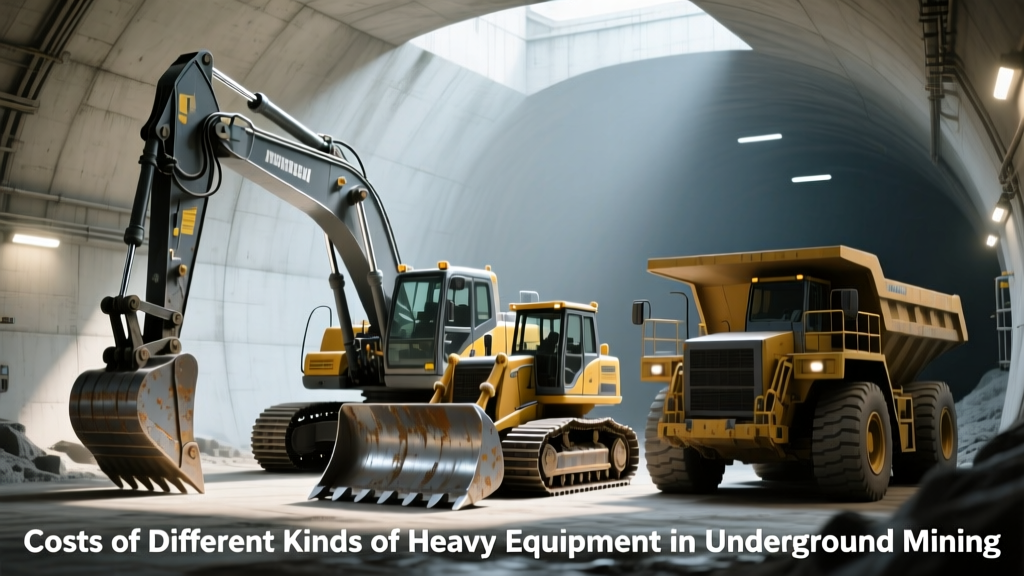
Costs of Different Kinds of Heavy Equipment in Underground Mining
Analyze capital and operating costs of different kinds of heavy equipment for underground mining. Compare BEV vs diesel ROI and lease frameworks.
The True Cost of Underground Fleet Acquisition in 2026
Capital allocation for subterranean extraction requires navigating a complex matrix of mobile machinery, stationary infrastructure, and ventilation economics. When evaluating the different kinds of heavy equipment required for sub-level stoping or drift development, mine planners must look beyond the initial purchase price. The transition toward battery-electric vehicles (BEVs) and automated drilling rigs has fundamentally altered the Total Cost of Ownership (TCO) models for underground operations.
Sub-level stoping operations demand precise synchronization of drill, blast, and muck cycles. A single bottleneck in the Load Haul Dump (LHD) fleet delays the entire development sequence, costing upwards of $15,000 per hour in lost production revenue. Therefore, budget planning must account for machine availability, mean time between failures (MTBF), and the hidden infrastructure costs associated with modern fleet deployment.
Capital Expenditure (CapEx) vs. Operating Expense (OpEx)
Historically, underground mining budgets heavily favored low-CapEx diesel fleets, absorbing the high OpEx of fuel, exhaust filtration, and massive ventilation requirements. In 2026, the paradigm has inverted. According to electrification benchmarks published by Epiroc, the upfront premium for BEV machinery is rapidly offset by the elimination of diesel particulate matter (DPM) ventilation taxes. Planners must now model infrastructure deltas: the cost of high-voltage charging bays versus the cost of deepening ventilation shafts and operating 500kW primary fans.
Cost Breakdown: Sub-Level Mining Fleet Baselines
The table below outlines current market baselines for primary underground development and production equipment. Pricing reflects 2026 OEM list prices, including standard telemetry and basic automation packages, but excludes site-specific delivery, assembly, and commissioning.
| Equipment Category | Representative 2026 Model | Estimated CapEx (USD) | Hourly OpEx (Energy + Maint.) |
|---|---|---|---|
| Development Drill Jumbo | Epiroc Boomer E2 | $850,000 - $1,150,000 | $145 - $180 |
| Diesel LHD (42-tonne class) | Sandvik TH551i | $550,000 - $680,000 | $110 - $140 |
| Battery-Electric LHD | Epiroc Minetruck MT42 | $750,000 - $920,000 | $65 - $85 |
| Underground Haul Truck | Sandvik TH663i | $900,000 - $1,200,000 | $160 - $210 |
| Roof Bolter / Scaler | MacLean SB5 | $450,000 - $600,000 | $90 - $120 |
Drill Jumbos: Precision vs. Price Tag
Development drill jumbos represent the highest hourly operating cost in the initial drift development phase. A twin-boom rig like the Sandvik DD422i or Epiroc Boomer E2 is a highly complex electro-hydraulic system. The primary budget drain on these units is the hydraulic drifter (e.g., the COP 1838HD or RD525).
⚠️ Maintenance Gotcha: Drifter RebuildsMine planners frequently underbudget drifter maintenance. These components require complete teardown and rebuild every 3,500 to 4,500 impact hours. A factory-certified rebuild kit and labor for a heavy-duty drifter costs between $28,000 and $42,000. Failing to rotate drifters and maintain a hot-swap inventory will result in catastrophic internal failures, turning a planned $35,000 overhaul into a $90,000 replacement.
Furthermore, the high-pressure hydraulic hose assemblies on jumbos are subject to extreme abrasion in tight drifts. Budgeting $12,000 annually per rig for preventative hose replacement and quick-coupler maintenance prevents unplanned downtime that stalls the entire blast cycle.
LHDs and Haul Trucks: The Diesel vs. Battery-Electric Pivot
When selecting the different kinds of heavy equipment for mucking and haulage, the choice between diesel and BEV powertrains dictates the mine's long-term infrastructure budget. Fleet optimization data from Sandvik Mining and Rock Solutions indicates that while diesel LHDs maintain a 20% to 30% lower initial purchase price, their total lifecycle cost is heavily penalized by ventilation requirements.
The Ventilation Tax
Diesel equipment requires massive airflow to dilute exhaust gases and DPM to meet regulatory standards. Research on subterranean airflow and particulate management by the National Institute for Occupational Safety and Health (NIOSH) highlights the severe respiratory risks and strict regulatory limits associated with diesel exhaust. To comply, mines must operate primary fans continuously, consuming 2 to 4 megawatts of power, and invest millions in shaft-deepening or secondary ventilation raises as the mine expands.
BEV Infrastructure Realities
Transitioning to a BEV fleet, such as the Epiroc Minetruck MT42, eliminates the DPM ventilation requirement, allowing mines to reduce airflow by up to 50%. However, this shifts the budget from ventilation to electrical infrastructure:
- Battery Swap Stations: Automated overhead crane systems and battery cassettes cost $180,000 to $250,000 per installation.
- Grid Upgrades: Fast-charging bays require dedicated substations. Upgrading a site's power feed to support 400kW+ rapid chargers can add $500,000 to surface CapEx.
- Battery Degradation: Lithium-iron-phosphate (LFP) battery packs represent roughly 35% of the BEV's CapEx. Planners must budget for a mid-life battery swap at approximately 18,000 operating hours, costing upwards of $200,000.
Scaling and Bolting: The Hidden Budget Drains
Ground support equipment is often treated as an afterthought in fleet budgeting, yet it presents unique financial risks. Roof bolters and scalers operate in the most hazardous, freshly blasted environments. The MacLean SB5 scaler, for example, utilizes a high-frequency impact hammer to remove loose rock. The boom cylinders and pivot pins on these machines endure severe shock loading.
Budgeting for ground support equipment must include a 15% premium for structural weld repairs and non-destructive testing (NDT) of boom assemblies every 2,000 hours. Ignoring this preventative budget leads to catastrophic boom failures under load, posing severe safety risks and resulting in extended machine downtime while custom steelwork is fabricated.
Lease vs. Buy Decision Matrix for 2026
Deciding whether to purchase or lease underground equipment depends on the mine's proven reserves, expected utilization rates, and balance sheet constraints. Use the following framework to guide acquisition strategy:
| Acquisition Strategy | Ideal Scenario | Financial Impact |
|---|---|---|
| Outright Purchase | Mine life > 10 years; Utilization > 6,000 hrs/yr; Strong corporate balance sheet. | Lowest long-term TCO. Requires heavy upfront CapEx and internal maintenance staffing. |
| Operating Lease | Mine life 3-7 years; Exploratory phases; Need for guaranteed availability. | Higher monthly cost, but shifts major component rebuild risks to the OEM. Preserves capital for exploration. |
| Rent-to-Own | Ramping up production; Awaiting final feasibility study approval. | Locks in current pricing while allowing early exit if ore body grading underperforms. |
Total Cost of Ownership (TCO) Modeling Framework
To accurately compare bids from OEMs for your underground fleet, build a 10-year TCO model incorporating the following specific variables:
- Base CapEx & Freight: Include underground disassembly, hoisting down the shaft, and reassembly costs (often $40,000 - $80,000 per machine).
- Energy Consumption Delta: Model diesel at $4.50/gallon (accounting for surface-to-underground transport logistics) versus industrial power at $0.08 - $0.12/kWh, factoring in demand charges for peak BEV charging.
- Component Rebuild Cycles: Map out engine overhauls (12,000 hrs) for diesel versus electric motor and inverter servicing for BEVs.
- Consumables: Ground engaging tools (GET), bucket lips, and drill steels. A 51-tonne haul truck will consume $45,000 to $60,000 annually in GET replacement alone in abrasive ore bodies.
- Residual Value: Diesel engines hold predictable rebuild value. BEV residual values are highly dependent on the secondary market's ability to repurpose degraded LFP packs for stationary surface storage.
Expert Insight: Do not evaluate equipment bids in isolation. A drill jumbo with a 5% higher purchase price but an integrated rod-handling system and auto-collaring feature will reduce manual labor requirements by one operator per shift. Over a five-year development contract, that labor savings alone will eclipse the initial capital premium, proving that automation is a cost-reduction tool, not just a safety feature.
Ultimately, budgeting for underground heavy equipment requires a holistic view of the extraction ecosystem. By rigorously modeling the intersection of machine capabilities, energy infrastructure, and ground conditions, mine planners can secure a fleet that maximizes tonnage per dollar invested.