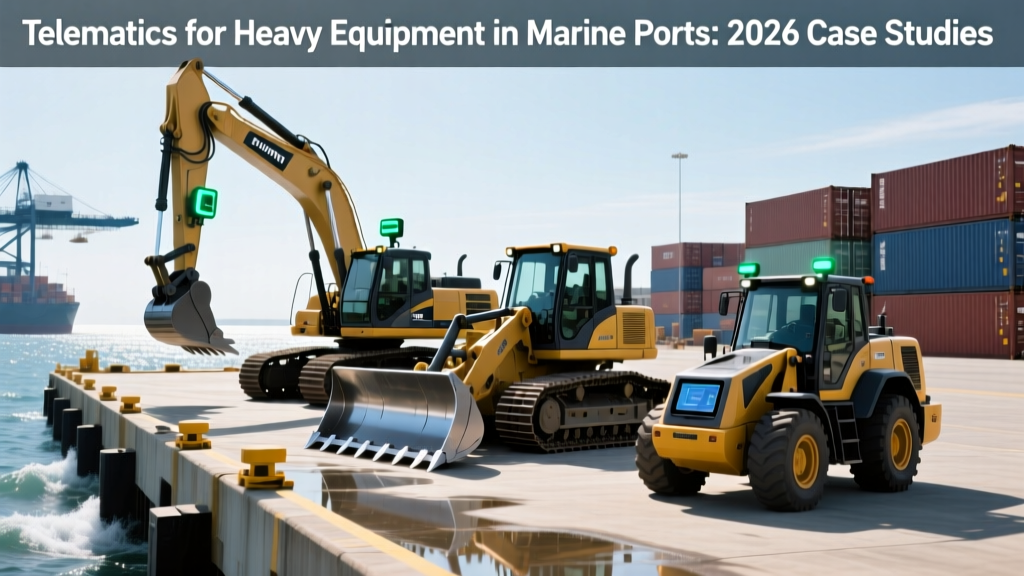
Telematics for Heavy Equipment in Marine Ports: 2026 Case Studies
Explore how telematics for heavy equipment optimizes marine port operations. 2026 case studies on RTG cranes, reach stackers, and TOS integration.
The Extreme Environment of Marine Terminals
Marine ports represent the most punishing operational environments for heavy machinery. Salt spray, continuous 24/7 duty cycles, and high-density traffic demand specialized telematics for heavy equipment that goes far beyond standard construction site tracking. While a standard GPS tracker on a bulldozer might only need to report location and basic engine hours, port equipment requires real-time CAN bus data streaming, edge computing for crane load moments, and seamless API handshakes with Terminal Operating Systems (TOS).
Hardware Warning: Salt-Air CorrosionStandard IP67-rated telematics gateways routinely fail within 4 to 6 months in marine environments due to salt-induced galvanic corrosion on antenna connections and wiring harnesses. For port deployments, specify hardware with IP69K ratings and marine-grade tinned copper wiring. Connectors must be sealed with dielectric grease and utilize NEMA 6P enclosures to withstand high-pressure washdowns and driving salt rain.
Case Study 1: RTG Crane Automation via Private 5G
The transition from diesel to electric Rubber-Tyred Gantry (RTG) cranes has accelerated, but the true efficiency gains come from telemetry integration over private 5G networks. At a major European automated terminal, the deployment of Konecranes OPTIME telematics on a fleet of 18 electric RTGs fundamentally changed container handoff metrics.
Overcoming Wi-Fi Latency in High-Density Stacks
Historically, terminals relied on mesh Wi-Fi networks, which suffered from signal occlusion when container stacks reached 6-high (approximately 15.5 meters). In 2025 and 2026, the shift to private 5G (operating on CBRS or dedicated local spectrum) provided the sub-10ms latency required for real-time telematics. This allowed the terminal to stream hoist motor torque, trolley position, and spreader twist-lock status directly to the control room without packet loss.
| Operational Metric | Baseline (Mesh Wi-Fi) | Post-Telematics (5G) | Variance |
|---|---|---|---|
| Container Moves Per Hour (MPH) | 28.4 | 33.1 | +16.5% |
| Spreader Sway Incidents | 4.2 per shift | 0.8 per shift | -80.9% |
| Unplanned Downtime (Hoist Motors) | 14 hours/month | 2 hours/month | -85.7% |
| Data Packet Loss Rate | 8.4% | 0.02% | -99.7% |
Case Study 2: Reach Stacker Fleet Optimization
For mid-sized terminals handling breakbulk and mixed TEU (Twenty-foot Equivalent Unit) volumes, reach stackers are the primary movers. A North American port authority retrofitted its fleet of Kalmar DRG450-70S5 reach stackers with Kalmar Key Telematics to combat rising diesel costs and premature boom wear.
Enforcing Eco-Driving and Load Limits
The Kalmar DRG450 features a 45-ton lifting capacity, but operators frequently pushed the machine into the red zone by swinging loaded containers at maximum boom extension. The telematics gateway tapped into the J1939 CAN bus to monitor hydraulic pressure, boom angle, and engine RPM. By implementing geofenced speed limits and automated engine derating when operators exceeded safe load-moment thresholds, the port achieved significant operational shifts.
'We discovered that 30% of our fuel burn was occurring during idle periods while operators waited for truck chassis. By integrating the telematics data with our gate appointment system, we implemented an auto-shutoff protocol after 3 minutes of idle, saving over $42,000 annually per machine in fuel alone.'
— Director of Terminal Operations, US Gulf Coast Port
Hardware Selection: OEM vs. Third-Party Telematics
Port procurement managers face a critical decision: utilize proprietary OEM telematics (like Liebherr LiDAT or Kalmar Key) or deploy aftermarket heavy-duty telematics (like Samsara or Geotab). The choice depends heavily on the depth of data required.
Procurement Decision Framework
- OEM Systems (e.g., Kalmar Key, Konecranes OPTIME):
- Pros: Deep proprietary code access (e.g., spreader twist-lock sensor faults, specific hydraulic valve spool wear). Direct integration with OEM predictive maintenance algorithms. Warranty compliant.
- Cons: High licensing fees ($150-$300 per unit/month). Siloed data that requires custom API work to feed into third-party TOS platforms.
- Best For: Ship-to-Shore (STS) cranes and complex Mobile Harbor Cranes (MHC) where structural load telemetry is mission-critical.
- Aftermarket Systems (e.g., Samsara, Geotab Heavy Duty):
- Pros: Unified dashboard across mixed fleets (terminal tractors, light vehicles, reach stackers). Lower hardware costs ($800-$1,200 upfront). Excellent GPS and video-telematics integration.
- Cons: Limited to standard J1939 / OBD-II data. Cannot read proprietary PLC (Programmable Logic Controller) codes from crane slewing rings or hoist drums.
- Best For: Terminal tractors (e.g., Konecranes SMV, Ottawa yard hostlers) and yard support vehicles.
Integration with Terminal Operating Systems (TOS)
Telematics data is useless if it sits in a silo. In modern marine ports, equipment telemetry must feed directly into the TOS (such as Navis N4 or TSB). According to the UNCTAD Review of Maritime Transport, port digitalization is the primary driver for reducing vessel turnaround times, a metric that directly impacts global supply chain fluidity.
The API Handshake: Navis N4 and Equipment Telemetry
To bridge the gap between the machine's CAN bus and the TOS, terminals deploy edge gateways that translate raw telemetry into standardized EDI (Electronic Data Interchange) or RESTful API payloads.
- Event Trigger: The reach stacker spreader locks onto a 40ft container. The twist-lock sensor sends a signal via the CAN bus.
- Edge Processing: The onboard telematics gateway packages the Container ID (via OCR cameras), GPS coordinates, and weight data.
- API Transmission: The gateway pushes a JSON payload via private 5G to the port's middleware server.
- TOS Update: Navis N4 receives the webhook, updates the container's status from 'Grounded' to 'Wheeled', and assigns a destination slot in the yard.
ROI and Procurement Strategy for 2026
When budgeting for telematics for heavy equipment in a marine environment, port authorities must look beyond the initial hardware purchase. A comprehensive retrofit for a legacy diesel reach stacker typically costs between $4,500 and $8,500 per unit, including marine-grade harnesses, IP69K cameras, and installation labor.
However, the ROI is realized through the reduction of catastrophic failures. For example, a single Mobile Harbor Crane (MHC) slewing ring failure can cost upwards of $250,000 in parts and crane downtime, not including the demurrage fees from delayed vessels. Telematics systems that monitor grease distribution pressure and rotational torque can predict slewing ring degradation up to 400 operating hours before catastrophic seizure.
For port authorities and terminal operators evaluating these systems, the mandate is clear: prioritize IP69K hardware, mandate private 5G for high-density stacking zones, and ensure your chosen telematics provider offers open REST APIs for seamless TOS integration. As noted by the American Association of Port Authorities, the terminals that successfully merge physical equipment telemetry with digital twin modeling are the ones capturing the highest margins in an increasingly competitive global shipping landscape.