Selecting Types of Construction Machinery for Airport Ground Support
Expert guide to selecting specialized types of construction machinery for airport ground support, including pricing, FOD compliance, and heavy GSE models.
The Airside Heavy Equipment Matrix: Bridging Civil and Aerospace
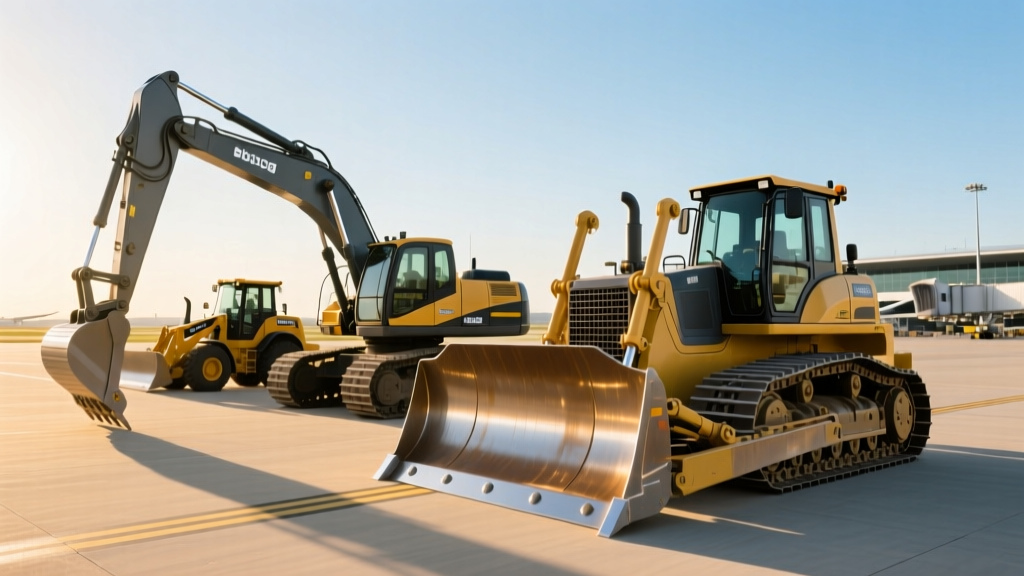
Airport expansion and apron maintenance projects represent one of the most heavily regulated and physically demanding environments for heavy equipment procurement. When airport authorities and specialized civil contractors evaluate types of construction machinery for airside operations, standard civil earthmoving specs are insufficient. Airside environments demand strict adherence to Foreign Object Debris (FOD) mitigation, extreme load tolerances for aircraft towing, and precise turning radii within confined taxiway corridors.
For 2026 procurement budgets, the line between traditional heavy construction machinery and Ground Support Equipment (GSE) is increasingly blurred. Heavy runway pavers, specialized wheel loaders, and massive towbarless pushback tractors all fall under the capital expenditure umbrella for airport infrastructure. Selecting the wrong machinery class can result in catastrophic FOD events, runway pavement failures, or severe operational bottlenecks.
⚠️ CRITICAL PROCUREMENT WARNING: Standard civil construction machinery cannot be deployed on active or newly sealed airside aprons without extensive FOD modifications. Unsealed bearings, standard pneumatic tires that shed rubber, and exposed hydraulic lines pose immediate threats to jet engine ingestion. Always specify 'Airside/FOD-Compliant' configurations in your RFQs.Heavy Runway Paving and Earthmoving Machinery
Runway and taxiway construction requires continuous, high-tolerance concrete slipform paving. Unlike highway paving, airport runways must support the dynamic point-loads of aircraft landing gear (up to 300+ metric tons) without micro-fracturing.
Wirtgen SP 1600 Slipform Paver
The Wirtgen SP 1600 remains the industry benchmark for heavy airside concrete paving. Designed for widths up to 16 meters, it can pave a full runway lane in a single pass. For 2026 deployments, contractors are prioritizing the SP 1600 with the dual-tier track system, which provides the necessary traction on wet, freshly graded sub-bases without slipping.
- Max Paving Width: 16.0 meters (52.5 ft)
- Max Paving Thickness: 500 mm (20 in)
- Engine: Cummins QSL 9 (Tier 4 Final / Stage V compliant)
- 2026 Procurement Cost: $1.4M – $1.9M USD (depending on sensor and stringless guidance packages)
Caterpillar 988K XE Wheel Loader (Airside Configured)
While standard wheel loaders handle material transport, the 988K XE with an advanced drivetrain is frequently specified for airside apron expansion. The critical modification for airport use is the factory-installed debris shielding and solid polyurethane-filled tires, eliminating the risk of pneumatic tire blowouts and rubber FOD near active gates.
Heavy Aircraft Pushback and Tow Tractors
Airport ground support relies heavily on specialized heavy machinery to move aircraft. Towbarless tractors are classified as heavy industrial machinery due to their immense hydraulic clamping forces and drivetrain torque requirements.
Goldhofer AST-1X Towbarless Tractor
The Goldhofer AST-1X is engineered to handle wide-body aircraft, including the Boeing 777 and Airbus A350 (ICAO Code F). It lifts the aircraft's nose gear via a hydraulic cradle, eliminating the need for heavy, FOD-prone towbars. With the 2026 push toward zero-emission airside operations, the AST-1X is increasingly ordered with high-capacity lithium-ion battery arrays rather than traditional diesel powertrains, reducing localized NOx emissions on the apron.
- Max Aircraft MTOW: 350,000 kg
- Clamping Force: Up to 220 kN
- 2026 Procurement Cost: $750,000 – $920,000 USD
Heavy Machinery Procurement Matrix
| Equipment Category | Primary Model Example | Max Capacity / Spec | Est. Price Range (2026) |
|---|---|---|---|
| Slipform Paver | Wirtgen SP 1600 | 16m width / 500mm depth | $1.4M – $1.9M |
| Heavy Wheel Loader | CAT 988K XE (Airside) | 14.5 tonne payload | $650,000 – $780,000 |
| Towbarless Tractor | Goldhofer AST-1X | 350,000 kg MTOW | $750,000 – $920,000 |
| Runway Sweeper | Johnston JS8000 | 8.2m sweep width | $420,000 – $480,000 |
Procurement Pitfalls: FOD Mitigation and Edge Cases
When sourcing FAA Airport Design Advisory Circulars and cross-referencing with IATA Ground Operations standards, procurement officers frequently encounter three critical failure modes in heavy equipment selection:
1. The Hydraulic Leak Hazard
Standard civil excavators and loaders utilize high-pressure hydraulic lines routed along the exterior of the boom and arm. On an active apron, a micro-leak of hydraulic fluid onto the concrete creates a severe slip hazard for ground crew and can degrade specialized runway sealants. Airside machinery must feature internal hydraulic routing or secondary containment drip pans welded directly to the chassis.
2. Acoustic and Emission Constraints
Heavy machinery operating near passenger terminals must comply with strict localized acoustic limits (typically under 75 dB(A) at 7 meters). Procurement teams must specify acoustic attenuation packages and, increasingly, battery-electric drivetrains to meet 2026 airport sustainability mandates.
3. Unsealed Bearing Degradation
De-icing fluids (glycol-based) and runway de-icing salts are highly corrosive. Standard construction machinery bearings will seize within months of airside winter operations. Specifications must mandate IP68-rated sealed bearings and specialized marine-grade epoxy coatings on all undercarriage components.
Decision Framework: Matching Machinery to ICAO Airport Codes
To optimize capital allocation, align your heavy machinery procurement with the airport's ICAO Aerodrome Reference Code. This prevents over-specifying equipment for regional hubs or under-specifying for international gateways.
ICAO Code C (Regional / Narrow-Body Operations)
Aircraft: Boeing 737, Airbus A320 family.
Required Heavy Machinery Profile: Standard slipform pavers (Wirtgen SP 500 class), conventional towbar tractors (TLD TPX-100), and mid-capacity sweepers. Focus budget on high-maneuverability equipment capable of navigating tight 15-meter taxiway fillets.
ICAO Code F (International / Wide-Body Operations)
Aircraft: Boeing 747-8, 777X, Airbus A380.
Required Heavy Machinery Profile: Heavy-duty Wirtgen Slipform Pavers (SP 1600 class) to handle 60-meter runway widths. Goldhofer AST-1X or similar heavy towbarless tractors capable of 350+ MTOW. High-capacity 8-meter runway sweepers to clear massive debris footprints generated by heavy wide-body landings.
Final Procurement Directives
Selecting the right heavy equipment for airport ground support and runway infrastructure requires abandoning standard civil construction catalogs. By mandating FOD-compliant configurations, specifying internal hydraulic routing, and aligning equipment MTOW and paving widths with the facility's ICAO classification, procurement teams can secure machinery that delivers decades of reliable airside service while maintaining absolute compliance with aerospace safety regulations.