How Heavy Equipment Simulation Ensures Renewable Construction Safety
Discover how heavy equipment simulation ensures OSHA and ASME compliance for wind and solar construction, reducing lift failures and terrain risks.
The Compliance Imperative in Renewable Megaprojects
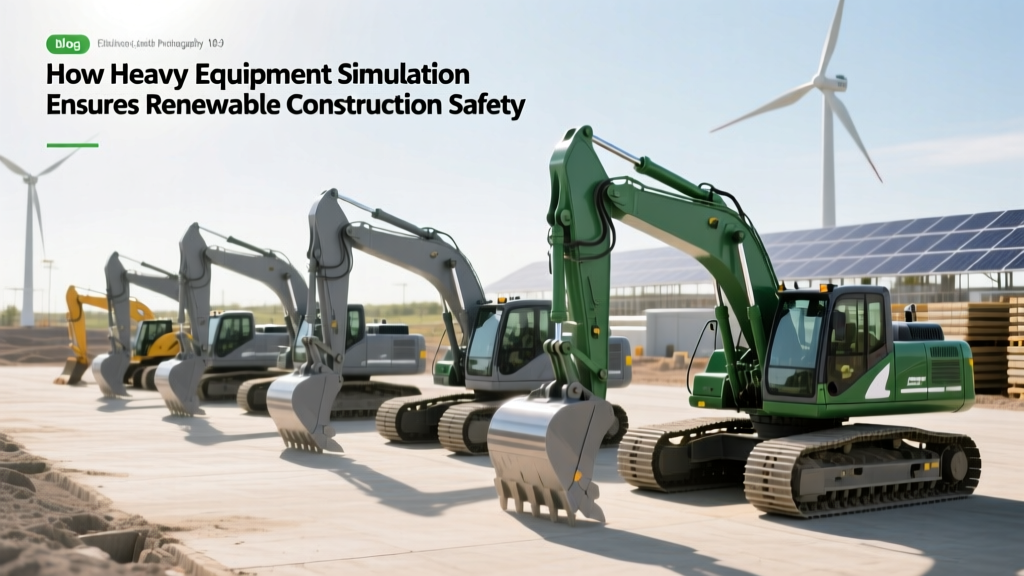
Compliance Warning: Under OSHA 1926 Subpart CC, failure to verify ground bearing pressure (GBP) before a critical wind turbine lift can result in citations exceeding $16,131 per violation, alongside catastrophic equipment loss and project delays.Renewable energy construction operates at the extreme edges of heavy machinery capabilities. Erecting a 150-meter wind turbine tower or driving thousands of steel piles across uneven solar farm terrain requires equipment operating near its maximum load charts and stability limits. Traditional 2D lift plans and static soil reports are no longer sufficient to meet modern safety standards. Site engineers and safety directors are now mandated to prove operational safety through dynamic digital modeling before mobilizing equipment to the site.
Core Safety Standards Governing Renewable Heavy Machinery
Compliance in renewable construction is governed by a triad of regulatory and engineering standards. Understanding these frameworks is critical for selecting the right simulation parameters.
- OSHA 1926 Subpart CC (Cranes and Derricks in Construction): Specifically, 1926.1417 (Operation) requires operators and directors to account for wind speed, ground conditions, and dynamic loading. For wind turbine erection, this means calculating the exact sail area of the blade assembly and its effect on crane side-loading.
- ASME B30.5 (Mobile and Locomotive Cranes): Dictates the structural and stability testing requirements for crawler cranes, including the mandatory use of load moment indicators (LMI) and the physical limits of outrigger or crawler pad deployment on temporary matting.
- IEC 61400 & ISO 22111: While IEC 61400 focuses on turbine design, its installation annexes dictate maximum allowable wind speeds for hoisting (typically halting lifts at 9.8 m/s or 22 mph). ISO 22111 governs temporary works, directly impacting how solar pile-driving rigs must be stabilized on sloped terrain.
How Heavy Equipment Simulation Mitigates Lift & Terrain Risks
Integrating heavy equipment simulation into the pre-construction phase bridges the gap between theoretical load charts and real-world site variables. By creating a 4D digital twin of the construction sequence, safety managers can identify clearance clashes, ground failure points, and center-of-gravity shifts before the first piece of iron arrives on site.
Wind Turbine Crawler Crane Lifts
Consider the erection of a 5.5 MW onshore turbine using a Liebherr LR 13000 crawler crane. The nacelle weighs approximately 115 metric tons and must be hoisted to a hub height of 125 meters. The primary safety risk is not the crane's lifting capacity, but the Ground Bearing Pressure (GBP) exerted by the crawler tracks during the boom raise and hoist sequence.
Simulation software calculates the dynamic GBP shift as the crane slews. If the soil shear strength is 2.5 tons/m², but the simulation reveals a localized GBP spike of 4.1 tons/m² during the 45-degree slew, the safety director must engineer a timber or steel matting system to distribute the load. Without simulation, the crane risks punching through the subgrade, leading to a catastrophic tip-over.
Solar Pile Driving on Uneven Terrain
Solar farms are frequently built on marginal, sloped land. A Gayk HSG hydraulic ramming machine driving 8-meter H-piles on a 12-degree incline faces severe rollover risks. Simulation models the machine's center of gravity as the mast articulates to maintain vertical pile alignment. By simulating the lateral forces exerted by the hydraulic hammer (typically 7,000 Joules of impact energy), engineers can determine the exact slope limit—often capping operations at 15 degrees—before requiring specialized track modifications or terracing.
| Parameter | Simulation Input | Real-World Tolerance Limit | Compliance Standard |
|---|---|---|---|
| Wind Speed (Blade Hoist) | 8.5 m/s (Dynamic Gust Modeling) | Max 9.8 m/s sustained | IEC 61400 / OEM Manual |
| Ground Bearing Pressure | 18.5 tons/m² (Peak Slew) | Must not exceed Soil Shear Strength | OSHA 1926.1402 |
| Boom Deflection | 1.4 meters at 120m radius | Accounted for in tagline tension | ASME B30.5 |
| Tail Swing Clearance | 1.2 meters from turbine tower | Minimum 0.6 meters required | OSHA 1926.1424 |
Step-by-Step: Integrating Simulation into Site Safety Plans
To achieve full regulatory compliance and pass third-party safety audits, site supervisors should follow this integration protocol:
- Geotechnical Data Import: Upload cone penetration test (CPT) and soil boring logs into the simulation environment to create a 3D subgrade model.
- Equipment Digital Twin Selection: Load the exact OEM CAD and load-chart data for the specific machine (e.g., Manitowoc MLC300 with VPC-MAX attachment).
- Clash Detection Run: Execute a virtual lift sequence to identify spatial conflicts with temporary structures, anemometer towers, or adjacent turbine pads.
- Matting Optimization: Use the GBP heat map generated by the simulation to design the crane pad. This prevents over-engineering the pad, saving thousands of dollars in timber mat rentals.
- Audit Documentation: Export the 4D lift sequence and GBP calculations as a PDF dossier to submit to the project's Professional Engineer (PE) and OSHA compliance officers.
Cost-Benefit Analysis of Pre-Lift Simulation Software
The financial argument for simulation extends beyond avoiding OSHA fines; it directly optimizes heavy equipment operational costs. According to data analyzed by the National Renewable Energy Laboratory (NREL), logistical delays and ground preparation account for nearly 35% of wind farm installation costs.
By utilizing simulation, contractors routinely reduce crane pad footprints by 12% to 18%. For a 50-turbine project requiring heavy timber mats (priced at roughly $1,200 per crane pad), an 18% reduction in matting saves approximately $10,800 in material and transport costs alone. Furthermore, simulating the assembly sequence of the main boom and luffing jib can reduce on-site assembly time by 14 hours, saving roughly $12,500 in crane hourly rates and crew labor.
| Software Platform | Primary Use Case | Estimated Annual License Cost | Key Compliance Feature |
|---|---|---|---|
| Liebherr Crane Planner 2.0 | Wind Turbine Crawler Lifts | $8,000 - $15,000 | OEM-verified GBP and LMI limits |
| Bentley SYNCHRO 4D | Full Site Sequence & Solar Logistics | $10,000 - $14,000 | Time-based clash detection & haul road analysis |
| AutoCAD Plant 3D / Inventor | Custom Rigging & Solar Pile Arrays | $2,100 - $3,500 | Precise sling angle and tension calculations |
Frequently Asked Questions on Simulation Compliance
Does OSHA explicitly mandate 3D simulation for critical lifts?
OSHA does not explicitly name '3D simulation' in 1926 Subpart CC. However, the standard strictly mandates that the lift director must verify ground conditions, clearances, and load dynamics. For complex renewable lifts (e.g., tandem lifts or lifts exceeding 80% of the crane's chart capacity), third-party Professional Engineers and site owners almost universally require a simulated lift plan as the only acceptable method to prove compliance with these OSHA mandates.
How accurate are GBP simulations compared to physical soil testing?
Simulations are only as accurate as the geotechnical data fed into them. A simulation using generic soil assumptions can be off by 30% or more. When calibrated with site-specific Cone Penetration Test (CPT) data and dynamic modulus values from plate load tests, modern finite element analysis (FEA) simulations predict ground settlement and GBP distribution within a 5% to 8% margin of error, which easily satisfies ASME B30.5 safety factors.
Can simulation prevent solar pile driver rollovers on slopes?
Yes. Advanced kinematic simulations model the exact shift in the machine's center of gravity when the mast is tilted to compensate for terrain slope. By inputting the specific soil friction coefficient and the machine's track footprint, safety engineers can establish strict operational slope limits (e.g., maximum 12-degree lateral slope) and program the machine's inclinometer to automatically halt operations if those simulated safety thresholds are breached in the field.