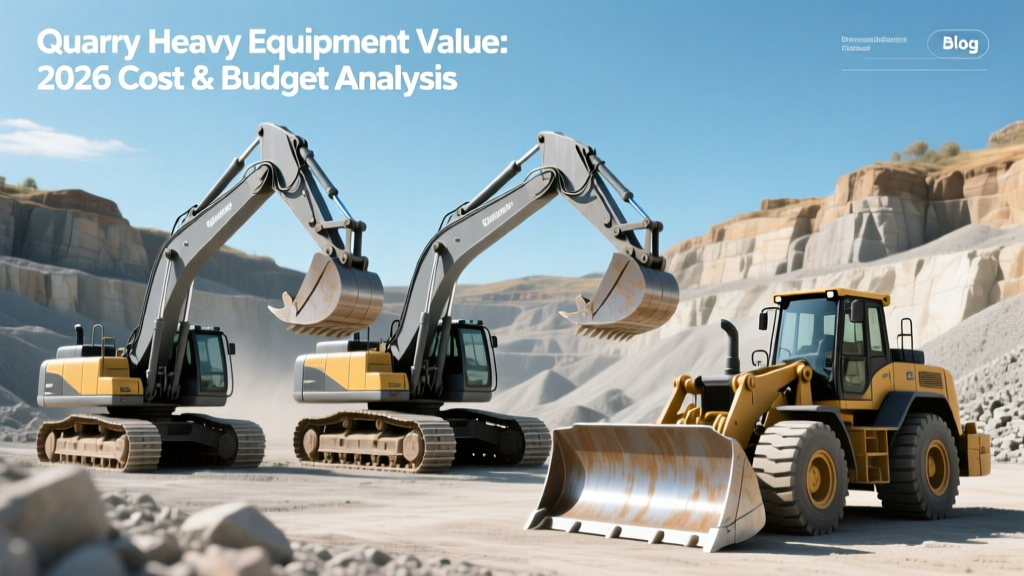
Quarry Heavy Equipment Value: 2026 Cost & Budget Analysis
Analyze true heavy equipment value in quarry operations. Compare CapEx, OpEx, wear part costs, and depreciation for crushers and screeners in 2026.
Quarrying and aggregate processing operate on a high-volume, low-margin economic model. In this environment, evaluating heavy equipment value requires looking far beyond the manufacturer's initial invoice. A mobile jaw crusher with a lower upfront cost but higher fuel consumption and accelerated manganese wear will destroy operational margins within 18 months. For fleet managers and quarry owners planning 2026 capital expenditures, calculating the true Cost Per Ton (CPT) is the only reliable method for determining equipment viability.
Decoding Heavy Equipment Value in Aggregate Processing
Heavy equipment value in the quarry sector is not a static number; it is a dynamic ratio of production output against total lifecycle costs. According to the U.S. Geological Survey (USGS), crushed stone production consistently exceeds 1.4 billion tons annually in the United States, meaning even a $0.05 reduction in processing cost per ton yields massive annual savings. To capture this value, operators must transition from sticker-price purchasing to Total Cost of Ownership (TCO) modeling.
The Cost-Per-Ton (CPT) Formula
CPT = (CapEx Amortization + Fuel/Energy + Wear Parts + Labor + Maintenance Downtime) / Total Saleable Tons Processed
Note: Downtime must be calculated at the cost of lost production revenue, not just the hourly repair rate.
CapEx vs. OpEx: Mobile Tracked vs. Stationary Plants
The most significant budget decision in modern quarrying is choosing between mobile tracked crushers and stationary modular plants. Mobile units offer pit-to-pit flexibility, eliminating the need for a fleet of 40-ton articulated dump trucks to haul raw blast rock to a primary hopper. However, this flexibility carries a steep operational premium.
| Equipment Profile | Estimated CapEx (2026) | Fuel Burn (Gal/Hr) | Typical TPH | 5-Year Resale Value |
|---|---|---|---|---|
| Mobile Tracked Jaw (e.g., Metso Lokotrack LT106) | $580,000 - $650,000 | 12 - 16 | 250 - 300 | 45% - 55% |
| Mobile Tracked Impactor (e.g., Sandvik QI442) | $720,000 - $810,000 | 18 - 24 | 300 - 350 | 35% - 45% |
| Stationary Primary Jaw (e.g., Sandvik CJ613 Modular) | $350,000 - $450,000* | N/A (Electric) | 400 - 550 | 20% - 30% |
*Stationary CapEx excludes civil works, conveyor infrastructure, and electrical grid tie-ins, which can add $250,000+ to the initial site setup.
When evaluating heavy equipment value here, the stationary plant wins on pure processing cost per ton due to the lower cost of grid electricity versus diesel. However, if the quarry face advances more than 1.5 miles from the plant, the cost of hauling raw material via ADTs (Articulated Dump Trucks) negates the stationary plant's OpEx advantage, making the mobile tracked unit the superior financial choice.
Depreciation Realities and Undercarriage Traps
Aggregate processing equipment depreciates differently than standard earthmoving machinery. A wheel loader in a quarry retains value based on hour-meter and cosmetic condition. A tracked mobile crusher retains value based on the condition of its undercarriage and crushing chamber internals.
"A 2021 track crusher with 6,000 hours might book at $280,000 on paper. But if the track chains are stretched and the sprockets are hooked, the buyer faces a $45,000 to $65,000 undercarriage replacement bill. That hidden liability instantly destroys the machine's resale value and shifts the negotiation leverage entirely to the buyer."
The 5-Year Depreciation Curve for Quarry Fleet
- Year 1: 20% - 25% drop (Immediate transition from 'new' to 'used' market).
- Year 2-3: 10% - 15% annual drop. Equipment is still under warranty; value holds if maintenance logs are digitized and verified.
- Year 4: 15% - 20% drop. Major components (hydraulic pumps, generator ends) approach end-of-life. Value plummets if preemptive rebuilds are not documented.
- Year 5+: Value stabilizes at 25% - 35% of original CapEx, functioning as a baseline 'scrap and salvage' plus core component value.
Wear Part Economics: Manganese and Screen Media
The crushing chamber is where operational budgets are won or lost. Selecting the wrong metallurgy for jaw dies or cone mantles will artificially inflate the cost per ton, severely damaging the long-term heavy equipment value proposition.
Manganese Steel Selection (Jaw & Cone Crushers)
Quarry managers must match the manganese grade to the abrasiveness and silica content of the rock. Using standard Mn14 (14% manganese) on highly abrasive granite will result in jaw dies wearing out in 300 hours. Upgrading to Mn18 or Mn22 increases the upfront cost per set from $8,500 to $13,500, but extends wear life to 900+ hours. Furthermore, Mn22 work-hardens faster under impact, meaning it actually becomes more wear-resistant as it processes tough rock.
Screen Media: Polyurethane vs. Woven Wire
On vibrating screens (e.g., Kleemann MOBISCREEN series), the choice of screen media dictates both yield and downtime.
Cost Comparison: Polyurethane vs. Woven Wire (per sq. ft.)- Woven Wire: $25 - $40 / sq. ft. | Lifespan: 400 - 600 hours. | Blinding risk: High in wet clay conditions.
- Polyurethane (PU): $110 - $150 / sq. ft. | Lifespan: 2,500 - 4,000 hours. | Blinding risk: Near zero due to flexible apertures.
Verdict: While PU requires a 4x higher initial budget allocation, its 6x longer lifespan and elimination of weekly screen-change downtime (which costs roughly $1,200 per hour in lost production) makes it the mandatory choice for high-volume 2026 aggregate budgets.
Regulatory and Environmental Cost Variables
Budgeting for heavy equipment in 2026 requires strict adherence to environmental regulations, which directly impact equipment spec sheets and operational costs. The U.S. Environmental Protection Agency (EPA) mandates Tier 4 Final and Stage V emissions standards for nonroad diesel engines. Stage V engines require Diesel Exhaust Fluid (DEF) and advanced Diesel Particulate Filters (DPF). In high-dust quarry environments, DPF filters can clog prematurely if the engine operates at low loads (a common issue when a crusher is waiting on a delayed blast). Budgeting must include $3,500 per incident for forced DPF regeneration or filter replacement.
Furthermore, mitigating respirable crystalline silica is non-negotiable. The National Institute for Occupational Safety and Health (NIOSH) enforces strict exposure limits. Equipping new crushers with automated wet suppression systems and enclosed conveyors adds $35,000 to $60,000 to the initial CapEx, but prevents catastrophic OSHA fines and work stoppages that would otherwise obliterate equipment ROI.
2026 Budget Allocation Framework for Quarry Managers
To maximize heavy equipment value in the upcoming fiscal cycles, aggregate producers should structure their budgets using the following decision matrix:
- Audit the Haul Distance: If the quarry face is advancing beyond 1.2 miles from the primary hopper, reallocate CapEx from stationary plant upgrades to mobile tracked primary crushers to eliminate ADT haul costs.
- Ring-Fence Wear Part Capital: Do not fund manganese jaw dies and cone mantles out of general maintenance OpEx. Create a dedicated 'Metallurgy CapEx' line item to ensure buyers can afford premium Mn22 alloys without requiring secondary approvals that delay shipping.
- Implement Telematics for Undercarriage Preservation: Mandate GPS and telematics tracking (e.g., Metso Metrics or Sandvik My Fleet) to monitor track-spinning and excessive reverse travel. Operator behavior accounts for up to 40% of premature undercarriage degradation.
- Factor in Power Infrastructure: If transitioning to electric stationary cone crushers (like the Sandvik CH840i), budget an additional $120,000 for high-voltage drop cables and substation upgrades, which are frequently omitted from initial vendor quotes.