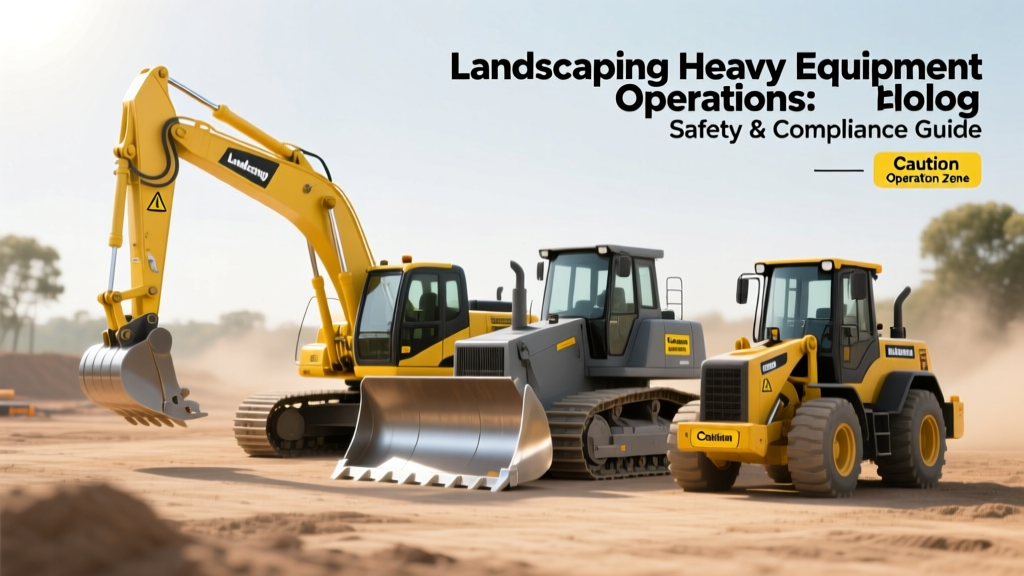
Landscaping Heavy Equipment Operations: Safety & Compliance Guide
Master landscaping heavy equipment operations with our safety compliance guide. Learn OSHA standards, rollover risks, and machine-specific protocols.
The Compliance Reality of Landscaping Heavy Equipment Operations
Landscaping heavy equipment operations bridge the gap between residential precision and commercial earthmoving. Unlike open-terrain mining or highway grading, landscaping requires operating 10,000-pound machines in confined backyards, near retaining walls, over septic fields, and on graded slopes. This unique environment creates a complex web of liability. The Occupational Safety and Health Administration (OSHA) classifies most landscaping machinery under 29 CFR 1926.602 (Earthmoving and Excavation Equipment) and Subpart O (Motor Vehicles, Mechanized Equipment).
⚠️ Compliance Warning: Bypassing safety interlocks, removing Rollover Protective Structures (ROPS), or failing to enforce seatbelt usage on skid steers and compact track loaders routinely results in OSHA 'Serious' violations. As of the latest penalty adjustments, these fines exceed $16,000 per instance, and willful violations can escalate to over $160,000.For fleet managers and landscape contractors, safety is not merely about avoiding fines; it is about mitigating the catastrophic physics of compact machinery. A fully loaded compact track loader (CTL) operating on a 15-degree slope with wet clay soil faces severe lateral shear risks. Understanding the exact mechanical thresholds and regulatory mandates for your specific fleet is the baseline for legal and safe landscaping heavy equipment operations.
Machine-Specific Risk Profiles and OSHA Mandates
Landscaping fleets typically rely on three core equipment categories. Each presents distinct failure modes and requires specific compliance protocols.
1. Skid Steer Loaders vs. Compact Track Loaders (CTLs)
While traditional wheeled skid steers like the Bobcat S770 offer high travel speeds and zero-radius turning, their aggressive steering mechanism causes lateral turf shear and drastically increases the risk of lateral tip-overs on slopes exceeding 12 degrees. Conversely, CTLs like the Caterpillar 259D3 distribute weight over a larger footprint, reducing ground pressure to as low as 4.5 psi. This makes them ideal for soft turf, but their heavier undercarriage raises the machine's center of gravity.
- OSHA Mandate: Both machines must be equipped with ROPS compliant with ISO 3471 and Falling Object Protective Structures (FOPS) compliant with ISO 3449 when operating near trees or overhead hazards.
- Interlock Compliance: Modern machines feature seatbelt-to-ignition interlocks. Tampering with these sensors to allow 'standing operation' is a direct violation of OSHA 1926.602(a)(2).
2. Mini Excavators and Swing-Radius Hazards
Mini excavators, such as the Kubota KX040-4, are staples for trenching irrigation lines and digging planting beds. The primary hazard is the counterweight swing radius. In confined residential yards, the rear swing radius frequently intersects with fences, structures, or pedestrian pathways.
"According to NIOSH construction safety guidelines, crush injuries from excavator swing radii account for a significant percentage of struck-by fatalities. If the 360-degree swing zone cannot be barricaded, a dedicated spotter must be utilized, and the operator must maintain visual or radio contact at all times."
3. Compact Wheel Loaders
Used for moving bulk mulch, gravel, and topsoil, compact wheel loaders operate at higher speeds than skid steers. The primary compliance issue is load stability. Carrying a full bucket of wet topsoil (which can weigh upwards of 3,000 lbs) at an elevated height shifts the center of gravity forward, bypassing the machine's rated operating capacity (ROC) and leading to forward pitch-overs during braking.
Equipment Compliance Matrix: Landscaping Fleet
| Equipment Class | Primary OSHA Citation | Max Safe Slope (Loaded) | Required ROPS Standard | Critical Blind Spot |
|---|---|---|---|---|
| Skid Steer Loader | 1926.602(a)(1) | 12° - 15° (Lateral) | ISO 3471 | Right Rear Quadrant |
| Compact Track Loader | 1926.602(a)(1) | 18° - 22° (Longitudinal) | ISO 3471 / ISO 3449 | Lower Front (Bucket) |
| Mini Excavator | 1926.602(a)(9) | Manufacturer Spec (Usually 10°) | ISO 12117 (Tip-over) | Counterweight Swing |
| Compact Wheel Loader | 1926.602(a)(3) | 8° - 10° (Articulated Turn) | ISO 3471 | Articulation Pinch Point |
Attachment Safety: The Hidden Liability in Landscaping
Landscaping heavy equipment operations rarely involve bare buckets. The use of hydraulic attachments introduces secondary compliance hazards that are frequently overlooked during site audits.
Hydraulic Mulchers and Brush Cutters
When equipping a CTL with a forestry mulcher (e.g., Fecon FGT60), the rotor spins at upwards of 2,200 RPM, capable of ejecting wood shrapnel at speeds exceeding 150 mph. Standard wire mesh guarding is insufficient for OSHA compliance in populated areas.
💡 Pro Tip: Upgrade to polycarbonate Lexan guarding with a minimum thickness of 0.5 inches (12.7mm). Ensure the guarding is rated for high-impact ballistic debris. Document the installation and include it in the daily pre-start inspection checklist.Quick-Attach Locking Mechanisms
Hydraulic quick-attach systems allow operators to switch from pallet forks to trenchers in minutes. However, if the manual locking pins are not fully engaged, the attachment can detach mid-cycle. OSHA requires that all attachments be positively secured. Operators must physically exit the cab and verify that the locking levers are fully seated and the secondary safety pins are inserted before applying hydraulic pressure to the attachment.
Daily Pre-Start Compliance Framework
To audit-proof your landscaping heavy equipment operations, implement a standardized, documented pre-start inspection. Relying on memory or informal 'walk-arounds' is a primary target for OSHA inspectors following an incident.
- Fluid and Hydraulic Line Check: Inspect all hydraulic hoses for 'weeping' or micro-fractures. A pinhole leak in a 3,000 PSI hydraulic system can inject fluid into the skin, causing severe necrosis. Use a piece of cardboard to check for leaks; never use bare hands.
- Undercarriage and Track Tension: For CTLs, measure track sag. The industry standard is 1.5 to 2.0 inches of sag at the midpoint between the front idler and rear sprocket. Over-tensioned tracks accelerate roller wear and increase the risk of track de-tracking on uneven terrain.
- ROPS and FOPS Integrity: Inspect the ROPS welds and mounting bolts for micro-cracks or rust scaling. If the machine has experienced a previous rollover, the ROPS must be replaced or recertified by the manufacturer; it cannot be reused.
- Safety Interlock Testing: Start the machine, lower the armrests, and attempt to drive without the seatbelt fastened. If the machine moves, the interlock is defeated and the machine must be immediately tagged out of service.
- Backup Alarm Verification: OSHA 1926.602(a)(9) mandates that earthmoving equipment with an obstructed rear view must have an audible backup alarm or a dedicated spotter. Test the alarm for a minimum of 85 decibels at 4 feet behind the machine.
Ground Pressure, Soil Shear, and Environmental Compliance
Landscaping often involves working near sensitive infrastructure, such as retaining walls, septic drain fields, and newly poured concrete foundations. While OSHA focuses on worker safety, the physics of ground pressure directly impacts both safety and property liability.
A fully loaded compact wheel loader can exert over 60 psi of ground pressure. Operating this machine within 4 feet of an unsupported retaining wall can cause catastrophic soil shear, leading to wall collapse and subsequent machine tip-over. Fleet managers must mandate a 'buffer zone' protocol: heavy machinery must remain at a distance equal to the depth of the excavation or the height of the retaining wall, unless the soil has been geotechnically engineered to support the dynamic load. Refer to OSHA's Excavation and Trenching guidelines for specific soil classification (Type A, B, or C) and corresponding slope requirements.
Operator Certification and Documentation Requirements
OSHA does not issue 'licenses' for heavy equipment operators; the burden of proof for competency rests entirely on the employer. For landscaping firms, this means establishing an internal or third-party certification program.
Audit-Proofing Your Fleet
Every operator file must contain:
- Classroom Training Records: Covering machine physics, load charts, and OSHA Subpart O regulations.
- Practical Evaluation Sign-Off: A documented field test evaluated by a competent person, demonstrating the operator's ability to safely maneuver the specific machine model (e.g., Cat 259D3) with various attachments.
- Annual Refresher Documentation: Retraining is mandatory whenever an operator is observed using the equipment unsafely, is involved in a near-miss incident, or is assigned to a new machine class.
Summary: The Landscaping Compliance Checklist
- Verify ROPS/FOPS certification (ISO 3471/3449) on all loaders and excavators.
- Ensure seatbelt interlocks are functional and strictly enforced.
- Mandate 0.5-inch polycarbonate guarding for all high-RPM mulching attachments.
- Enforce physical verification of quick-attach locking pins before hydraulic engagement.
- Maintain documented, machine-specific practical evaluations for every operator.
By treating safety protocols as operational baselines rather than administrative burdens, landscaping contractors can protect their workforce, avoid crippling OSHA penalties, and ensure that their heavy equipment operations remain profitable and legally defensible.