Underground Mining: Remote Control Heavy Equipment LHDs vs Drill Rigs
Compare remote control heavy equipment for underground mining. Analyze tele-remote LHDs vs automated drill rigs, ROI, specs, and 2026 fleet alternatives.
The Shift to Tele-Remote and Autonomous Underground Fleets
Deep-level hard rock extraction has fundamentally changed. As ore bodies push past 1,500 meters, ambient rock temperatures and seismic risks make human presence at the face increasingly untenable. Consequently, remote control heavy equipment has transitioned from a niche safety upgrade to a baseline operational requirement. In 2026, the debate is no longer about whether to automate, but which equipment category offers the highest return on investment: tele-remote Load-Haul-Dump (LHD) loaders or autonomous underground drill rigs. Both systems remove operators from the hazard zone, but they rely on vastly different network architectures, sensor suites, and capital expenditure models.
2026 Ventilation & Safety Reality: Transitioning to Battery Electric Vehicle (BEV) remote control heavy equipment reduces underground ventilation power costs by up to 45% compared to diesel equivalents. More importantly, tele-remote operation entirely eliminates operator exposure to silica dust, diesel particulate matter (DPM), and blast fumes, aligning with strict modern MSHA and global occupational health mandates.Core Equipment Showdown: Tele-Remote LHDs vs. Automated Drill Rigs
Choosing between automating your mucking fleet or your development drilling fleet depends on identifying the primary bottleneck in your mine plan. Below is a structural comparison of the two dominant remote control heavy equipment categories.
| Feature | Tele-Remote LHD Loaders | Automated Drill Rigs |
|---|---|---|
| Primary Function | Mucking, tramming, and dumping blasted rock | Face drilling, bolting, and tunnel development |
| Automation Level | Line-of-sight or far-to-far tele-remote (manual control via video) | Supervised autonomy (executes pre-programmed digital drill plans) |
| Base Price Range (2026 BEV) | $850,000 - $1,150,000 | $1,700,000 - $2,400,000 |
| Automation Package Cost | $110,000 - $145,000 | $190,000 - $260,000 |
| Network Latency Tolerance | <100ms (Critical for real-time video tramming) | <500ms (Telemetry only; rig follows local digital map) |
| Typical ROI Payback | 18 - 24 months (via increased shift utilization) | 24 - 36 months (via precision overbreak reduction) |
Load-Haul-Dump (LHD) Loaders: Deep Dive & Alternatives
Tele-remote LHDs represent the most common entry point for remote control heavy equipment in underground mining. The operator sits in a surface or underground control room, using physical joysticks and pedals while watching a multi-screen video feed from the machine. The latest 2026 BEV models integrate LiDAR-based collision avoidance and auto-tramming capabilities, where the machine steers itself between drawpoints while the operator controls the bucket and speed.
Sandvik LH518B vs. Epiroc ST14
The 18-tonne payload class is the industry standard for medium-to-large hard rock mines. The Sandvik LH518B features a patented 6-minute battery swap system, allowing continuous operation without waiting for fast-charge cycles. Its tele-remote package relies on a robust 4-camera 1080p low-light array. Alternatively, the Epiroc ST14 utilizes a modular battery system and the Rig Control System (RCS 5), which provides highly granular telemetry on drivetrain health. While the Sandvik unit excels in continuous high-tonnage tramming due to its rapid swap mechanism, the Epiroc ST14 is often preferred in mines with restrictive turning radii due to its slightly more compact articulated chassis design. According to Sandvik Mining and Rock Solutions, automating their BEV LHD fleet typically yields a 25% increase in equipment utilization by eliminating shift changes and operator fatigue breaks.
Pros & Cons of Tele-Remote LHDs
- Pro: Immediate removal of personnel from unsupported ground and blast zones.
- Pro: Allows for overlapping shifts; one operator can manage multiple machines sequentially.
- Con: Requires high-bandwidth, ultra-low latency Private 5G or Wi-Fi 6 networks to prevent video stutter, which can cause operator motion sickness and safety hazards.
- Con: Bucket fill factors can drop by 5-10% compared to an experienced operator sitting in the cab, as depth perception via 2D screens remains imperfect despite stereoscopic advancements.
Underground Drill Rigs: Precision & Alternatives
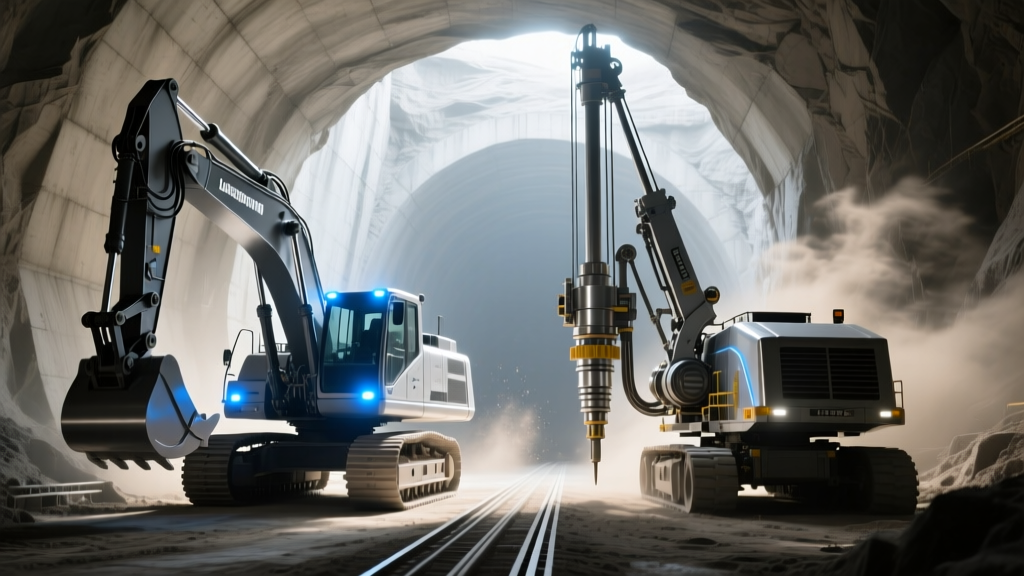
Unlike LHDs, which require constant human input for navigation, remote control heavy equipment in the drilling category operates on supervised autonomy. The operator designs a 3D drill pattern on a surface server. The drill rig drives to the face, aligns its booms using onboard inertial measurement units (IMUs) and laser scanners, and executes the pattern autonomously. The operator merely monitors the telemetry and intervenes only if a fault occurs.
Epiroc Boomer E2 vs. Sandvik DD422iE
The twin-boom electric drill rig market is dominated by the Epiroc Boomer E2 and the Sandvik DD422iE. The Boomer E2 is renowned for its hydraulic direct control (HDC) system, which provides exceptional precision in fractured rock conditions where automated feed pressure must adapt in milliseconds. The Sandvik DD422iE, however, boasts the iSure software suite, which automatically adjusts drilling parameters based on real-time rock resistance feedback, optimizing explosive placement and reducing overbreak. Overbreak reduction is the hidden financial driver here; saving just 5 centimeters of unnecessary rock extraction per blast can save millions annually in ground support and concrete backfill costs. Data from Epiroc Automation and Tele-Remote Systems indicates that their automated boom positioning achieves an accuracy of ±50mm, vastly superior to manual drilling inconsistencies.
Expert Insight: Do not confuse tele-remote drilling with autonomous drilling. True remote control heavy equipment in development drilling means the machine is executing a digital twin plan. If your mine lacks a robust 3D surveying and digital mine planning workflow, an autonomous drill rig will simply automate bad drill patterns faster.
Decision Framework: Which Automation Investment Yields Higher ROI?
Mine planners must apply a strict decision matrix when allocating capital for remote control heavy equipment. Follow this framework to determine your primary investment:
- Identify the Bottleneck: Is your mill starving for ore (mucking bottleneck), or are you failing to advance development meters fast enough to open new stopes (drilling bottleneck)?
- Evaluate Network Infrastructure: If your mine relies on legacy leaky feeder or basic Wi-Fi mesh networks, you cannot support tele-remote LHDs. Drill rigs, requiring only low-bandwidth telemetry, can operate on legacy networks. Upgrade to Private LTE/5G before buying tele-remote LHDs.
- Assess Ground Conditions: In highly fractured, seismically active zones where ground support installation immediately follows the blast, autonomous drill rigs with bolt-and-drill capabilities offer superior safety ROI. In stable, massive ore bodies, LHD automation provides faster tonnage throughput.
Infrastructure Requirements for Remote Control Heavy Equipment
Deploying remote control heavy equipment is 20% hardware and 80% infrastructure. The following systems are non-negotiable for 2026 fleet deployments:
- Private 5G / LTE Networks: Essential for tele-remote LHDs. Provides the <20ms latency and high uplink bandwidth required for multi-stream HD video feeds. Wi-Fi 6 is a viable alternative but struggles with signal handover in long, winding ramp declines.
- Proximity Detection Systems (PDS): Mandated by safety regulators globally. Systems utilizing ultra-wideband (UWB) tags on personnel and LiDAR on the equipment ensure automatic braking if a human enters the machine's swing or tram radius.
- Surface Control Rooms: Ergonomically designed pods with ultra-wide curved monitors, haptic feedback joysticks, and climate control. Operator fatigue in control rooms is a documented issue; proper ergonomic investment directly impacts shift-long productivity.
- Digital Mine Planning Integration: For autonomous drill rigs, the equipment must seamlessly ingest CAD-based drill plans via the mine's central server, requiring robust underground-to-surface data synchronization protocols.
Ultimately, the integration of remote control heavy equipment in underground mining is a systemic operational overhaul. Whether selecting the rapid-tramming Sandvik LH518B or the precision-drilling Epiroc Boomer E2, success relies on matching the machine's automation profile to the mine's specific geological and network realities. For further regulatory context on underground automation safety, refer to the guidelines published by the Mine Safety and Health Administration (MSHA).