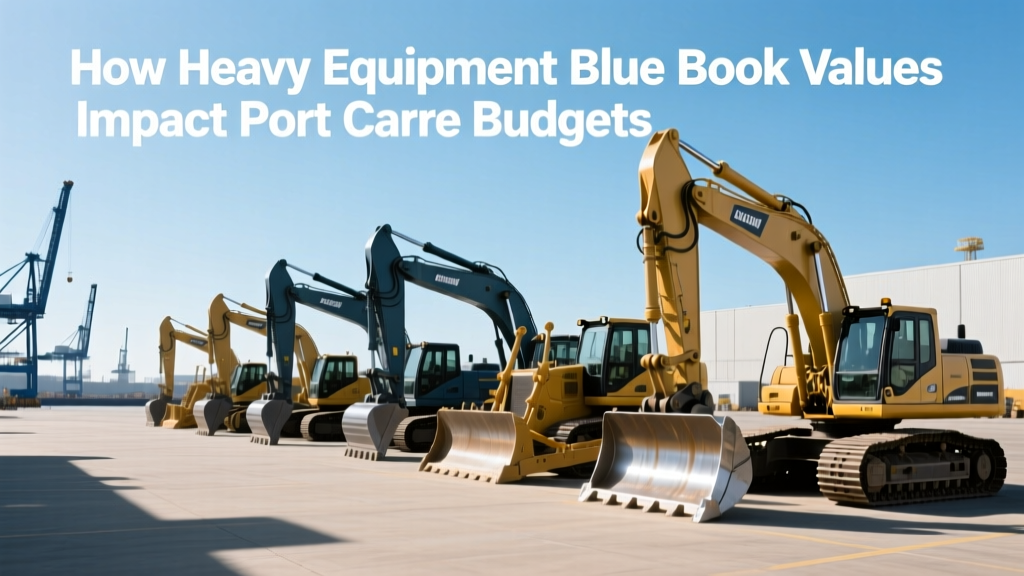
How Heavy Equipment Blue Book Values Impact Port Crane Budgets
Learn how to interpret heavy equipment blue book values for marine assets, adjust for saltwater corrosion, and budget for STS and RTG crane fleets.
The Valuation Disconnect in Marine Terminal Fleets
When port authorities and marine terminal operators consult standard heavy equipment blue book values to plan capital expenditures or liquidate aging fleets, they frequently encounter a massive valuation disconnect. Unlike standardized earthmoving machinery—where a Caterpillar 330 excavator holds a predictable depreciation curve across global markets—marine and port equipment is highly bespoke, heavily regulated, and subjected to extreme environmental degradation. Relying on unadjusted baseline guides for Ship-to-Shore (STS) cranes, Rubber-Tired Gantry (RTG) cranes, or marine reach stackers will inevitably lead to severe budget shortfalls or over-capitalization.
According to the ASCE Infrastructure Report Card for Ports, the average age of marine cargo handling equipment in North America is steadily increasing, pushing terminal operators to make critical decisions regarding mid-life overhauls versus outright replacement. To execute these budgets accurately in 2026, procurement teams must understand how to extract baseline data and apply rigorous marine-specific multipliers.
Key Insight: The Bespoke Depreciation TrapStandard valuation guides aggregate auction data primarily from construction and agriculture. A mobile harbor crane with a customized 50-ton lifting spreader and automated twistlock system will not reflect those capital improvements in a generic guide. Terminal operators must treat baseline guides as a starting point, not a final appraisal.
Asset Class Valuation Matrix: STS, Mobile Harbor, and Reach Stackers
To build an accurate 2026 replacement budget, we must look at specific asset classes and how their actual market behavior diverges from published guides. The table below illustrates the baseline new costs, the unadjusted year-7 guide value, and the actual realized market value for core port equipment.
| Asset Class & Model Baseline | 2026 New Cost (Approx.) | Year-7 Unadjusted Guide | Year-7 Marine-Adjusted Reality |
|---|---|---|---|
| STS Crane (e.g., Konecranes STS450 Super Post-Panamax) | $11,500,000 | $5,750,000 (50%) | $4,100,000 (35%) |
| Mobile Harbor Crane (e.g., Liebherr LHM 550) | $7,200,000 | $3,600,000 (50%) | $3,150,000 (43%) |
| Reach Stacker (e.g., Kalmar DRG450-7S5) | $680,000 | $306,000 (45%) | $238,000 (35%) |
Notice the divergence in the STS crane category. Because STS cranes are often built to the exact rail gauge and lifting height requirements of a specific terminal berth, their secondary market is incredibly narrow. If a terminal closes or upgrades, the cost to dismantle, transport, and reconfigure an STS crane for a different port can exceed $1.5 million, drastically suppressing its real-world liquidation value compared to standard heavy equipment blue book values.
The 'Saltwater Penalty': Adjusting for C5-M Marine Corrosion
The single largest variable missing from generic valuation guides is the environmental degradation factor. Port equipment operates in ISO 12944 C5-M (Very High Marine) corrosivity zones. Salt spray, high humidity, and aggressive wind loads accelerate structural fatigue and electrical housing failures.
Calculating the Corrosion Depreciation Multiplier
When evaluating used marine equipment or forecasting the end-of-life salvage value of your current fleet, apply the following structural assessment framework:
- Category 1 (Fully Compliant C5-M Coating): Equipment specified with marine-grade epoxy primers and polyurethane topcoats, maintained on a strict 3-year touch-up cycle. Adjustment: Deduct 5% from baseline guide.
- Category 2 (Standard Industrial Coating in Marine Zone): Equipment originally built for inland use but deployed at a port. Expect severe pitting on the boom and chassis. Adjustment: Deduct 18-22% from baseline guide due to mandatory sandblasting and recoating costs prior to resale.
- Category 3 (Critical Structural Pitting): If ultrasonic testing reveals wall-thickness loss exceeding 15% on primary load-bearing members (such as the slewing bearing on a mobile harbor crane), the asset is functionally unviable for secondary sale. Adjustment: Value drops to scrap steel weight plus salvageable powertrain components.
Standard IP55 electrical enclosures will fail within 48 months in a saltwater environment. When budgeting for new RTG cranes, mandate IP66 or IP67 ratings for all hoist and trolley drive inverters. This adds roughly $45,000 to the initial capital expenditure but preserves up to $120,000 in residual blue book value by preventing catastrophic inverter corrosion.
Retrofit ROI: E-RTG Conversions and Automation Upgrades
As highlighted in the UNCTAD Review of Maritime Transport, global ports are aggressively decarbonizing. Many terminals are retrofitting diesel-powered RTG cranes with Electrified RTG (E-RTG) busbar or cable reel systems, and integrating automated Optical Character Recognition (OCR) portals.
Do these capital improvements increase the asset's heavy equipment blue book values? The reality is nuanced:
- E-RTG Electrification: A full diesel-to-electric RTG conversion costs between $450,000 and $600,000 per crane. While it drastically reduces hourly operating costs and aligns with U.S. DOT Maritime Administration (MARAD) green port initiatives, the secondary market will only credit 25% to 35% of the retrofit cost to the crane's residual value. The electrical infrastructure is often tied to the specific terminal's busbar layout.
- Automated OCR & Remote Control: Upgrading a crane for remote operation from a central control room requires $200,000+ in sensor arrays, LiDAR, and latency-free 5G networking. This yields a near-zero bump in traditional guide values, as these systems are usually proprietary to the terminal's specific Terminal Operating System (TOS) software.
"Terminal operators must separate operational ROI from residual asset value. An E-RTG conversion pays for itself in fuel and maintenance savings within five years, but it will not save you from a steep depreciation curve if you attempt to sell the crane to a port with incompatible electrical infrastructure."
5-Step Framework for Port Fleet Budget Allocation
To bridge the gap between published guides and the financial realities of marine terminal operations, implement this 5-step valuation framework during your annual budget planning cycle:
Step 1: Extract the Baseline Earthmoving Equivalent
Isolate the base powertrain and chassis value. For a reach stacker, look at the heavy equipment blue book values for a standard 45-ton heavy-duty forklift or loader, stripping away the specialized marine spreader attachments.
Step 2: Apply the Marine Environment Multiplier
Subtract 12% to 18% from the baseline to account for accelerated corrosion on hydraulic cylinders, wire ropes, and structural welds, assuming standard marine maintenance protocols were followed.
Step 3: Factor in Regulatory Compliance Obsolescence
Marine handlers and terminal tractors are subject to strict EPA Tier 4 and IMO Tier III emissions standards. If your fleet contains Tier 3 marine diesel engines (common in units manufactured prior to 2018), apply an immediate 25% obsolescence penalty to the guide value, as many major ports now ban non-compliant equipment from operating within their gates.
Step 4: Deduct Specialized Attachment Reconditioning
Container spreaders (e.g., Bromma or ELME models) endure violent impacts and require frequent twistlock replacements. Budget $15,000 to $22,000 per spreader for mandatory recertification and structural NDT (Non-Destructive Testing) before assuming the asset holds its listed guide value.
Step 5: Calculate Dismantling and Logistics Liabilities
For STS and large gantry cranes, the cost to dismantle, barge, and re-erect the equipment can represent 15% to 20% of the machine's total value. Always subtract estimated logistics liabilities from the heavy equipment blue book values to find the true net realization figure for your balance sheet.