Heavy Equipment Earth Movers in Demolition: Attachments & Case Studies
Explore how heavy equipment earth movers are adapted for demolition. Review 2026 attachment specs, hydraulic requirements, and real-world teardown case studies.
Repurposing Standard Carriers for Controlled Teardowns
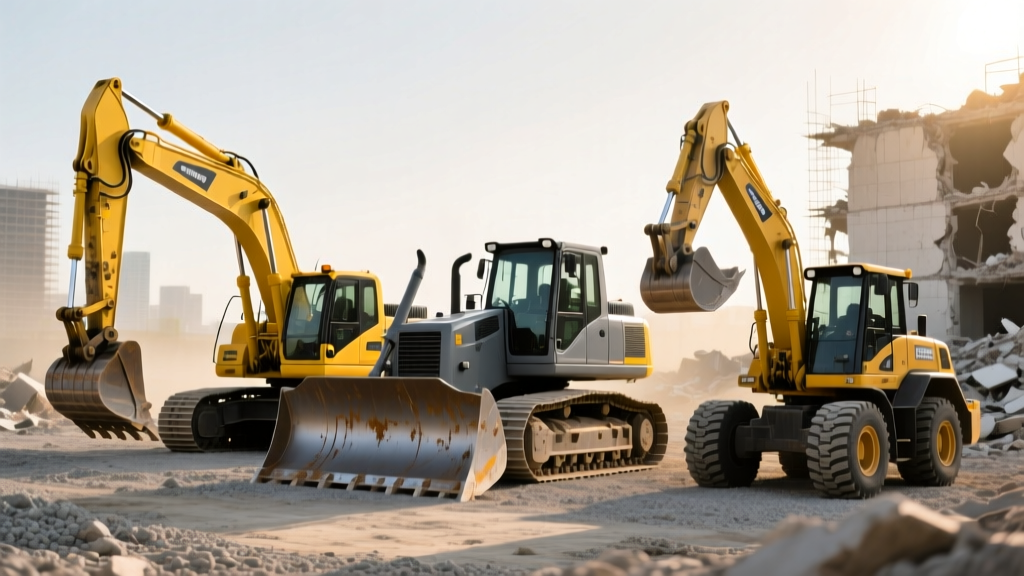
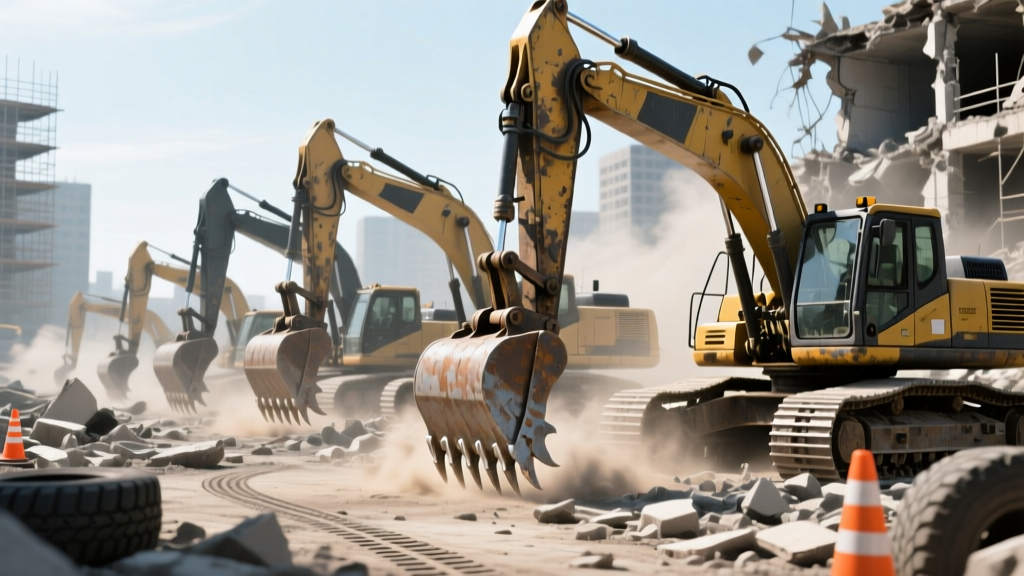
While traditionally engineered for trenching, mass excavation, and grading, heavy equipment earth movers form the backbone of the modern demolition fleet. By swapping standard digging buckets for specialized hydraulic work tools, contractors transform 30-ton to 80-ton excavators and wheel loaders into highly efficient structural dismantling machines. The transition from earthmoving to demolition requires more than a quick coupler change; it demands precise hydraulic tuning, structural reinforcement, and an understanding of material-specific failure mechanics.
This guide examines how base carriers are configured for demolition, provides a 2026 pricing and specification matrix for primary attachments, and analyzes two field case studies that highlight the operational edge cases of using earth movers in structural teardowns.
Base Carrier Selection: Beyond Standard Digging Configurations
Not every earth mover is suitable for the shock loads and lateral stresses inherent in demolition. When selecting a base carrier like the Caterpillar 336 Next Gen or the Komatsu PC490HRD-11, contractors must evaluate three critical modifications:
- Counterweight Optimization: Demolition attachments, particularly rotating shears and large hydraulic breakers, shift the center of gravity forward. Carriers must be fitted with heavy-duty counterweights (often 2,000 to 4,000 lbs heavier than standard earthmoving configs) to maintain lifting capacity and prevent tip-overs during high-reach lateral swings.
- Track Pad and Undercarriage Upgrades: Standard triple-grouser pads tear easily on rebar and concrete rubble. Demolition-specific earth movers utilize flat cast shoes or rubber-padded tracks to distribute the machine's operating weight (often exceeding 85,000 lbs) across unstable debris fields without puncturing the undercarriage.
- Falling Object Protective Structures (FOPS): Level II FOPS cab guards are non-negotiable. These include heavy-gauge steel mesh over the windshield and reinforced roof plates designed to deflect 500-lb concrete chunks falling from 40+ feet.
2026 Demolition Attachment Specifications & Pricing Matrix
Selecting the correct tool dictates the cycle time and profitability of a teardown. Below is a comparison of primary demolition attachments matched to standard heavy equipment earth mover weight classes, reflecting 2026 market pricing and hydraulic requirements.
| Attachment Type | Model Example | Carrier Weight Class | Aux. Hydraulic Flow Req. | 2026 Avg. Price Range |
|---|---|---|---|---|
| Hydraulic Pulverizer | Epiroc DP 4500 | 35 - 50 Tons | 115 - 170 GPM | $65,000 - $82,000 |
| Rotating Demolition Shear | Genesis GXP 5500R | 45 - 65 Tons | 160 - 210 GPM | $145,000 - $168,000 |
| Hydraulic Breaker (Hammer) | Atlas Copco MB 2000 | 25 - 40 Tons | 75 - 105 GPM | $32,000 - $45,000 |
| Multi-Processor (w/ Jaws) | Cat MP332 (Concrete) | 30 - 38 Tons | 100 - 130 GPM | $95,000 - $115,000 |
Field Case Study 1: High-Reach Urban Hospital Implosion
The Scenario: Dismantling a 6-story reinforced concrete medical facility in a dense metropolitan zone. The contractor utilized a Volvo EC480E HR (High Reach) earth mover equipped with an Epiroc DP 5000 demolition pulverizer.
The Challenge: The primary obstacle was not structural resistance, but silica dust mitigation and rebar entanglement. Standard pulverizers often leave rebar tangled in the concrete jaw, requiring manual torching by ground crews—a massive safety hazard in an active drop zone.
The Solution & Execution: The contractor retrofitted the pulverizer with a specialized rebar cutter blade integrated into the lower jaw, allowing the operator to sever #8 and #10 rebar simultaneously while crushing the concrete. To manage dust, the earth mover's boom was fitted with a high-pressure misting ring connected to an onboard 300-gallon water tank, delivering 15 GPM directly to the jaw contact point.
Hydraulic Edge Case Warning: When running continuous misting systems and high-torque pulverizers simultaneously, hydraulic oil temperatures can spike. On the Volvo EC480E, operators must monitor the return oil temperature gauge. If hydraulic fluid exceeds 180°F (82°C), the viscosity drops, leading to internal bypassing in the pulverizer's rotation motor and a 20% loss in crushing force.Field Case Study 2: Steel Mill Dismantling with Rotating Shears
The Scenario: Tearing down a decommissioned 1970s steel rolling mill, requiring the processing of heavy W24x104 I-beams and 2-inch thick plate steel. The fleet relied on Caterpillar 352 earth movers paired with Genesis GXP 5500R rotating shears.
The Challenge: The shears were stalling mid-cut when biting into the thickest flange intersections. Ground crews initially blamed the shear's hydraulic cylinder, but diagnostic telemetry from the earth mover's onboard CAT Vision system revealed the issue was rooted in the carrier's auxiliary hydraulic circuit.
The Root Cause: The shear requires a momentary spike in hydraulic pressure (up to 5,800 psi) to initiate the cut through high-tensile steel. The earth mover's auxiliary relief valve was factory-set to 5,075 psi to protect standard digging thumb attachments. When the shear hit the dense steel intersection, the relief valve dumped the oil back to the tank, robbing the shear of the necessary breakout force.
The Fix: A hydraulic technician reconfigured the carrier's auxiliary pump combiner logic and adjusted the high-pressure relief valve to 6,000 psi, strictly matching the shear's manufacturer specifications. Cycle times on W24 beams dropped from 45 seconds to 12 seconds.
Diagnostic Framework: Troubleshooting Attachment Underperformance
When heavy equipment earth movers underperform in demolition applications, the fault rarely lies with the attachment's steel structure. Use this diagnostic matrix to isolate hydraulic and mechanical failures:
- Symptom: Attachment rotates sluggishly or not at all.
Cause: Case drain line restriction. Rotating shears and pulverizers require a dedicated case drain line to route internal motor leakage back to the hydraulic tank. If this line is kinked, or if the contractor incorrectly plumbed it into the main return line, backpressure exceeds 50 psi and blows the motor's internal shaft seal.
Fix: Install a zero-pressure case drain line directly to the tank, bypassing the return filter. - Symptom: Jaw closes slowly but opens at normal speed.
Cause: Accumulator nitrogen bleed. Demolition shears use a hydraulic accumulator to provide a burst of speed during the closing stroke. If the nitrogen pre-charge drops below 1,200 psi (due to a leaking Schrader valve), the shear loses its 'snap' and relies solely on pump volume.
Fix: Check and recharge the accumulator nitrogen pre-charge to the exact OEM spec using a calibrated gauge. - Symptom: Excessive vibration transferred to the carrier boom.
Cause: Worn elastomer dampeners or incorrect operating angle. Hydraulic breakers must be kept perpendicular (90 degrees) to the concrete surface. 'Blank firing' (firing the breaker without downward pressure) destroys the carrier's boom pins and stick cylinders.
Fix: Replace dampeners and enforce strict operator training on down-pressure protocols.
According to the OSHA Demolition Standards, structural stability must be continuously monitored during teardowns. When utilizing heavy equipment earth movers for selective demolition, operators must maintain a clearance distance of at least one-and-a-half times the height of the wall or structure being dismantled to account for unpredictable collapse vectors.
Matching the Earth Mover to the Material Stream
Profitability in demolition is dictated by material separation at the source. Misapplying attachments leads to contaminated scrap loads, which recycling yards penalize heavily. Follow this decision framework for optimal tool selection:
- Heavy Structural Steel (I-Beams, Plate): Use a Rotating Shear. The continuous rotation allows the operator to align the jaws perpendicular to the beam web without repositioning the earth mover, maximizing the 700+ tons of cutting force.
- Reinforced Concrete Foundations: Use a Hydraulic Pulverizer. The wide jaw opening and blunt crushing teeth fracture the concrete away from the rebar, producing a clean aggregate stream and a separate ferrous metal pile.
- Slab-on-Grade and Footings: Use a Hydraulic Breaker or Multi-Processor with cracking jaws. Breakers are ideal for fracturing thick, un-reinforced mass concrete before it is loaded into articulated dump trucks.
- Brick, Block, and Light Wood Framing: Use a Grapple Rake or Demolition Bucket. These low-flow, high-width attachments allow wheel loaders and smaller earth movers to rapidly sort and load mixed C&D (Construction and Demolition) debris into roll-off containers.
For comprehensive safety protocols regarding material handling and structural collapse zones, contractors should regularly consult the National Demolition Association Safety Guidelines to ensure site compliance and operator protection.