The Essential List Heavy Equipment Managers Need for Demolition
Explore the definitive list heavy equipment managers use for demolition. Compare high-reach excavators, hydraulic shears, and real-world teardown case studies.
When safety directors and fleet managers list heavy equipment assets required for a controlled mechanical teardown, the margin for error is zero. Selecting the wrong excavator class or mismatching hydraulic flow rates to an attachment doesn't just delay a project—it creates catastrophic structural collapse risks and destroys profit margins through excessive fuel burn and premature hydraulic pump failure. This guide details the exact machinery, attachment specifications, and procurement frameworks used by Tier 1 demolition contractors in 2026.
CRITICAL SAFETY DIRECTIVE: According to OSHA demolition standards, all structural demolition requires a competent person to inspect the equipment and the structure prior to every shift. High-reach excavators must be operated on verified load-bearing ground mats when working near compromised foundations.The Economics of Mechanical Demolition in 2026
Explosive implosions are increasingly rare due to urban density and environmental regulations regarding particulate dispersion. Consequently, the industry has shifted heavily toward mechanical dismantling. The EPA reports that over 600 million tons of construction and demolition (C&D) debris are generated annually in the United States, with mechanical separation yielding the highest purity of recyclable rebar and concrete. To maximize scrap value, contractors must deploy machines that can precisely separate steel from concrete at the source, rather than relying on downstream sorting facilities.
Core Fleet: High-Reach and Heavy Excavators
The foundation of any commercial demolition fleet relies on 40-ton to 100-ton class excavators. For multi-story structures, ultra-high demolition (UHD) configurations are mandatory.
Ultra-High Demolition (UHD) Excavators
The Caterpillar 340 UHD remains the industry benchmark for mid-rise commercial teardowns. With a maximum reach of 92 feet (28 meters) and a 3.3-ton tool capacity at full extension, it allows operators to process 8-story structures from ground level. In 2026, the Stage V / Tier 4 Final compliant engine delivers 311 hp, but the critical metric for demolition is the hydraulic pump output. The 340 UHD features an implement pump flow of 158 gpm (598 L/min), which is the exact threshold required to run mid-class multi-processors without stalling.
Heavy-Duty Base Machines for Processing
Once the structure is felled, processing the debris requires high-breakout-force machines. The Volvo EC480E HR is frequently deployed for ground-level processing. Operating at 110,000 lbs, its heavy counterweight and reinforced undercarriage absorb the severe shock loads generated when dropping 5-ton concrete slabs into hoppers or crushers. Procurement cost for a new EC480E HR in 2026 hovers between $680,000 and $740,000, depending on the undercarriage pad width and cab guarding packages.
Attachment Matrix: Matching Hydraulic Flow to Material
An excavator is only as effective as its end-effector. Mismatching an attachment's required gallons-per-minute (GPM) to the carrier's auxiliary hydraulic circuit results in either sluggish cycle times (under-flow) or blown hydraulic seals and shattered chisels (over-flow).
| Attachment Type | Primary Application | Required Flow (GPM) | 2026 Market Price Range |
|---|---|---|---|
| Hydraulic Shears (e.g., Genesis GXP 550R) | Slicing structural I-beams, rebar, and H-piles. | 145 - 185 GPM | $85,000 - $125,000 |
| Concrete Crushers (e.g., NPK CE-40) | Primary reduction of reinforced concrete walls. | 120 - 150 GPM | $55,000 - $75,000 |
| Pulverizers (e.g., Trevi Benne TF 30) | Secondary crushing; separating rebar from concrete. | 90 - 130 GPM | $35,000 - $50,000 |
| Hydraulic Hammers (e.g., Atlas Copco HB 3600) | Trench rock breaking, thick foundation busting. | 75 - 100 GPM | $40,000 - $60,000 |
In 2026, manual pin-knocking is considered a severe bottleneck. Equipping carriers with hydraulic quick couplers (like the Werk-Braucht or Tilrotator systems) reduces attachment swap times from 45 minutes to under 90 seconds, increasing daily billable processing time by up to 18%.
Case Study: Dismantling the 140,000 Sq Ft Textile Mill
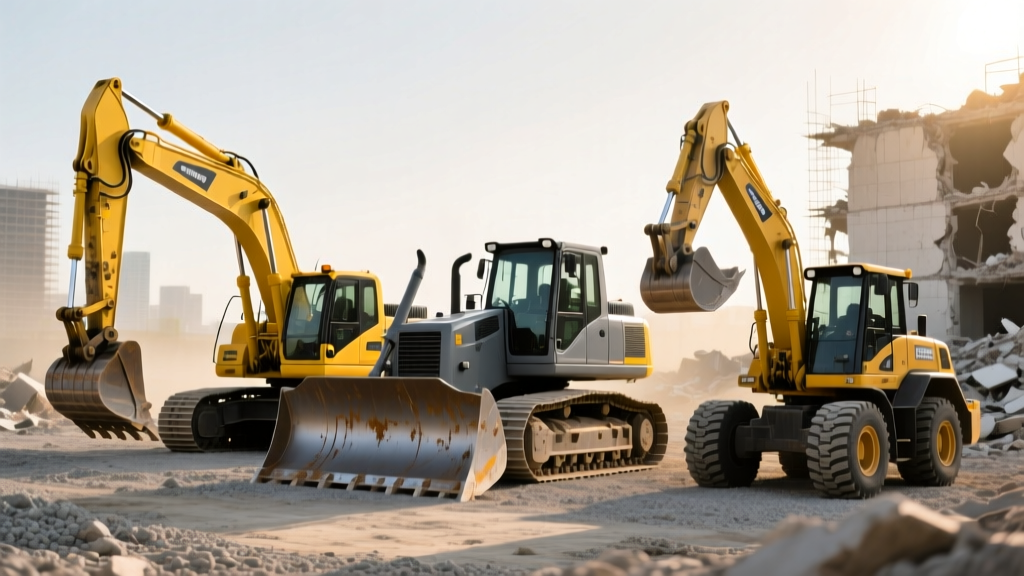
To understand how these assets function in sequence, consider the recent mechanical dismantling of a 1920s reinforced concrete textile mill in the Northeast. The structure featured 14-inch thick floors with heavily oxidized, dense rebar networks. The site was bordered by active rail lines, precluding any explosive options or uncontrolled debris fallout.
Phase 1: Soft Strip and Hazardous Abatement
Before heavy machinery engaged the structure, compact track loaders (CTLs) like the Bobcat T86 equipped with enclosed cabs and HEPA filtration systems performed interior soft stripping. This removed non-structural partitions, asbestos-containing mastic, and lead-painted drywall, ensuring the heavy demolition phase wouldn't aerosolize regulated toxins.
Phase 2: Top-Down Structural Reduction
A Cat 352 UHD was positioned on engineered timber crane mats to distribute the 130,000 lb operating weight. The machine was fitted with a 10,000 lb-class hydraulic shear. The operator systematically severed the roof trusses and top-floor columns, working backward to maintain a controlled collapse envelope. The shear's 1,200-ton cutting force easily sliced through the W12x65 steel girders, while the rotation motor allowed the operator to precisely lay 40-foot beams flat onto the debris pile without dropping them from height.
Phase 3: Ground-Level Processing and Loading
Two Volvo EC380E excavators handled the ground processing. One was fitted with a hydraulic hammer to fracture the massive concrete foundation piers, while the second utilized a multi-processor with concrete-crushing jaws. The multi-processor pulverized the concrete, allowing the 1-inch rebar to pop out cleanly. This on-site separation yielded 98% clean aggregate for sub-base reuse and high-grade #1 heavy melting steel (HMS) scrap, generating $145,000 in offset revenue that effectively covered the fuel and labor costs for the entire 6-week project.
"The profitability of modern demolition isn't in the teardown; it's in the material recovery. If your list heavy equipment plan doesn't include dedicated secondary processors for rebar extraction, you are leaving 20% of the project's gross revenue in the landfill."
— Director of Operations, National Demolition Association Member Firm
Procurement Framework: Rent vs. Buy Decision Tree
Capital expenditure for a complete demolition fleet easily exceeds $2.5 million. Fleet managers must rigorously evaluate utilization rates before adding assets to their permanent roster.
- High-Reach Excavators (UHD): Rent. Unless your firm executes more than six high-rise teardowns annually, the $800,000+ capital cost and specialized transport requirements make ownership a liability. 2026 rental rates for a 340 UHD average $28,000 to $35,000 per month.
- 40-Ton Class Base Machines (e.g., Cat 349, Volvo EC480): Buy. These are the workhorses used for processing, loading, and site prep. Utilization typically exceeds 1,500 hours annually, justifying the $450,000 purchase price and allowing the firm to build equity in an asset with a strong secondary market resale value.
- Hydraulic Shears and Multi-Processors: Buy, but lease the jaws. The base housing and hydraulic cylinders endure immense stress. Purchasing the main body is standard, but renting specialized jaw sets (e.g., swapping from a shear jaw to a crusher jaw) prevents owning $25,000 attachments that sit idle for months.
Maintenance Realities: The Hidden Cost of Demolition
Demolition environments are uniquely hostile to machinery. Concrete dust acts as an abrasive lapping compound, destroying cylinder rods and turbochargers. When spec'ing machines for this work, managers must mandate heavy-duty air pre-cleaners (like the Sy-Klone system) and pressurized cab HVAC units. Furthermore, cylinder rod guards and FOPS (Falling Object Protective Structures) Level 2 cab guarding are non-negotiable. A single piece of falling rebar can shatter a standard excavator windshield and result in fatal operator injuries, not to mention the immediate OSHA site shutdown that follows.
By strictly aligning carrier hydraulics with attachment demands, prioritizing material recovery tools, and applying rigorous utilization frameworks to procurement, demolition contractors can transform a chaotic teardown into a highly predictable, profitable material harvesting operation.