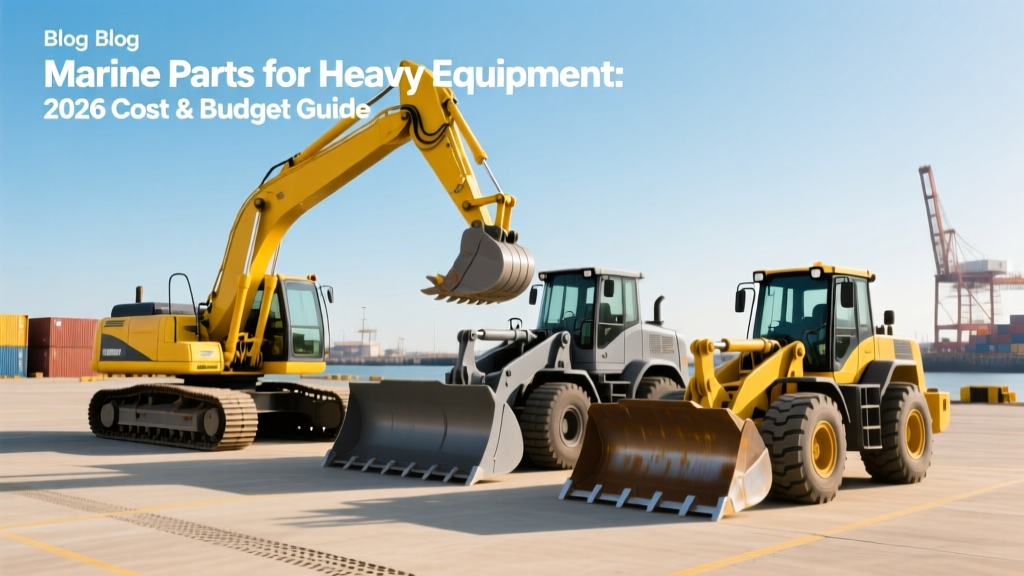
Marine Parts for Heavy Equipment: 2026 Cost & Budget Guide
Analyze 2026 costs for marine and port heavy equipment parts. Learn budget strategies for ship-to-shore cranes, reach stackers, and terminal tractors.
The Hidden Premium of Marine-Grade Components
Operating heavy machinery in maritime environments introduces a brutal combination of saltwater aerosolization, high cyclic loading, and 24/7 operational demands. When procurement teams search for parts heavy equipment OEMs designate as 'marine-grade', they are not simply buying standard industrial components with a coat of paint. They are investing in specialized metallurgy, advanced sealing technologies, and rigorous corrosion protection systems that fundamentally alter the budget planning lifecycle for port terminals.
Unlike inland construction or mining sites, port facilities face the relentless degradation of chloride-induced pitting. A standard hydraulic cylinder that might last 15,000 hours in a dry quarry environment can suffer catastrophic seal failure and rod pitting in under 4,000 hours when exposed to coastal sea spray without proper marine-specific engineering. For terminal operators and fleet managers, understanding the precise cost drivers of these specialized components is critical for maintaining OpEx predictability in 2026.
2026 Industry Data Highlight: According to the UNCTAD Review of Maritime Transport, global port throughput and vessel sizes continue to climb, pushing terminal equipment to utilization rates exceeding 85%. This elevated operational tempo drives the average annual maintenance and parts spend per Ship-to-Shore (STS) crane to approximately $280,000–$340,000, a 12% increase from 2024 baselines due to specialized material costs.The Corrosion Tax: ISO 12944-9 and Material Upgrades
The single largest budget variance in marine heavy equipment parts is the 'corrosion tax'—the premium paid for components engineered to survive Category CX (Extreme Marine) environments as defined by ISO 12944-9. This standard dictates multi-layer coating systems, thermal-sprayed aluminum (TSA) treatments, and the use of high-grade duplex stainless steels.
Real-World Cost Implications
- Structural Steel & Boom Sections: Replacement boom sections or structural weldments treated to ISO 12944-9 carry a 22% to 35% price premium over standard C4 (Industrial) coatings. A replacement telescopic boom section for a harbor crane can easily exceed $145,000.
- Fasteners and Hardware: Standard zinc-plated bolts will fail in months. Marine terminals must budget for 316L or A4-80 stainless steel fasteners, which cost roughly 4 to 6 times more per kilogram than standard grade 8.8 carbon steel equivalents.
- Electrical Enclosures: Control cabinets and junction boxes must be rated IP66 or higher and constructed from marine-grade aluminum or fiberglass composites, adding $1,200 to $2,500 per enclosure compared to standard painted steel NEMA 12 boxes.
2026 Component Cost Matrix for Port Machinery
To build an accurate annual parts budget, terminal managers must move beyond generic percentage-based estimates and look at specific high-wear components. The following matrix details current 2026 pricing for critical replacement parts across common port machinery.
| Equipment Type | Component | Est. 2026 Cost (USD) | Replacement Interval |
|---|---|---|---|
| STS Gantry Crane | Main Hoist Wire Rope (60m) | $18,500 - $24,000 | 2,500 - 3,500 hours |
| STS Gantry Crane | Spreader Twistlock Assembly | $3,800 - $5,200 (set of 4) | 15,000 cycles |
| Mobile Harbor Crane | Slewing Ring Bearing (Liebherr LHM class) | $65,000 - $95,000 | 25,000+ hours |
| Reach Stacker (45-ton) | Hydraulic Hoist Cylinder | $12,000 - $16,500 | 8,000 - 10,000 hours |
| Terminal Tractor | Fifth Wheel Coupling Plate | $2,200 - $3,400 | 12,000 hours |
Budgeting Framework: STS Cranes vs. Rubber-Tired Gantry (RTG)
While both STS cranes and RTGs are staples of container terminals, their parts consumption profiles and budgeting requirements differ vastly due to their operational mechanics and exposure levels.
Ship-to-Shore (STS) Gantry Cranes: The High-CapEx Parts Challenge
STS cranes operate directly over the water, bearing the brunt of marine aerosolization. Furthermore, the dynamic loads of lifting 30-ton containers from rolling vessels create immense shock loads on the spreader and hoist mechanisms. Budgeting for STS parts requires a heavy focus on fatigue-resistant metallurgy and heavy-duty wire ropes. In 2026, the shift toward ultra-large container vessels (ULCVs) means STS cranes are extending their booms further and lifting higher, increasing the moment arm and accelerating wear on trolley wheels and gantry rails. Terminal budgets must allocate roughly 60% of their STS maintenance spend to structural fatigue mitigation and hoist drivetrain components.
Rubber-Tired Gantry (RTG) Cranes: The Mobility and Tire Factor
RTGs operate within the container yard, slightly more sheltered from direct sea spray but subjected to constant steering and ground-bearing stress. The most volatile line item in an RTG parts budget is the tire and wheel assembly. A single set of heavy-duty, marine-compound RTG tires can cost between $28,000 and $36,000. Furthermore, the continuous 90-degree crab-steering maneuvers shred standard rubber compounds. Budget planners must factor in premium polyurethane-infused or specialized port-duty tires, alongside the frequent replacement of steering actuator seals which are prone to ingesting abrasive yard dust mixed with salt residue.
Procurement Warning: According to infrastructure guidelines referenced by the World Bank's Port and Waterway Transport frameworks, substituting OEM load-bearing parts with uncertified aftermarket alternatives in marine environments introduces severe liability risks. The micro-fracture tolerance of marine-grade forged steel is tightly controlled; unauthorized metallurgy substitutions in twistlocks or hoist sheaves can lead to catastrophic dropped loads.
Strategic Sourcing: Navigating 2026 Supply Chain Lead Times
The global supply chain for specialized marine heavy equipment parts remains constrained by the limited number of foundries capable of producing large-scale, ISO-certified marine castings. Lead times for critical components like STS trolley gearboxes or RTG slewing bearings frequently stretch to 16–24 weeks. To prevent millions of dollars in demurrage and vessel delay penalties, port authorities are adopting aggressive inventory and sourcing strategies.
The Rise of On-Site Additive Manufacturing
Major hubs, such as those profiled in the Port of Rotterdam's infrastructure initiatives, are integrating industrial 3D printing directly into terminal workshops. While printing a load-bearing crane hook is impossible, terminals are successfully using wire-arc additive manufacturing (WAAM) and high-strength polymer printing to produce non-critical but operationally vital parts on demand. Brackets, sensor housings, cable guides, and custom tooling that previously required 8-week shipping times from overseas OEMs are now printed in 48 hours, saving thousands in expedited freight costs and reducing equipment downtime.
Predictive Maintenance ROI in Marine Environments
The most effective way to control parts expenditure in 2026 is to stop replacing components on a fixed time-schedule and start replacing them based on actual degradation. Marine environments accelerate wear unpredictably; a sudden storm surge or an unusually humid month can halve the life of an electrical contactor.
Investing in IoT vibration sensors and acoustic emission monitors for critical drivetrains yields a massive return on investment. For example, installing a $4,500 continuous vibration monitoring suite on an RTG hoist motor allows maintenance teams to detect bearing pitting weeks before catastrophic seizure. This transforms a potential $45,000 motor replacement and 3-day downtime event into a planned $2,200 bearing swap during a scheduled 4-hour maintenance window.
Actionable Budgeting Checklist for Terminal Managers
- Audit Coating Specifications: Ensure all structural replacement parts in your 2026 budget explicitly mandate ISO 12944-9 CX compliance to avoid premature rust-jacking.
- Establish Local Consignment Stock: Negotiate with OEMs to hold high-wear consumables (twistlocks, hoist ropes, hydraulic filters) in a local bonded warehouse, shifting holding costs to the supplier while guaranteeing 24-hour availability.
- Invest in Oil Analysis Kits: Allocate $15,000 annually for daily hydraulic and gear oil spectrometry. Detecting saltwater ingress in hydraulic fluid early saves $100,000+ in downstream pump and valve replacements.
- Standardize Fleet Architectures: When ordering new terminal tractors or reach stackers, mandate standardized engine and transmission platforms across the fleet to consolidate your parts inventory and leverage bulk purchasing discounts.
Ultimately, budgeting for marine and port equipment parts is not about finding the cheapest component; it is about calculating the lowest total cost of ownership per container moved. By prioritizing marine-specific metallurgy, leveraging predictive sensor data, and adapting to modern localized manufacturing, terminal operators can transform their maintenance budgets from a reactive liability into a predictable, optimized operational asset.