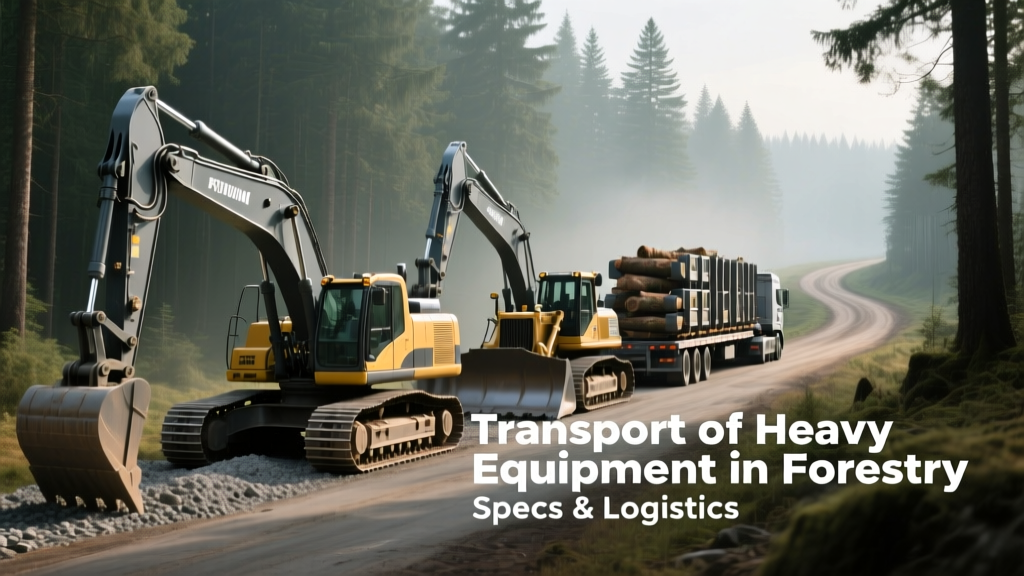
Transport of Heavy Equipment in Forestry: Specs & Logistics
Master the transport of heavy equipment in forestry. Explore technical specs, tie-down protocols, and lowboy requirements for moving harvesters and forwarders.
The Unique Challenge of Forestry Machine Logistics
The transport of heavy equipment in the logging sector presents a distinct set of engineering and regulatory hurdles. Unlike standard earthmoving machinery, forestry equipment—such as harvesters, forwarders, and feller bunchers—features extreme weight distributions, oversized tire configurations, and delicate hydraulic crane systems. Moving a 25-ton forwarder or a tracked feller buncher over public highways requires precise load calculations, specialized lowboy trailers, and strict adherence to cargo securement protocols. Failure to account for the dynamic pivot points of a forestry machine can result in catastrophic load shifts, snapped tie-down chains, and severe highway accidents.
⚠️ Critical Warning: Bogie Axle SwayForwarders utilize tandem bogie axles designed to pivot over uneven terrain. If the bogie oscillation is not mechanically locked or physically strapped down before loading, the rear frame will sway violently during highway transit. This dynamic movement generates kinetic energy that easily exceeds the Working Load Limit (WLL) of standard transport chains, leading to sudden tie-down failure.
Technical Specifications Dictating Transport Requirements
To plan the transport of heavy equipment in forestry, dispatchers must understand the exact physical envelope of the machinery. The following table outlines the baseline specifications for three common forestry machines that dictate trailer selection and permitting requirements.
| Machine Model | Classification | Operating Weight | Transport Width (Standard Tires) | Max Crane Reach |
|---|---|---|---|---|
| John Deere 1510E | Forwarder | 50,700 lbs (23,000 kg) | 10'2" (3.10 m) with 700mm tires | 27.9 ft (8.5 m) |
| Komatsu 931.1 | Harvester | 46,300 lbs (21,000 kg) | 9'8" (2.95 m) with 600mm tires | 36.1 ft (11.0 m) |
| Tigercat H855C | Feller Buncher (Tracked) | 68,000 lbs (30,844 kg) | 10'6" (3.20 m) over tracks | 24.0 ft (7.3 m) |
Data sourced from manufacturer specification sheets and John Deere Forestry Equipment Lineup documentation.
Dimensional Constraints and Oversize Permitting
The federal maximum legal width for a load on the US highway system without a permit is 8 feet 6 inches (102 inches). As the table demonstrates, modern forestry machines equipped with wide 600mm or 700mm flotation tires almost universally exceed this limit. Transporting a John Deere 1510E with its standard 700/55-26.5 tires requires an oversize load permit, which typically adds $150 to $400 in administrative fees per state crossed, plus the mandatory cost of pilot escort vehicles (averaging $2.50 to $3.50 per mile in 2026). To avoid these costs, some logistics crews deflate the tires or swap to narrower 500mm transport tires, though this adds 3 to 5 hours of labor at the origin and destination sites.
Hydraulic and Crane Locking Mechanisms
Forestry harvesters and forwarders feature complex hydraulic cranes (such as the Logset 11F or John Deere CF7) that must be secured during transit. Relying solely on hydraulic lock valves is a critical failure mode in heavy equipment transport.
The Failure Mode: Hydraulic Drift and Vibration
High-frequency road vibrations cause micro-spools in hydraulic control valves to shift, leading to slow hydraulic cylinder drift. If a crane boom is left resting on hydraulic pressure alone, it can slowly lift or swing during a 200-mile transit, eventually striking an overpass or shifting the machine's center of gravity off the trailer deck.
Standard Operating Procedure: Crane Securing- Retract and Lower: Fully retract the telescopic boom extensions and lower the main boom into the designated mechanical transport cradle or saddle.
- Engage Mechanical Pins: Insert the hardened steel transport pins through the boom and chassis brackets. This transfers the load from the hydraulic cylinders to the machine's structural steel.
- Secure the Grapple/Head: Close the harvester head or forwarder grapple around a designated transport stump or bolt-on deck block. Wrap a heavy-duty ratchet strap (minimum 10,000 lbs WLL) around the grapple rotator to prevent pendulum swinging.
- Lock the Slew Motor: Engage the mechanical slew brake in the cab to prevent the crane pedestal from rotating on its gear ring.
Mechanical Tie-Down and Securing Protocols
The FMCSA Cargo Securement Regulations mandate that heavy equipment over 10,000 lbs must be secured with a minimum of four tie-downs, and the aggregate Working Load Limit (WLL) of the tie-downs must equal at least half the weight of the equipment. For a 50,000 lb forwarder, the tie-down system must provide a minimum aggregate WLL of 25,000 lbs.
Chain Selection and Angle Dynamics
Standard 3/8-inch Grade 70 transport chain has a WLL of 6,600 lbs. Four chains provide an aggregate WLL of 26,400 lbs, which mathematically meets the requirement for a 50,000 lb machine. However, chain angle drastically reduces effective downward force. A chain pulled at a 45-degree angle loses approximately 30% of its vertical securing power. For forestry equipment, which has a high center of gravity due to elevated crane pedestals and loaded bogies, a 6-chain configuration using 1/2-inch Grade 70 chains (WLL 11,300 lbs each) is the industry best practice to counteract lateral roll forces on banked highway curves.
- Front Tie-Downs: Attach to the chassis towing eyes or designated D-rings. Pull forward and down at a 30 to 45-degree angle to prevent rearward shifting during braking.
- Rear Tie-Downs: Attach to the rear articulation joint or chassis tow points. Pull rearward and down to prevent forward shifting during acceleration.
- Lateral Tie-Downs: Cross the chains in an "X" pattern over the machine's center of gravity to eliminate side-to-side sway.
Track vs. Wheel: Undercarriage Transport Considerations
While forwarders and harvesters are typically wheeled, feller bunchers and mulching tractors often utilize steel or rubber tracks. The transport of heavy equipment with steel tracks requires specific deck preparations.
Steel grouser pads will instantly destroy asphalt highways and will be severely worn by the friction of a steel lowboy deck. When transporting a tracked Tigercat or John Deere feller buncher, the trailer deck must be lined with 2-inch thick hardwood timber mats (typically oak or laminated bamboo) to provide friction and protect both the tracks and the trailer. Alternatively, machines equipped with steel tracks must be fitted with bolt-on rubber street pads before entering public roadways, a process that takes a two-man crew approximately 4 hours using impact wrenches and specialized pad presses.
Lowboy Trailer Selection and Axle Configurations
Standard flatbed trailers are unsuitable for forestry machinery due to the extreme deck height (often 58 to 60 inches), which pushes the tall machine cab over the 13'6" legal bridge height limit. Transport requires specialized equipment:
| Trailer Type | Deck Height | Max Payload | Best Application |
|---|---|---|---|
| Standard RGN (Removable Gooseneck) | 24" - 28" | 45,000 lbs | Wheeled Harvesters (narrow tire config) |
| Tri-Axle Lowboy with Flip Axle | 18" - 22" | 65,000 lbs | Heavy Forwarders (John Deere 1910E) |
| Multi-Axle Extendable (Jeep + Booster) | 14" - 18" | 100,000+ lbs | Tracked Feller Bunchers & Chippers |
Extendable lowboys are critical for forwarders, which have exceptionally long wheelbases (often exceeding 20 feet between the front and rear bogie centers). The trailer must be extended to ensure the machine's weight is distributed evenly across the trailer axles and the truck's drive axles, preventing overweight fines at DOT weigh stations.
Frequently Asked Questions (FAQ)
What are the OSHA requirements for loading forestry equipment?
Under the OSHA Logging Operations Standard (1910.266), employers must ensure that machines are loaded and secured in a manner that prevents shifting during transit. This includes using designated loading ramps with adequate traction and ensuring the machine's parking brakes and mechanical locks are fully engaged before the operator dismounts.
How much does it cost to transport a forestry harvester 200 miles?
In 2026, specialized heavy haul rates for oversized forestry equipment average $4.50 to $6.00 per loaded mile. A 200-mile move will typically cost between $1,200 and $1,800 for the base freight rate. However, if the machine's tire width requires oversize permits and a pilot car, add an additional $600 to $900 for permitting, escort services, and route surveying.
Can I transport a forwarder with the payload bunk loaded?
No. Forwarders must be transported with the payload bunk completely empty. Transporting logs on a public highway shifts the center of gravity dangerously high, violates DOT weight distribution limits, and creates a severe hazard from rolling logs in the event of a sudden stop or collision. All timber must be unloaded at the landing or mill before the machine is driven onto a transport trailer.