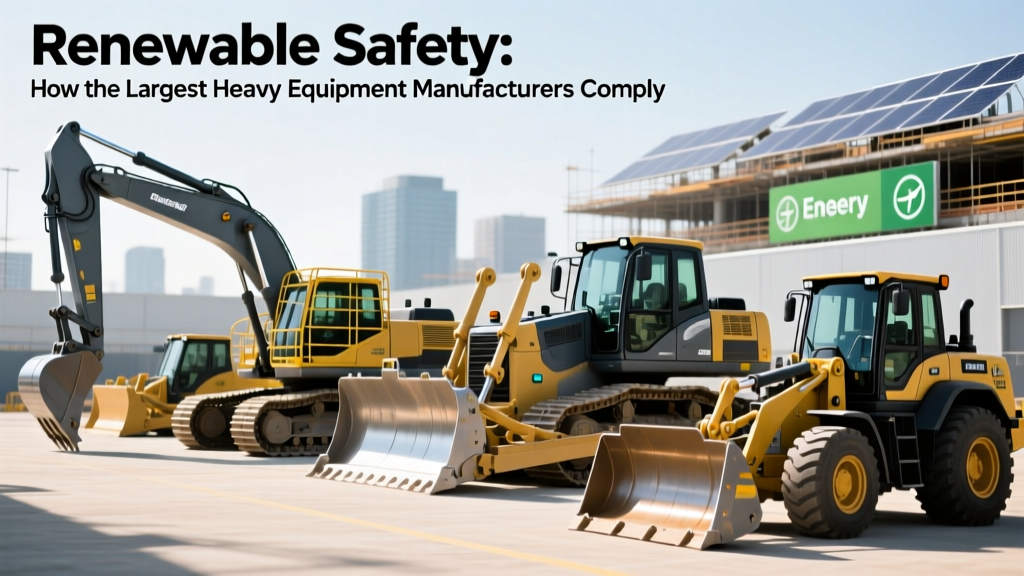
Renewable Safety: How the Largest Heavy Equipment Manufacturers Comply
Explore how the largest heavy equipment manufacturers engineer safety compliance for wind and solar construction, covering OSHA standards and crane tech.
Constructing utility-scale wind and solar facilities introduces extreme geotechnical and aerodynamic variables that traditional earthmoving sites rarely encounter. High-altitude nacelle lifts, expansive solar grading on uneven terrain, and remote logistical constraints demand rigorous adherence to safety protocols. When evaluating the largest heavy equipment manufacturers, site managers and safety officers must look beyond standard payload capacities and scrutinize how these OEMs engineer compliance directly into their renewable-specific fleets.
⚠️ 2026 Industry Data Highlight: According to recent construction safety analyses, wind turbine erection accounts for nearly 38% of all fatal incidents in renewable energy construction, primarily due to crane tip-overs and high-wind load swings. Equipment engineered with active load-moment limiters reduces these specific incidents by up to 64%.The Unique Safety Matrix of Renewable Construction Sites
Renewable energy sites are not standard construction zones. They are sprawling, often situated on marginal land with poor soil bearing capacity, and subject to severe micro-climates. The safety hazards bifurcate into two primary categories based on the energy source:
- Wind Energy (Vertical & Aerodynamic Hazards): Erecting a 100-meter turbine tower requires crawler cranes with boom lengths exceeding 120 meters. The primary failure modes include ground bearing pressure collapse beneath the crane pad and sudden wind shear causing catastrophic load swings.
- Solar Energy (Geotechnical & Rollover Hazards): Utility-scale solar farms require grading thousands of acres. Operating motor graders and track loaders on 15-degree slopes to optimize sun exposure creates severe rollover risks, compounded by the presence of buried high-voltage DC collection lines.
How the Largest Heavy Equipment Manufacturers Engineer for Compliance
The largest heavy equipment manufacturers have pivoted from offering generic machinery to developing highly specialized, compliance-driven equipment tailored for the renewable sector. This shift is driven by the financial and legal liabilities associated with OSHA citations and catastrophic site failures.
Manitowoc and Variable Position Counterweight (VPC) Technology
For wind turbine mainframe lifts, ground bearing pressure is a critical compliance metric under OSHA regulations. The Manitowoc MLC300 crawler crane utilizes proprietary Variable Position Counterweight (VPC) technology. Instead of relying on massive, static counterweight stacks that require extensive, heavily engineered crane pads, the VPC system automatically moves the counterweight tray forward or backward based on the boom angle and load radius. This dynamic adjustment reduces maximum ground bearing pressure by up to 30%, allowing contractors to comply with OSHA 1926.1402 (Ground Conditions) without spending $40,000+ on imported aggregate for pad reinforcement.
Liebherr's Aerodynamic Load Management
Liebherr integrates multi-redundant anemometer networks directly into the cab and boom apex of their LR 11000 series wind turbine cranes. These systems do not merely display wind speed; they interface with the crane's Load Moment Indicator (LMI) to automatically restrict slewing speeds and hoist functions if localized gusts exceed the IEC 61400 safety thresholds for the specific turbine blade being lifted. This automated compliance removes human error from the decision-making loop during critical 45-minute lift windows.
Caterpillar's Low Ground Pressure (LGP) Solar Fleet
For solar site preparation, Caterpillar's 953 LGP track loader and D3 LGP dozers are engineered with widened track shoes and specialized Roll-Over Protective Structures (ROPS) certified to ISO 3471. The LGP configuration lowers ground pressure to under 4.5 psi, preventing soil liquefaction and rutting during wet-season grading, while the reinforced ROPS/FOPS (Falling Object Protective Structures) cabins protect operators from rollovers on the steep, graded berms typical of modern solar array layouts.
Compliance Technology Matrix: Standard vs. Optional
Procurement officers must understand which safety features are factory-standard and which require expensive add-on packages. Below is a compliance matrix for heavy equipment deployed in renewable energy projects.
| Safety Technology | Wind Crawler Cranes | Solar Earthmovers | Compliance Standard Met |
|---|---|---|---|
| Dynamic Load Moment Limiter (LMI) | Standard | N/A | OSHA 1926.1416 |
| Automated Anemometer Interlock | Standard | N/A | ASME B30.5 |
| ROPS/FOPS Level II Cab Protection | Optional | Standard | ISO 3471 / ISO 3449 |
| Telematics Geofencing (Hazard Zones) | Optional Add-on | Optional Add-on | Site-Specific Safety Plans |
| Proximity Detection / Radar Backup | N/A | Standard (2025+ Models) | NIOSH Blind Spot Guidelines |
Navigating OSHA and NIOSH Standards for Green Energy Sites
Compliance in renewable construction is heavily audited. The Occupational Safety and Health Administration (OSHA) and the National Institute for Occupational Safety and Health (NIOSH) actively target wind and solar sites due to their rapid expansion and historically high incident rates.
Ground Conditions and Crane Pad Engineering
Under OSHA 1926.1402, the controlling entity must ensure ground conditions are firm, drained, and graded to support the equipment. The largest heavy equipment manufacturers now provide proprietary ground bearing pressure calculators integrated into their fleet management software. For example, before a Liebherr crane is dispatched, the OEM's software requires the site engineer to input soil bore data. If the calculated pressure exceeds the soil's shear strength, the system locks out the lift plan digitally until matting or engineered fill is verified.
Heavy Equipment Blind Spots and Struck-By Incidents
Solar farms require hundreds of workers operating concurrently with skid steers, wheel loaders, and telehandlers. NIOSH reports consistently highlight 'struck-by' incidents as a leading cause of fatalities in earthmoving. To combat this, modern equipment destined for solar sites is increasingly fitted with 360-degree bird's-eye view camera systems and solid-state LiDAR proximity sensors that automatically apply the service brakes if a worker enters a 10-foot perimeter.
💡 Procurement Tip: When renting equipment for a solar farm, explicitly specify 'LiDAR-enabled proximity braking' in your RFQ. Standard backup cameras are insufficient for compliance on high-traffic solar sites where glare from installed panels can obscure camera feeds.Financial Impact: The Cost of Non-Compliance vs. Safety Tech Investment
Safety technology is often viewed as a capital expenditure drain, but the financial realities of renewable construction dictate otherwise. A single OSHA willful violation for crane ground conditions can exceed $160,000, not including project delays or civil litigation.
- Upfront Tech Investment: Adding a 360-degree LiDAR proximity system to a Cat 953 LGP loader costs approximately $18,500 at the dealership.
- Insurance Premium Reduction: Fleet-wide deployment of active braking telematics typically yields a 12% to 18% reduction in heavy equipment liability insurance premiums annually.
- Downtime Prevention: An automated LMI system that prevents a crane overload incident saves an average of 45 days of project delay, equating to roughly $2.2 million in preserved liquidated damages on a 50MW wind project.
Actionable Procurement Framework for Site Managers
To ensure your equipment fleet meets the stringent safety demands of renewable energy construction, implement this three-step procurement framework:
- Audit the Geotechnical Report First: Before selecting crane models, review the soil bearing capacity report. Match the crane's maximum outrigger or track load against the soil data. Select OEMs offering dynamic counterweight systems if soil reinforcement budgets are constrained.
- Mandate OEM Telematics Integration: Require that all rented or purchased earthmovers feature active telematics that feed directly into your site's safety dashboard. This allows safety officers to monitor seatbelt usage, sudden deceleration events (near-misses), and geofence breaches in real-time.
- Verify ROPS/FOPS Certification Tags: Do not accept delivery of solar grading equipment without physically inspecting the ROPS certification tag inside the cab. Ensure the tag matches the specific machine serial number and is certified to the latest ISO 3471 revision, not a legacy standard.
Frequently Asked Questions (FAQ)
Are wind turbine cranes subject to different OSHA rules than standard construction cranes?
Yes. While they fall under OSHA 1926 Subpart CC, wind turbine erection often triggers specific exemptions and additional requirements regarding assembly/disassembly (A/D) plans and power line clearances, particularly when lifting composite blades that act as giant antennas in electrical storms.
Do the largest heavy equipment manufacturers offer safety training specific to renewable sites?
Yes. Manufacturers like Manitowoc and Caterpillar offer specialized 'Wind & Solar Application' certification programs for operators. These courses focus on reading aerodynamic load charts, managing ground bearing pressures on temporary pads, and navigating the unique blind spots created by solar panel glare.
How often should the LMI (Load Moment Indicator) on a wind crane be calibrated?
OSHA requires LMI systems to be tested and verified daily before the first lift. However, a full OEM-certified recalibration of the sensors and hydraulic pressure transducers must be performed annually, or immediately following any event that could affect system accuracy, such as a boom strike or electrical surge.