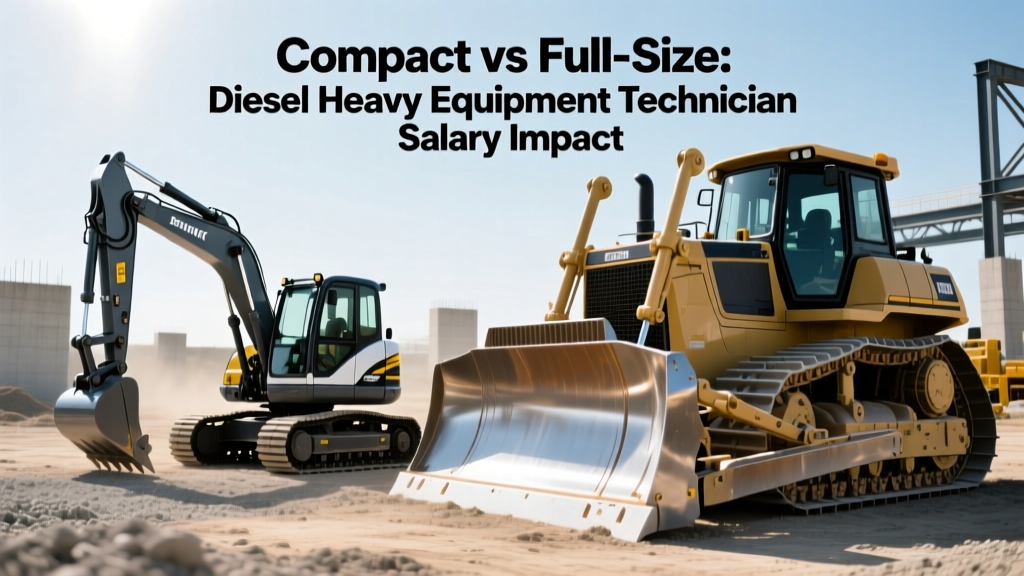
Compact vs Full-Size: Diesel Heavy Equipment Technician Salary Impact
Discover how the rising diesel heavy equipment technician salary impacts your TCO when choosing between compact and full-size construction fleets.
Beyond the Sticker Price: The Fleet Sizing Dilemma
Procurement teams and owner-operators frequently isolate the invoice price when debating compact versus full-size construction equipment. However, the modern total cost of ownership (TCO) model demands a broader lens. As machines become denser with telematics, high-pressure common rail fuel systems, and complex aftertreatment modules, the labor required to maintain them has fundamentally shifted. The decision to deploy a single 36-ton full-size excavator versus a fleet of three 5-ton compact excavators is no longer just an earthmoving calculus; it is a human resources and maintenance capacity decision.
In 2026, the acute shortage of qualified heavy-duty mechanics means that fleet sizing must be directly correlated with your maintenance infrastructure. If you lack the internal capacity to support Tier 4 Final and Stage V emissions systems, the operational downtime of a full-size machine can obliterate your project margins within a single workweek.
The Hidden TCO Variable: Diesel Heavy Equipment Technician Salary
When calculating lifecycle costs, the diesel heavy equipment technician salary is often the most volatile and underestimated variable. According to the U.S. Bureau of Labor Statistics, the demand for diesel service technicians continues to outpace the supply of trade school graduates, driving compensation upward.
While the national median base pay hovers around $62,000, the reality of retaining a technician capable of diagnosing a Caterpillar C9.3B engine DEF fault or recalibrating a John Deere hydraulic pump is vastly different. Fully burdened rates—including benefits, specialized diagnostic software licenses (like Cat ET or John Deere Service Advisor), and ongoing OEM certification training—push the true cost of an in-house senior diesel tech well past $95,000 annually.
The Tier 4 Final / Stage V Tax
Full-size equipment requires advanced emissions troubleshooting. Active Diesel Particulate Filter (DPF) regeneration requires sustained high-heat exhaust cycles. When full-size machines are used in stop-and-go applications (like deep trenching or pipe laying), they frequently fail to reach passive regen temperatures, triggering derate codes. Clearing these codes and performing forced regens requires a certified technician with a proprietary laptop. Compact machines, while also subject to emissions regulations, often utilize simpler engine architectures or are cycled through dealer warranty networks, bypassing the need for a six-figure in-house specialist.
5-Year TCO Matrix: Full-Size vs. Compact Fleet
To understand how maintenance labor skews the ROI, consider this 5-year TCO comparison between one full-size excavator and a two-machine compact fleet deployed to achieve similar (though not identical) daily production volumes.
| Cost Factor (5-Year Projection) | 1x Full-Size (e.g., Cat 336 GC) | 2x Compact (e.g., Kubota KX057-4) |
|---|---|---|
| Initial Acquisition Cost | $485,000 | $170,000 ($85k x 2) |
| Fuel & DEF Consumption | $115,000 | $68,000 |
| Undercarriage & Wear Parts | $42,000 | $14,000 |
| In-House Tech Labor Allocation | $85,000 (Requires dedicated senior tech) | $22,000 (Generalist or dealer-supported) |
| Downtime Revenue Loss (Est.) | $65,000 | $18,000 |
| Total 5-Year TCO | $792,000 | $292,000 |
Note: While the full-size machine offers superior single-point breakout force and lift capacity, the compact fleet provides redundancy. If one compact machine suffers a blown hydraulic hose, production continues at 50%. If the single full-size machine throws a proprietary CAN-bus fault, production drops to 0% until a specialized technician arrives.
Technical Maintenance Divergence: Where the Hours Go
The gap in maintenance hours between compact and full-size iron is rooted in hydraulic complexity and physical scale. A full-size dozer or excavator operates with main hydraulic pumps pushing upwards of 150 gallons per minute (gpm) at pressures exceeding 5,000 psi. Replacing a burst hydraulic line or rebuilding a swashplate pump on a 40-ton machine requires heavy rigging, fluid containment protocols, and hours of bleeding air from the system.
The Compact Advantage: Modular and Accessible
Compact equipment, such as a Bobcat E35 or Takeuchi TB235, typically operates in the 20 to 30 gpm range. Components are tightly packed but modular. A general mechanic with standard hand tools and a basic understanding of hydraulic schematics can often swap a compact machine's travel motor or main control valve in a single afternoon. Furthermore, compact machines are easily loaded onto a standard equipment trailer and transported to a dealer's service bay, completely eliminating the need for expensive field-service call-out fees.
The Full-Size Reality: Field Service Dependencies
You cannot easily tow a 75,000-pound wheel loader back to the shop. When a full-size machine fails on a remote grading site, you must bring the shop to the machine. This means paying the diesel heavy equipment technician salary for travel time, maintaining a fleet of customized field-service trucks equipped with cranes and welding rigs, and absorbing the massive opportunity cost of the machine sitting idle while waiting for parts and personnel.
'We used to run a mixed fleet of 30-ton and 3-ton excavators. We realized we were paying our top-tier diesel techs $85 an hour to chase electrical gremlins on the big iron, while the compact machines were essentially running themselves on a dealer-supported CVA (Customer Value Agreement) contract. We shifted our strategy: full-size iron is now only purchased if the specific site geography demands it, and we mandate dealer maintenance contracts to cap our labor exposure.'
— Fleet Manager, Midwest Earthworks Contractor (Interviewed Q1 2026)
When Full-Size Equipment Justifies the Labor Premium
Despite the heavy burden of technician salaries and specialized maintenance, full-size equipment remains non-negotiable for specific applications. You must absorb the higher TCO and labor costs when:
- Mass Earthmoving & Production Trenching: If your daily quota requires moving 3,000+ cubic yards of dirt, compact machines simply lack the bucket capacity and cycle speed to compete, regardless of maintenance savings.
- Heavy Lift and Pipe Laying: Laying 48-inch concrete storm drains requires the counterweight and lift capacity of a 30-ton+ excavator. Compact machines will physically tip or fail to meet safety load-chart requirements.
- Severe Demolition: Running hydraulic breakers, shears, or pulverizers on large structural concrete generates shock loads that will rapidly destroy the pins, bushings, and structural integrity of compact machine booms.
When Compact Equipment Wins the ROI Battle
The compact segment is rapidly cannibalizing full-size market share in specific niches, driven directly by the desire to avoid the overhead of a dedicated in-house diesel mechanic. Choose compact fleets when:
- Utility and MEP Work: Mechanical, Electrical, and Plumbing (MEP) contractors working in tight urban footprints benefit from the zero-tail-swing and rubber-track footprint of compact machines, avoiding the cost of road closures and heavy transport permits.
- Landscaping and Final Grade: Precision grading around existing structures requires the nimbleness of a compact track loader or mini-excavator.
- Lack of In-House Maintenance: If your business model relies on operator-owners or general laborers rather than certified heavy-duty mechanics, compact equipment with active dealer warranties protects your balance sheet from catastrophic repair bills.
Decision Framework: Matching Fleet Size to Maintenance Capacity
Before signing a purchase order, run your operational profile through this three-point framework to determine if your maintenance infrastructure can support the iron:
1. Assess Your Diagnostic Capability
Do you own the OEM proprietary software required to read Tier 4 Final fault codes? If you are relying on generic OBD2-style readers, you cannot effectively maintain modern full-size equipment. Action: If you lack proprietary software and the budget for the $95k+ technician to run it, pivot to compact machines covered by dealer telematics and warranty programs.
2. Calculate the Burdened Downtime Cost
Estimate the daily revenue loss when your primary full-size machine is down. Multiply that by the average 48-hour wait time for a specialized field-service tech to arrive on-site. Compare this against the redundancy of having two compact machines on the same site. Action: If a single point of failure threatens project liquidation damages, the compact fleet is the superior risk-mitigation strategy.
3. Evaluate Dealer Proximity
Full-size equipment is heavily dependent on dealer support networks for major component rebuilds (engines, transmissions, hydraulic pumps). Action: If your operating radius is more than 100 miles from an authorized OEM dealer with a robust field-service fleet, the logistics and travel-time costs of technician call-outs will destroy your profit margins. Stick to compact equipment that can be trailered to the shop in under two hours.
The Bottom Line on Fleet Sizing
Selecting between compact and full-size construction equipment is a financial strategy that extends far beyond the dealer lot. The rising diesel heavy equipment technician salary, combined with the extreme technical complexity of modern emissions systems, means that every full-size machine you purchase is effectively a commitment to a high-overhead maintenance ecosystem. By rigorously evaluating your actual production needs against your internal mechanical capabilities, you can right-size your fleet, cap your labor exposure, and protect your project margins in an increasingly unforgiving labor market.