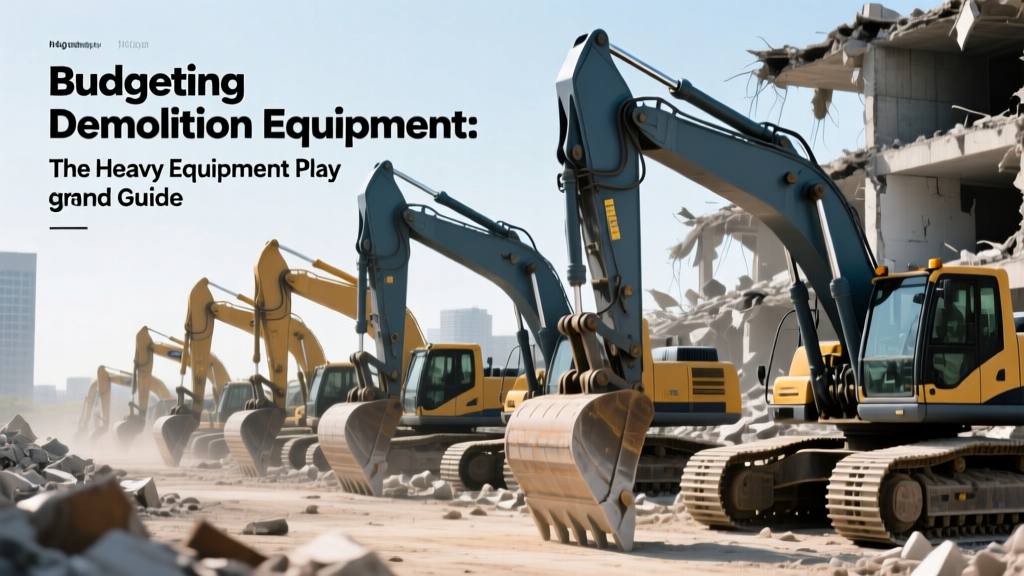
Budgeting Demolition Equipment: The Heavy Equipment Playground Guide
Analyze 2026 demolition equipment costs, from carrier CapEx to attachment OpEx, and learn how to test rigs at a heavy equipment playground.
Allocating capital for a demolition fleet requires moving beyond brochure specifications. A primary demolition rig and its accompanying attachments can easily push a single-machine budget past the $500,000 threshold. To mitigate the risk of purchasing under-matched or over-specified iron, top-tier contractors utilize a dealer's 'heavy equipment playground'—a controlled demo yard or testing facility—to empirically validate cycle times, hydraulic compatibility, and structural integrity before signing purchase orders. This guide breaks down the 2026 capital expenditure (CapEx) and operational expenditure (OpEx) realities of demolition carriers and attachments, providing a rigorous framework for budget planning and playground testing.
CapEx vs. OpEx Warning: Never budget for a demolition carrier based solely on the base machine price. A standard excavator requires $40,000 to $90,000 in demolition-specific upfits (FOGS cab guarding, heavy-duty belly pans, extended-reach boom configurations, and auxiliary hydraulic plumbing) before it is site-ready.The 2026 Demolition Carrier CapEx Matrix
The foundation of any demolition budget is the carrier machine. In 2026, the market is split between traditional modified excavators and specialized remote-controlled demolition robots. Your choice dictates not just the initial purchase price, but the ongoing labor and insurance costs.
| Carrier Type | Example Model | Base CapEx | Demo Upfit Costs | Total Budget Target |
|---|---|---|---|---|
| 35-Ton Class Excavator | Cat 336 / Komatsu PC360 | $360,000 - $390,000 | $65,000 (FOGS, Boom, Guards) | $425,000 - $455,000 |
| 50-Ton High-Reach | Cat 352 UHD | $550,000 - $600,000 | $85,000 (UHD Boom, Counterweight) | $635,000 - $685,000 |
| Remote Demo Robot | Brokk 170 | $280,000 - $310,000 | $15,000 (Extra batteries, remotes) | $295,000 - $325,000 |
Remote-controlled units like the Brokk 170 command a premium per ton of operating weight but drastically reduce workers' compensation liabilities and allow for interior structural teardowns where cabbed machines cannot fit. Standard 35-ton excavators remain the workhorses for exterior envelope stripping and foundation processing.
Attachment Economics: Sizing and Selection
An excavator is merely a hydraulic power plant; the attachment is the revenue generator. Mismatching attachment weight or hydraulic flow requirements to the carrier is the most common budgeting error in demolition. Over-sizing an attachment starves the hydraulic system, causing cavitation and premature pump failure, while under-sizing leads to excessive structural stress on the carrier's stick and boom.
Hydraulic Breakers vs. Processing Attachments
For primary concrete reduction, hydraulic breakers (e.g., Epiroc MB 1700 or Atlas Copco HB 2000) remain the standard. Budget between $25,000 and $35,000 for a mid-class breaker. However, breakers are high-OpEx tools. They consume massive amounts of fuel, generate severe vibration that accelerates carrier pin wear, and produce high volumes of silica dust.
Conversely, multi-processors with concrete cutter and shear jaws (e.g., Cat MP324 or LaBounty UP 45) represent a higher initial CapEx ($65,000 to $110,000) but offer vastly superior ROI on large-scale structural projects. They operate quietly, allow for on-site rebar separation, and drastically reduce silica dust generation.
Rule of Thumb: If your project requires processing more than 3,000 cubic yards of reinforced concrete, the fuel savings, reduced GET (Ground Engaging Tool) wear, and scrap steel recovery generated by a multi-processor will offset its $80,000+ price premium over a hydraulic breaker within 14 months.
Validating Your Budget at a Heavy Equipment Playground
Brochure cycle times are calculated in sterile, factory-controlled environments. Real-world demolition involves twisted I-beams, 6,000 PSI high-strength concrete, and tangled rebar. Before authorizing a wire transfer, mandate a testing session at the dealer's heavy equipment playground. Arrive with a strict testing protocol to protect your capital allocation.
The 5-Point Playground Testing Protocol
- Verify True Auxiliary Flow: Do not rely on the cab monitor's digital readout. Have a technician install a physical flow meter between the stick and the attachment. A Cat MP324 shear requires exactly 158 GPM at 5,076 PSI. If the playground machine is only pushing 130 GPM due to pump wear or improper swashplate calibration, your cycle times on-site will destroy your profit margins.
- Test Breakout Force on Cured Material: Bring or source actual cured, reinforced concrete (minimum 4,000 PSI). Digging in loose dirt at the dealer yard tells you nothing about the breakout force required to fracture a foundation footing.
- Evaluate FOGS Clearance and Visibility: With the attachment fully extended and curled, check the operator's sightlines. Ensure the Falling Object Guard System (FOGS) mesh does not blind the operator when tracking the shear jaws at maximum reach.
- Check Hydraulic Hose Routing: Inspect the stick and boom plumbing. Demolition requires spiral-wrapped, Kevlar-reinforced hoses routed *inside* the boom profile. External hoses will be severed by falling debris within the first week on site.
- Measure Cycle Times Under Load: Time the shear jaw closing cycle while cutting 1-inch Grade 60 rebar. Compare this physical stopwatch time against the manufacturer's spec sheet to calculate realistic daily tonnage processing rates.
Playground Troubleshooting Matrix
When testing at the heavy equipment playground, anomalies will occur. Use this matrix to diagnose issues before they become expensive field repairs.
| Symptom During Testing | Probable Cause | Required Playground Fix |
|---|---|---|
| Shear stalls or chatters on rebar | Auxiliary flow too high, causing hydraulic cavitation | Adjust pump swashplate; restrict flow via cab monitor to match attachment GPM spec |
| Breaker strikes weakly / low impact energy | Nitrogen charge depleted or tool bushing worn beyond tolerance | Check nitrogen PSI with gauge; measure moil point diameter with calipers |
| Attachment cylinder drifts down when suspended | Carrier boom check valve bypassing or cylinder seal failure | Hook up pressure gauge to aux circuit; rebuild check valve or replace cylinder seals |
Hidden OpEx: Compliance and Wear Mitigation
A comprehensive demolition budget must account for regulatory compliance and accelerated wear. Failing to budget for these hidden costs will erode your gross margins by 15% to 20% in the first year of operation.
Silica Dust and Lead Abatement Compliance
Demolition of legacy structures inevitably generates respirable crystalline silica and lead dust. The Occupational Safety and Health Administration (OSHA) strictly enforces the Permissible Exposure Limit (PEL) for silica at 50 micrograms per cubic meter of air (OSHA Demolition Standards). To comply without halting production for manual watering, budget $8,000 to $12,000 per carrier for integrated, high-pressure water misting systems mounted directly to the boom and attachment. Furthermore, if your heavy equipment playground testing or initial site assessments indicate lead-based paint, adherence to EPA Lead RRP guidelines will require specialized containment shrouding on your pulverizers, adding another $3,000 to $5,000 per attachment in custom fabrication.
Accelerated Pivot and Pin Wear
The shock loads generated by demolition attachments transfer directly into the carrier's boom and stick pivot pins. Standard grease intervals of 250 hours are insufficient for demolition. Budget for the installation of an automatic, high-pressure central lubrication system (e.g., Lincoln or SKF) costing approximately $4,500. This system must be programmed to deliver micro-doses of molybdenum-disulfide grease every 30 minutes of active PTO engagement. Additionally, allocate $12,000 annually in your OpEx model for premature bushing and pin replacements, as the lateral twisting forces of pulling down structural steel will ovalize pin bores much faster than standard trenching operations.
The Final Budget Sign-Off: Never finalize a demolition equipment purchase order based on a static quote. Use the heavy equipment playground to verify hydraulic flow, structural clearances, and cycle times. Only when the physical data matches the financial model should the capital be deployed.