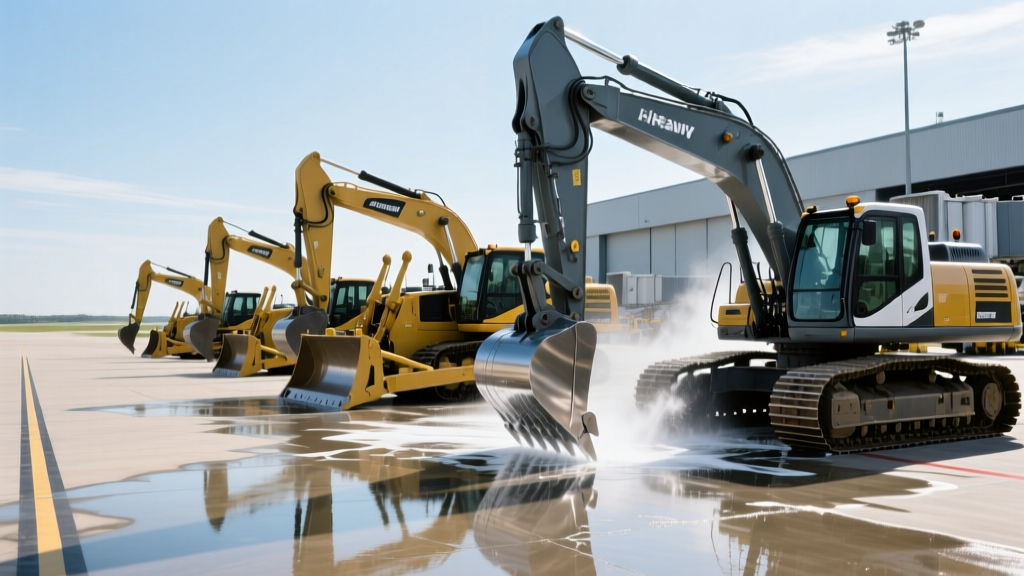
Heavy Equipment Washing for Airport GSE: Technical Specs & Flow
Explore technical specifications, automated telemetry, and EPA compliance for heavy equipment washing systems in airport ground support fleets.
The Operational Imperative of GSE Heavy Equipment Washing
Airport Ground Support Equipment (GSE)—ranging from 90,000-lb pushback tractors like the TLD TPX-100 to 1900-kVA mobile Ground Power Units (GPUs)—operates in one of the most chemically and mechanically hostile environments in industrial logistics. Tarmac operations expose these assets to jet fuel particulates, hydraulic fluid leaks, and highly corrosive potassium acetate and propylene glycol de-icing mixtures. Consequently, heavy equipment washing for airport fleets is not a cosmetic exercise; it is a strict, scheduled maintenance protocol designed to prevent catastrophic hydraulic steering failure, electrical arcing, and premature structural degradation.
Unlike standard construction machinery, GSE operates in tight proximity to aircraft fuselages and sensitive avionics. The washing systems deployed for these assets must balance aggressive contaminant removal with absolute precision to protect exposed sensors, telemetry arrays, and high-voltage electrical enclosures. This guide details the technical specifications, chemical interactions, and automated telemetry flows that define modern airport GSE wash bays.
Core Information Gain: The Glycol Factor
Standard heavy-duty alkaline degreasers (pH 11-13) used in construction washing are strictly prohibited for GSE that operates on winter aprons. When high-alkaline detergents mix with residual Type I or Type IV aircraft de-icing fluids (propylene glycol bases), they create a highly viscous, gelatinous sludge that binds to axle seals and clogs wash bay reclamation filters. Modern GSE washing requires pH-neutral (7.0) or mildly acidic (5.5-6.5) enzymatic foaming agents that break the glycol molecular bond without compromising the dielectric grease on high-voltage GPU cables.
Technical Specifications: Manual vs. Automated Wash Bays
Facilities managing fleets of over 50 GSE units are rapidly transitioning from manual pressure washing to automated, RFID-triggered drive-through systems. The table below contrasts the operational specifications of both methodologies for a standard aircraft tug and belt loader fleet.
| Specification Metric | Manual Pressure Washing | Automated RFID Wash Bay |
|---|---|---|
| Operating Pressure (Chassis) | 2,500 - 3,500 PSI | 1,200 - 1,500 PSI (Oscillating) |
| Operating Pressure (Electrical/GPU) | N/A (Hand-wiped only) | 400 PSI (Wide-angle fan nozzle) |
| Water Flow Rate | 4 - 8 GPM | 45 - 60 GPM (Multi-manifold) |
| Water Temperature | Ambient | 140°F (60°C) for glycol breakdown |
| Cycle Time (Pushback Tractor) | 45 - 60 minutes | 6 - 9 minutes |
| Water Reclamation Rate | 10% (Sump grates) | 85-95% (Closed-loop filtration) |
How Automated GSE Wash Systems Work: Telemetry & Flow
Modern airport wash bays utilize Programmable Logic Controllers (PLCs) integrated with the airport's GSE asset management software. The washing sequence is entirely automated, reducing human error and ensuring consistent coverage of complex undercarriage geometries.
- RFID Geofence Triggering: As a pushback tractor approaches the bay, an RFID reader scans the asset tag on the chassis. The PLC pulls the specific wash profile for that exact model (e.g., a low-profile profile for a tow-barless tug vs. a high-clearance profile for a scissor lift).
- Pneumatic Pre-Soak Application: Air-atomized foaming arches deploy a pH-neutral enzymatic detergent. The system pauses for exactly 120 seconds, allowing the foam to emulsify tarmac rubber deposits and jet-A1 fuel residue without drying on the surface.
- High-Volume, Low-Pressure (HVLP) Rinse: Unlike standard construction wash bays that use high-PSI pinpoint nozzles, GSE bays use HVLP oscillating manifolds delivering 1,500 PSI at 60 GPM. This volume-based approach flushes debris from deep within the steering linkages without forcing water past the dynamic seals.
- Undercarriage Targeting: Retractable floor nozzles activate, specifically targeting the hydraulic steering cylinders and brake calipers, which are highly susceptible to corrosive glycol pooling.
- Telemetry Logging: Upon completion, the PLC logs the wash cycle, water volume used, and chemical consumption to the fleet maintenance database, automatically resetting the unit's 'days since wash' maintenance interval.
Critical Failure Modes: Water Ingress and Sensor Blinding
Improper heavy equipment washing techniques routinely destroy sensitive GSE components. Maintenance managers must enforce strict pressure thresholds and verify Ingress Protection (IP) ratings before allowing equipment into automated bays.
⚠️ WARNING: Autonomous GSE Sensor VulnerabilityThe rise of Autonomous Guided Vehicles (AGVs) in airport ground operations, such as automated baggage tractors, introduces severe washing risks. LiDAR domes, ultrasonic proximity sensors, and optical cameras must never be subjected to direct high-pressure water streams. Automated wash bays must be programmed with 'sensor-blind zones' where nozzles automatically shut off within a 3-foot radius of the vehicle's primary telemetry mast to prevent micro-abrasions on optical lenses.
IP Rating Requirements for Wash Bay Survival
- IP65 (Dust tight, water jets): Insufficient for automated GSE washing. Standard junction boxes rated IP65 will suffer water ingress when exposed to 1,500 PSI oscillating nozzles.
- IP66 (Powerful water jets): The minimum acceptable rating for exterior electrical enclosures, solenoid valves, and alternator housings on tarmac equipment.
- IP69K (High-pressure, high-temperature washdown): Mandatory for GPU output connectors, battery management system (BMS) enclosures on electric GSE, and hydraulic pump controllers.
Water Reclamation and EPA Compliance Matrices
Airport aprons and maintenance facilities are heavily regulated regarding stormwater and industrial runoff. The EPA's Airport Deicing Category regulations strictly limit the discharge of glycol and chemical oxygen demand (COD) into municipal water systems. Therefore, GSE wash bays must incorporate advanced reclamation matrices.
| Reclamation Technology | Mechanism of Action | Efficacy & Limitations |
|---|---|---|
| Gravity Oil-Water Separators | Utilizes specific gravity differences to float jet fuel and hydraulic oils to the surface for skimming. | Highly effective for hydrocarbons; completely ineffective at removing dissolved glycols or heavy metal particulates. |
| Ultrafiltration (UF) Membranes | Forces wash water through semi-permeable membranes (0.01 to 0.1 microns) under high pressure. | Removes 99% of suspended solids and emulsified oils. Requires frequent backwashing and high CAPEX. |
| Bioreactors (Membrane Bioreactor) | Uses engineered bacteria to consume dissolved propylene glycol and reduce COD levels. | The only viable method for breaking down glycol runoff to meet EPA discharge limits. Requires strict temperature control (min 65°F) for bacterial survival. |
For comprehensive ground handling standards and environmental compliance frameworks, fleet managers should also consult the IATA Ground Operations Manual (IGOM), which outlines baseline safety and environmental protocols for apron equipment maintenance.
2026 Procurement & CAPEX Framework for GSE Wash Bays
Upgrading or installing a heavy equipment washing system for airport GSE requires significant capital expenditure, driven by the necessity for closed-loop water reclamation and PLC automation. Below is the current CAPEX framework for facility planners:
- Basic Manual Wash Pad with Sump Reclamation: $45,000 - $85,000. Includes reinforced concrete grading, heavy-duty grating, and a standard 3-stage oil-water separator. Excludes glycol bioremediation.
- Semi-Automated Roll-Over Wash System: $120,000 - $180,000. Similar to municipal bus wash systems but equipped with adjustable gantries to accommodate low-clearance tow-barless tugs and high-clearance scissor lifts.
- Fully Automated Drive-Through RFID Bay with Bioreactor: $315,000 - $550,000+. Includes PLC integration, HVLP oscillating manifolds, undercarriage robotics, and a complete membrane bioreactor (MBR) closed-loop water recycling plant capable of processing 15,000 gallons per day.
Summary Checklist for GSE Fleet Managers
- Verify all replacement electrical enclosures meet IP66 or IP69K ratings before washing.
- Mandate pH-neutral enzymatic detergents to prevent glycol sludge formation.
- Program automated PLCs with sensor-blind zones for AGV LiDAR and optical arrays.
- Ensure wash bay reclamation includes a bioreactor if local municipal codes prohibit glycol discharge.