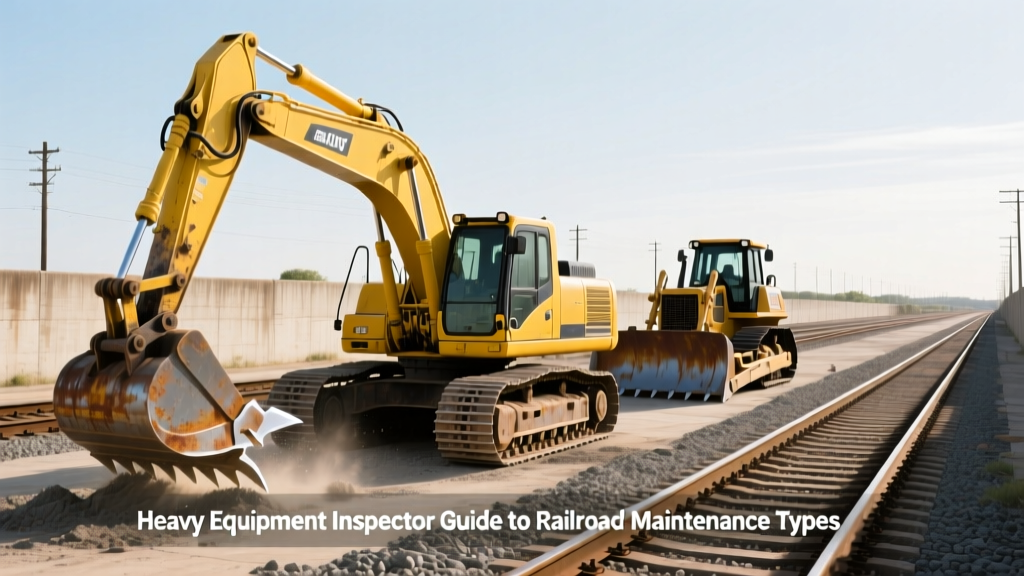
Heavy Equipment Inspector Guide to Railroad Maintenance Types
Learn what a heavy equipment inspector evaluates on railroad maintenance types, including tampers, regulators, and undercutters, with best practices.
The MOW Fleet: Core Railroad Maintenance Equipment Types
Railroad Maintenance of Way (MOW) relies on highly specialized, multi-million-dollar machinery to maintain track geometry and ballast integrity. When conducting site audits, the inspector must evaluate both the mechanical condition of these assets and the operator's adherence to manufacturer and regulatory parameters.
Track Tampers and Ballast Regulators
Track tampers, such as the Plasser & Theurer 09-3X Tamping Express, are the backbone of track surfacing. They lift, align, and pack crushed stone ballast beneath the ties. The primary inspection focus is the tamping bank. Inspectors must measure the squeeze pressure of the hydraulic cylinders, which typically operates between 2,000 and 2,800 psi. If pressure drops below 1,800 psi, the tines will fail to properly consolidate the ballast, leading to premature track settlement.
Furthermore, inspect the tamping tines for asymmetric wear. Tines worn more than 1.5 inches from their original profile fracture the ballast rather than packing it. Operators who run the machine with excessive down-pressure to compensate for worn tines will prematurely destroy the machine's vibration shafts—a repair costing upwards of $45,000.
Ballast regulators, like the Harsco PD-62, distribute the stone. Inspectors should check the conveyor belt tracking and the carbide wear liners on the plow blades. A common operator training gap is failing to adjust the plow angle for the specific ballast profile, causing excessive hydraulic stall conditions on the wing motors.
Undercutters and Rail Grinders
When ballast becomes fouled with mud and debris, undercutters like the Loram C44 Ballast Cleaner excavate, clean, and return the stone. The most critical component for the inspector is the cutter bar chain. Chain tension must be rigorously verified; a loose chain can derail from the sprocket at the end of the cut, causing catastrophic damage to the cutter bar housing. Operators must be trained to monitor the tension gauge (maintaining 4,000 to 5,000 lbs of tension) and adjust on the fly as the chain stretches.
Rail grinders, such as the Harsco RG400, use high-speed abrasive stones to remove rail corrugations and rolling contact fatigue. The inspector's priority here is the fire suppression system and stone RPM governors. Grinding generates massive spark showers; operators must be drilled on manual override procedures for the onboard water and foam suppression systems in case of automated sensor failure.
Inspector's Wear & Tolerance Matrix for MOW Machinery
| Component | Wear Limit / Tolerance | Est. Replacement Cost | Common Operator Error |
|---|---|---|---|
| Tamping Tines (Standard) | Replace at 1.5" profile loss | $350 - $450 each | Excessive down-force to compensate for wear |
| Undercutter Cutter Chain | 3% elongation limit | $18,000 - $25,000 per set | Failing to tension during initial break-in |
| Hi-Rail Guide Wheel Flange | Min thickness 1.25" | $2,200 per wheel assembly | Engaging gear on uneven road crossings |
| Grinder Abrasive Stones | Replace at 4" diameter | $85 - $120 per stone | Running dry without coolant flow |
Operator Training Gaps: What the Inspector Must Verify
A machine in perfect mechanical condition is still a liability if the operator lacks scenario-based training. Under 49 CFR Part 213 (Track Safety Standards), the movement of MOW equipment is strictly governed to prevent derailments and right-of-way incursions. The inspector must actively test the operator's knowledge, not just review their certification paperwork.
When inspecting a tamper or regulator, ask the operator to verbally walk through the emergency lift sequence. If the machine loses hydraulic power while the tamping bank or plow is lowered on the tracks, the operator must know how to use the manual accumulator release or hand-pump to raise the gear before the next scheduled train arrives. Hesitation here is a critical training failure.
Another major gap involves working near adjacent live tracks (fouling the right-of-way). Inspectors should verify that operators understand the specific sight-distance limitations of their equipment. For instance, the rearward visibility on a Loram C44 undercutter is severely restricted; operators must be trained to rely on designated ground spotters and camera systems, rather than attempting to reverse blindly.
Hi-Rail Conversion Gear: The Critical Inspection Point
Most MOW support vehicles (excavators, cranes, and supply trucks) utilize hi-rail (highway-railroad) conversion gear. This hydraulic guide-wheel system is the most frequent point of failure and derailment. The inspector must perform a live drop-test and drift-test.
⚠️ WARNING: Hydraulic Drift HazardHydraulic cylinder drift in hi-rail gear can cause a guide wheel to lift off the rail while moving at track speed, resulting in an immediate and catastrophic derailment. Never sign off on a hi-rail inspection without a timed drift test.
Step-by-Step Hi-Rail Verification Protocol
- Visual Alignment: With the vehicle on the road, lower the guide wheels. Check that the locking pins engage fully with an audible click and that the proximity sensors illuminate green on the dash.
- Flange Clearance: Measure the distance between the road tire and the railhead. It should be between 1.5 and 2.5 inches. If the road tires touch the rail, the vehicle will hunt (oscillate) at speeds over 15 MPH.
- The Drift Test: Raise the vehicle so the road tires are entirely off the ground, supported only by the rail guide wheels. Shut off the engine. Measure the distance from the guide wheel flange to the rail gauge face. Wait exactly 10 minutes. If the flange moves more than 1/4 inch away from the rail, the hydraulic holding valves or cylinder seals are failing. The unit must be tagged out.
- Emergency Retraction: Simulate a total electrical failure and require the operator to manually release the hydraulic lock valves to retract the guide wheels using the auxiliary road engine PTO (Power Take-Off).
Telematics and Documenting Deficiencies
Modern MOW equipment is heavily integrated with telematics. As an inspector, you should pull the ECM (Engine Control Module) and implement hydraulic data logs prior to the physical walkaround. Look for fault codes related to hydraulic over-temperature or engine lugging. These codes often indicate an operator who is pushing the machine beyond its designed cycle times, such as taking too deep of a cut with an undercutter or running a tamper at full vibration while traveling between work sites.
According to safety research highlighted by NIOSH regarding railroad worker safety, fatigue and repetitive motion in MOW equipment cabs contribute heavily to missed mechanical cues. Inspectors should evaluate the cab ergonomics: are the joystick controllers properly tensioned, and are the HVAC and air-suspension seats functional? A degraded seat transfers track shock directly to the operator, accelerating fatigue and reducing their ability to monitor the machine's acoustic and vibrational feedback.
Finally, document all deficiencies using a standardized, cloud-based MOW inspection matrix. Tag out any equipment with critical hi-rail drift, compromised fire suppression on grinders, or worn tamping tines. Provide the site foreman with a clear, prioritized punch list that separates 'immediate derailment hazards' from 'scheduled maintenance items', ensuring the right-of-way remains safe and compliant.