Optimizing Heavy Equipment in Construction: Demolition Attachments & Case Studies
Explore how specialized heavy equipment in construction drives demolition efficiency. Analyze 2026 case studies, attachment specs, and ROI data for teardowns.
Strategic Deployment of Heavy Equipment in Construction Demolition
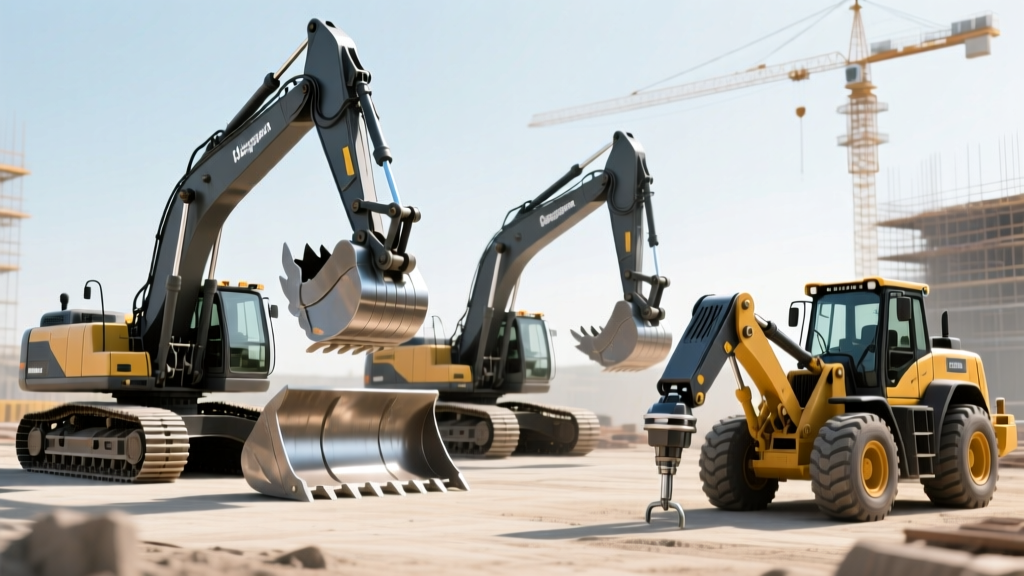
Mechanical demolition has largely superseded explosive implosion in urban environments due to stringent environmental regulations, adjacent structural risks, and the high value of recycled materials. The strategic selection of demolition attachments paired with appropriately sized excavators dictates project profitability. In 2026, the integration of 3D machine control and automated dust suppression directly into the attachment housing has redefined the operational baseline for tearing down reinforced concrete and structural steel.
Selecting the right heavy equipment in construction for demolition requires matching the carrier’s hydraulic flow (L/min) and operating pressure (bar) to the attachment’s specific requirements. Undersizing leads to cavitation and premature pump failure; oversizing causes thermal degradation of hydraulic seals and accelerated pin galling.
2026 Industry Benchmark: Top-tier demolition contractors are currently achieving a 22% reduction in fuel burn per ton of processed material by utilizing variable-displacement piston pumps paired with smart-flow hydraulic shear valves, compared to standard fixed-flow setups.Core Demolition Attachments: Specifications and Applications
The demolition sector relies on four primary attachment categories. Each serves a distinct material processing function, requiring specific carrier weight classes to maintain stability during high-reach or high-force operations.
| Attachment Type | Primary Target Material | Required Carrier Weight | Avg. Hydraulic Flow | Est. 2026 Price Range |
|---|---|---|---|---|
| Hydraulic Breaker | Thick concrete slabs, rock, trenching | 30 - 50 tons | 350 - 450 L/min | $45,000 - $75,000 |
| Demolition Shear | Structural steel (I-beams, H-piles) | 40 - 90 tons | 400 - 600 L/min | $120,000 - $185,000 |
| Concrete Pulverizer | Reinforced concrete, slab cracking | 20 - 45 tons | 250 - 350 L/min | $35,000 - $60,000 |
| Multi-Processor | Mixed C&D, rebar separation | 35 - 70 tons | 400 - 550 L/min | $90,000 - $140,000 |
Case Study 1: High-Rise Concrete Teardown via Mechanical Pulverization
Project Scope and Equipment Selection
A 14-story reinforced concrete parking structure in downtown Chicago required mechanical dismantling. The primary constraint was minimizing silica dust migration to adjacent active commercial properties, adhering to NIOSH silica exposure limits. The contractor deployed a Caterpillar 395 excavator equipped with an Epiroc DP 7000 demolition pulverizer featuring an integrated high-pressure water misting system.
Operational Data and ROI
- Processing Rate: 48 tons of reinforced concrete per hour.
- Rebar Recovery: The DP 7000’s integrated rebar cutter severed #8 and #10 rebar flush with the concrete, yielding a 94% clean steel recovery rate for scrap recycling.
- Dust Suppression: The on-tool misting system reduced airborne PM10 particulates by 78% compared to standard excavator-mounted water cannons, eliminating work stoppages for air-quality violations.
- Cost Efficiency: Total attachment and carrier operating cost averaged $14.50 per ton of processed material, undercutting the $22.00 per ton estimate for traditional wrecking-ball and secondary-crusher workflows.
Case Study 2: Industrial Steel Mill Decommissioning
The Challenge of High-Yield Steel
Decommissioning a 1970s-era steel mill in Pennsylvania involved cutting heavily corroded W24x176 I-beams and 2-inch thick gusset plates. Standard oxy-acetylene torching was prohibited due to lead-paint abatement protocols. The demolition team utilized a Komatsu PC800LC-11 paired with a LaBounty MSD7500R Universal Processor.
Hydraulic Tuning and Edge Cases
The MSD7500R requires a continuous operating pressure of 350 bar (5,075 psi) to generate its peak 1,500-ton jaw crushing force. During the first week, the crew experienced hydraulic overheating. The root cause: The excavator’s auxiliary hydraulic circuit was set to a continuous flow mode rather than an on-demand proportional mode, causing excess hydraulic fluid to bypass the relief valve and generate excessive heat.
Expert Insight: When pairing heavy equipment in construction with high-force shears, always program the carrier’s monitor to utilize 'Attachment Mode: Shear/Proportional'. This restricts flow strictly to the pedal input, dropping baseline hydraulic temperatures by up to 18°C during idle or positioning phases.
Once reprogrammed, the LaBounty shear processed 35 tons of structural steel per hour, cleanly shearing beams up to 30 inches wide without jaw deflection.
Decision Framework: Selecting the Right Demolition Setup
Contractors frequently misallocate equipment, using breakers for material processing or shears for concrete cracking. Use this framework to assign equipment:
IF Target = Unreinforced Concrete SlabsUSE: Hydraulic Breaker (e.g., Atlas Copco HB 4700).
WHY: High impact energy (12,000 Joules) fractures the matrix rapidly. Pulverizers will bounce off solid slabs without exposed edges to grip.IF Target = Reinforced Concrete Columns
USE: Multi-Processor / Pulverizer.
WHY: Jaws grip the concrete, crush it, and the secondary shear cuts the rebar. Breakers leave long, tangled rebar mats that require secondary torching.IF Target = Structural Steel Beams
USE: Demolition Shear.
WHY: Shears apply concentrated piercing force to pierce and cut steel. Pulverizers will suffer catastrophic jaw cracking if used on high-yield structural steel.IF Target = Mixed C&D / Interior Stripping
USE: Skid Steer with Demolition Grapple + Excavator with Sorting Grapple.
WHY: Precision sorting is required to separate copper wiring, drywall, and wood to meet EPA C&D recycling mandates.
Operational Edge Cases and Failure Modes
Even with correct equipment selection, heavy equipment in construction demolition faces severe mechanical stress. Recognizing these failure modes prevents catastrophic downtime.
1. Hydraulic Cavitation in Breakers
When an operator presses a hydraulic breaker against a surface before engaging the trigger, the nitrogen charge in the upper cylinder is compressed. Upon firing, the piston rebounds violently, creating a vacuum in the lower cylinder that boils the hydraulic fluid (cavitation). This implodes microscopically, eroding the cylinder walls and destroying the valve seals within 50 hours. Fix: Train operators to apply downward pressure only after the breaker begins striking, and release pressure immediately when the concrete breaks through.
2. Shear Blade Thermal Expansion
Continuous shearing of thick steel generates immense friction heat at the blade edges. If the shear’s adjustable gib (the guide keeping the moving jaw aligned) is set too tight, thermal expansion will cause the jaw to bind, snapping the main pivot pin. Fix: Maintain a strict 0.015-inch clearance on the gib shims, and rotate reversible shear blades every 400 operating hours.
3. Quick-Coupler Pin Galling
Frequent attachment changes in mixed-demolition sites cause wear on the quick-coupler pins. If grease grooves become packed with concrete dust, the pins will gall and seize, requiring torching to remove. Fix: Utilize automatic lubrication systems routed directly to the coupler pins, and specify hardened, diamond-coated pins for high-abrasion environments.
Summary of Strategic Teardown Execution
Profitability in modern demolition hinges on the precise calibration between carrier hydraulics and attachment mechanics. By leveraging 2026 advancements in on-tool dust suppression, variable-flow hydraulics, and specialized jaw geometries, contractors can drastically reduce secondary processing costs. The data from recent high-rise and industrial case studies confirms that matching the exact attachment to the material matrix—rather than relying on generalized buckets or undersized breakers—yields a 20% to 30% improvement in overall tonnage throughput and scrap recovery value.