Automatic Greasers for Heavy Equipment: Ag vs Construction Specs
Compare technical specs for automatic greasers for heavy equipment across agricultural and construction machinery, covering pressure, grease types, and ROI.
The Engineering Divide: Why Environment Dictates Lube Specs
Selecting the right lubrication architecture is not a one-size-fits-all engineering decision. While the fundamental goal of reducing friction remains constant, the operational realities of agricultural heavy equipment versus construction machinery demand vastly different technical specifications. Installing a system designed for a combine harvester onto a 30-ton excavator will result in catastrophic pin and bushing failures within weeks. Conversely, over-specifying a construction-grade system on a tractor leads to unnecessary capital expenditure and line-routing nightmares.
When evaluating automatic greasers for heavy equipment, fleet managers and maintenance engineers must align the pump displacement, metering valve architecture, line materials, and grease rheology with the specific environmental stressors of the machine's primary workspace. This guide breaks down the exact technical specifications, failure modes, and component selections required for agricultural versus construction applications.
How Automatic Greasers for Heavy Equipment Actually Work
Before diverging into sector-specific specs, it is critical to understand the two dominant metering architectures used in modern auto-lube systems:
1. Single-Line Parallel Systems
In a parallel system, a central pump pushes grease into a main supply line. Individual metering valves branch off this line. When the pump pressurizes the line, all valves discharge simultaneously into their respective bearings. Once a preset pressure is reached, the pump reverses or vents, allowing the valves to reset via internal springs. Advantage: If one bearing line clogs, the rest of the system continues to function. Disadvantage: It is difficult to monitor exactly which valve failed without advanced electronic cycle sensors.
2. Series Progressive Systems
Progressive systems route grease through a series of metering blocks. The grease must flow through the first piston to push the second, and so on. Advantage: Highly monitorable. If a single bearing line blocks, the entire system stops, triggering an immediate cab alarm. Disadvantage: A single blockage halts lubrication to the entire machine, which can be dangerous on high-wear construction attachments.
Engineering Insight: Modern 2026 fleet telematics increasingly favor series progressive systems paired with IoT pressure transducers. This allows maintenance teams to see exactly which metering block piston stalled via the machine's CAN bus network, reducing diagnostic time from hours to minutes.Agricultural Heavy Equipment: Specifying for Dust, Chemicals, and Seasonality
Agricultural machinery—such as Class 8 tractors, combines, and self-propelled forage harvesters—operates in environments defined by ultra-fine abrasive dust, highly corrosive chemical fertilizers, and distinct seasonal usage patterns. According to research from Penn State Extension, the primary cause of bearing failure in ag equipment is dust ingress acting as a lapping compound when grease purges are insufficient or improperly timed.
Technical Specifications for Ag Systems
- Pump Architecture: 12V or 24V DC electric pumps are standard. Hydraulic PTO-driven pumps are rarely used due to the need for lubrication while the tractor is idling or parked in the yard.
- Reservoir Capacity: Typically 2 kg to 4 kg (approx. 4 to 8 lbs). Ag machines have fewer lube points (usually 12 to 24) compared to earthmovers, and seasonal downtime allows for smaller reservoirs.
- Operating Pressure: 1,500 to 2,500 PSI. Ag pivot points and U-joints do not require the extreme breakaway pressures needed to push grease through heavily loaded excavator bucket pins.
- Line Material: Polyamide (nylon) tubing with push-to-connect fittings. Polyamide is highly resistant to the corrosive effects of anhydrous ammonia and liquid fertilizers, which will rapidly oxidize and degrade copper or standard steel lines.
- Grease Rheology: NLGI #2 Lithium Complex (e.g., John Deere Multi-Purpose HD) or NLGI #00 semi-fluid bio-based greases. Bio-greases are increasingly mandated in 2026 for equipment operating near waterways to prevent soil and water contamination in the event of a line rupture.
Construction Machinery: Specifying for Shock Loads and Submersion
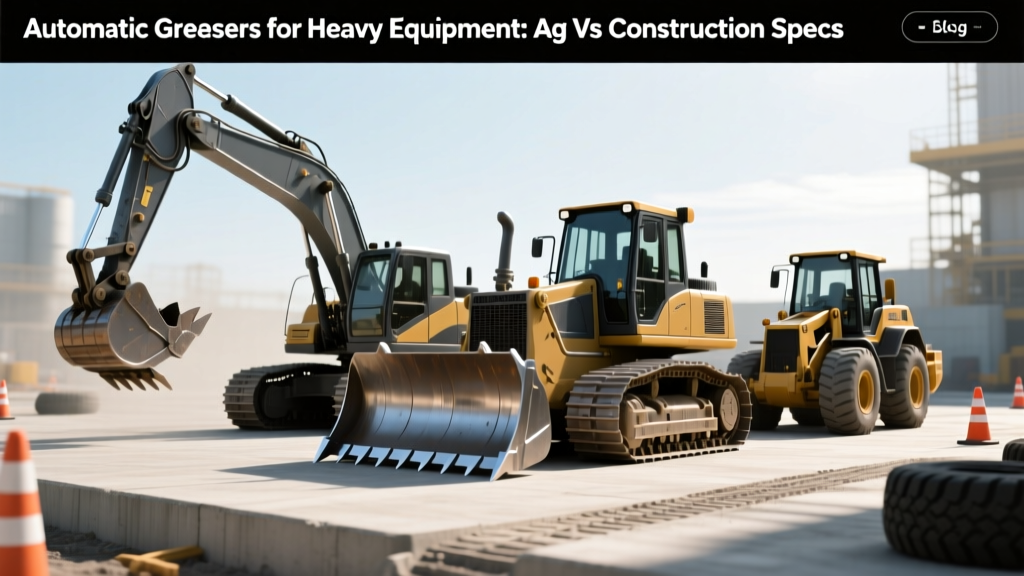
Construction equipment—excavators, wheel loaders, and bulldozers—faces high-impact shock loads, continuous 24/7 operation in mining or quarry settings, and total submersion in abrasive mud and clay. Data from SKF Group's lubrication division indicates that construction pivot points experience localized Hertzian contact stresses that can easily squeeze standard greases out of the load zone, requiring specialized extreme pressure (EP) formulations.
Technical Specifications for Construction Systems
- Pump Architecture: Hydraulic-driven piston pumps are the industry standard. They tap directly into the machine's auxiliary hydraulic circuit, providing immense volumetric output without relying on the machine's electrical alternator, which is often already maxed out by HVAC, lighting, and telematics.
- Reservoir Capacity: 8 kg to 15 kg (17 to 33 lbs), often equipped with heavy-duty mechanical or ultrasonic level indicators and internal agitation paddles to prevent grease separation in high-vibration environments.
- Operating Pressure: 3,500 to 4,500 PSI. Excavator bucket pins and dozer blade trunnions require massive pressure to overcome the physical load of the machine and push old, contaminated grease out of the seals.
- Line Material: Heavy-wall steel tubing or steel-braided hydraulic hoses for the main supply lines, stepping down to reinforced polyurethane only at the final articulation points. Exposed polyamide lines will be instantly severed by flying rocks or snagged rebar.
- Grease Rheology: NLGI #2 Molybdenum Disulfide (Moly) fortified grease (e.g., Mobilgrease XHP 322 Mine). The 3% to 5% moly content provides a solid-film lubricant barrier that prevents metal-on-metal galling during high-shock impacts.
Technical Comparison Matrix: Ag vs. Construction Auto-Lube
| Specification Parameter | Agricultural Equipment (e.g., Tractors, Combines) | Construction Equipment (e.g., Excavators, Dozers) |
|---|---|---|
| Primary Pump Drive | 12V/24V DC Electric | Hydraulic Piston (Aux Circuit) |
| System Pressure | 1,500 - 2,500 PSI | 3,500 - 4,500 PSI |
| Metering Architecture | Single-Line Parallel (often) | Series Progressive (mandatory) |
| Distribution Lines | Polyamide (Nylon) Tubing | Steel-braided hose / Steel tubing |
| Grease Formulation | Lithium Complex or Bio-based NLGI #2 / #00 | Moly-fortified EP NLGI #2 |
| Average Lube Points | 12 to 24 | 24 to 45+ |
| Typical Installed Cost | $2,200 - $3,500 | $4,500 - $7,500+ |
Cross-Application Failure Modes (What Happens When You Guess)
Misapplying systems between these two sectors is a common error among multi-sector fleet managers attempting to standardize inventory. The results are almost always destructive.
Edge Case 1: Bio-Grease in High-Load Excavator Pins
If a maintenance team loads an environmentally friendly, low-viscosity NLGI #00 bio-grease (intended for a combine harvester) into an excavator's auto-lube reservoir, the system will initially cycle fine. However, under the 40-ton breakout force of the excavator bucket, the bio-grease lacks the extreme-pressure (EP) additives and molybdenum film strength required to maintain the hydrodynamic wedge. The result is rapid boundary lubrication, leading to spalling, micro-welding, and catastrophic pin seizure within 200 to 300 operating hours.
Edge Case 2: Rigid Steel Lines on Articulated Tractors
Conversely, installing heavy-wall steel tubing on an articulated agricultural tractor to "make it tougher" ignores the machine's kinematics. Tractors experience high-frequency, multi-axis torsional twisting during PTO-heavy operations like mowing or tilling. Steel lines cannot absorb this continuous harmonic vibration and will work-harden, eventually cracking at the ferrule connections. The resulting grease leak will coat the tractor's undercarriage, attracting highly abrasive topsoil that acts like sandpaper on the universal joints.
Critical Maintenance Warning: Never mix grease formulations in a shared central reservoir. Mixing a Lithium Complex grease (Ag) with a Calcium Sulfonate or Moly grease (Construction) causes the thickeners to react chemically. This cross-contamination breaks down the grease matrix, turning it into a liquid sludge that will bypass the metering valves and leave bearings completely dry.Cost Analysis and ROI Timelines
The capital expenditure for automatic greasers for heavy equipment is easily justified when mapped against manual lubrication inefficiencies and premature wear component replacement.
- Agricultural ROI: A $2,800 system on a Class 8 tractor pays for itself in roughly 1.5 seasons. The primary savings come from eliminating the 45 minutes of daily manual greasing (labor savings) and extending the life of steering tie-rod ends and pivot pins, which cost $400–$800 each to replace.
- Construction ROI: A $6,000 hydraulic system on a 30-ton excavator achieves ROI in under 8 months. Replacing a single seized boom-to-stick pin and bushing set requires a crane, a press, and two mechanics for a full day, easily costing $3,500 in downtime and parts. Furthermore, proper auto-lube purging keeps abrasive silica dust out of the seals, extending undercarriage and attachment life by up to 30%.
Authoritative References
- Penn State Extension: Automatic Lubrication Systems for Farm Equipment - Technical guidelines on agricultural grease selection and dust ingress prevention.
- SKF Group: Automatic Lubrication Systems - Engineering specifications for heavy-duty progressive metering and high-pressure pump architectures.