Equipment Used to Lift Heavy Objects: Ag vs Construction Guide
Compare operator training for equipment used to lift heavy objects in agriculture vs construction. Covers load dynamics, terrain, and safety protocols.
The Core Divide: Sector-Specific Lifting Physics
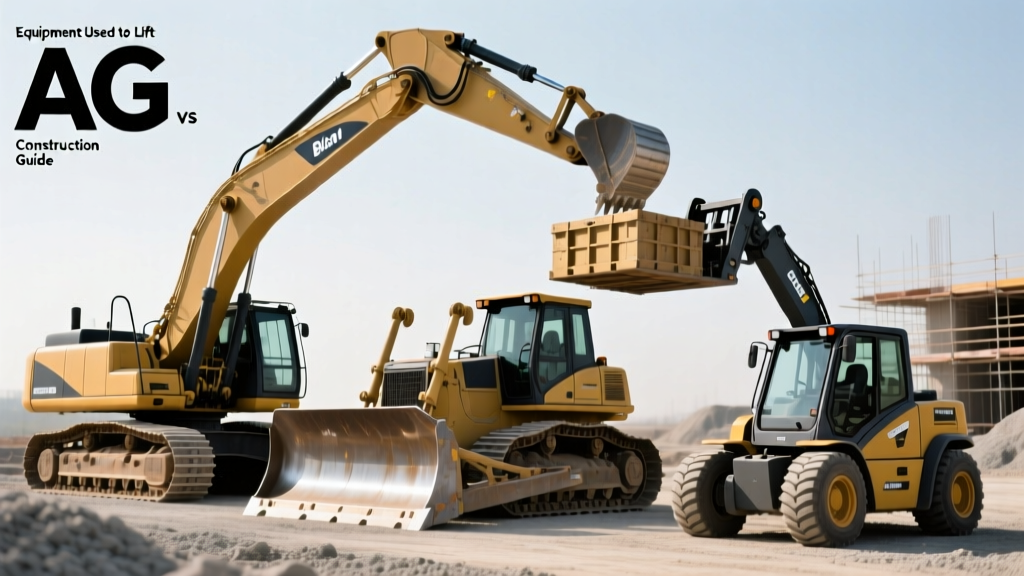
When fleet managers deploy the equipment used to lift heavy objects, the fundamental physics of the load and the ground conditions dictate the required training protocol. Agricultural and construction environments demand entirely different operational skill sets, even when the base machine—a telehandler or wheel loader—appears identical on paper. A JCB 530-70 Agri Plus moving high-moisture silage bales across a rutted field operates under vastly different mechanical stresses than a Manitou MT 1335 lifting palletized cinderblocks on a compacted commercial job site.
Operator training must bridge the gap between machine capability and environmental reality. Misapplying construction lifting principles to agricultural tasks, or vice versa, is a leading cause of catastrophic tip-overs and hydraulic failures. This guide dissects the specific training matrices required for heavy lifting equipment across both sectors, focusing on load dynamics, terrain variables, and attachment safety.
Agricultural Lifting: Managing Fluid Dynamics and Soft Terrain
Agricultural heavy equipment frequently operates on unimproved, soft, or uneven terrain. The primary machines utilized include articulating wheel loaders (like the John Deere 9620RX with an 800-series loader) and agricultural-spec telehandlers. The training focus here centers on variable-density loads and shifting centers of gravity.
The Slosh Effect and Variable Density
Unlike construction materials, agricultural loads are rarely static. Grain buckets, liquid manure tanks, and high-moisture round bales introduce complex fluid dynamics and shifting weight distributions. A 1,800 lb silage bale may leak moisture during a lift, altering its weight profile, while a grain bucket acts as a fluid load that sloshes forward when the boom is extended.
⚠️ WARNING: Dynamic Lateral Force in Ag LiftingWhen lifting fluid or semi-fluid agricultural loads, the slosh effect can amplify the dynamic lateral force on the telehandler chassis. A 2,000 lb static grain load can exert up to 2,800 lbs of dynamic forward force during rapid boom extension. Operators must be trained to 'feather' hydraulic controls, extending the boom at 20% throttle to prevent load swing and front-axle overload.
Euro-Coupler vs. ITA Carriage Safety
Agricultural telehandlers and tractors predominantly utilize hydraulic Euro-quick-couplers for attachments like bale spears and manure grapples. Training must emphasize hydraulic pressure release before manual intervention. Attempting to wiggle a seized Euro-coupler pin while the hydraulic system is still pressurized at 3,000 PSI is a frequent cause of severe injection injuries. Operators must be drilled on the 'lower, relieve, lock' sequence before dismounting the cab to adjust attachments.
Construction Lifting: Rigging, Load Charts, and Hard-Standing
Construction environments rely on precise load charts, engineered rigging, and hard-standing surfaces. The equipment used to lift heavy objects on these sites—such as rough-terrain cranes (e.g., Tadano GR-300EXL) and heavy-duty telehandlers—requires operators to understand structural rigging, wind-load limits, and ground bearing pressure.
Load Moment Indicators (LMI) and Sling Angles
Construction operators must master the onboard Load Moment Indicator (LMI) systems found on modern cranes and heavy telehandlers. Unlike Ag operators who rely heavily on visual estimation and machine 'feel', construction lifting requires mathematical precision. Training must cover sling angle tension calculations; for example, using a two-leg wire rope sling at a 30-degree angle from horizontal increases the tension on each leg by 100% compared to the actual load weight. Ignoring this multiplier is a primary cause of snapped rigging and dropped steel I-beams.
Outrigger Deployment and Ground Bearing Pressure
While Ag machines rely on tire footprint and articulation for stability, construction lifting equipment requires outriggers. Operators must be trained to calculate Ground Bearing Pressure (GBP). Deploying outriggers directly onto uncured asphalt or unverified backfill without proper crane mats (like the 4x4 foot TuffDeck mats rated for 80,000 lbs) can lead to immediate punch-through and machine overturn.
Operator Training Matrix: Ag vs. Construction
Fleet managers overseeing mixed-use equipment must implement sector-specific training modules. The table below outlines the critical divergence in operational focus.
| Training Module | Agricultural Focus | Construction Focus |
|---|---|---|
| Load Dynamics | Fluid slosh, moisture loss, shifting organic matter | Static dense loads, wind-sail effect on wide panels |
| Terrain & Stability | Soft soil, deep ruts, 15-degree lateral slopes | Compacted gravel, trench edges, outrigger pad placement |
| Attachment Coupling | Hydraulic Euro-couplers, PTO-driven grapples | ITA fork carriages, hydraulic thumb buckets |
| Primary Failure Mode | Rear-axle lift due to soft ground rutting | Outrigger punch-through or rigging snap |
Cross-Sector Crossovers: The Telehandler Dilemma
The most significant training gap occurs when a single machine, such as a Manitou or JCB telehandler, is transitioned between farm and construction duties. The machine's Rated Capacity Indicator (RCI) does not change, but the operational context does. An operator trained strictly on construction sites may attempt to drive a fully elevated telehandler across a soft farm field, unaware that the agricultural soil lacks the shear strength to support the dynamic point-loads of the tires. Conversely, an agricultural operator may attempt to lift a 4,000 lb steel HVAC unit using unrated bale spears instead of engineered pallet forks, leading to catastrophic attachment failure.
💡 Best Practice: The Dual-Certification ProtocolIf your fleet utilizes telehandlers across both sectors, operators must hold dual certifications. They must complete OSHA-compliant Powered Industrial Truck (PIT) training for construction environments and specialized agricultural loader safety training. Never assume a certified forklift operator can safely manage a front-end loader in a muddy feedlot.
Certification and Compliance Frameworks
Regulatory bodies treat the equipment used to lift heavy objects differently based on the industry classification. Compliance is not optional, and training documentation must be kept on-site for auditing.
- Construction Cranes & Telehandlers: Operators must comply with OSHA 1926.1400 Cranes and Derricks in Construction. For telescopic boom cranes and heavy telehandlers used in hoisting, operators are required to hold third-party certification, such as the NCCCO Telescopic Boom Crane certification. This requires rigorous written and practical exams focusing on load charts and rigging.
- Agricultural Loaders & Telehandlers: While OSHA's general industry standards (1910.178) apply to some farm equipment, agricultural exemptions often exist for family-owned farms. However, commercial agricultural operations and large-scale corporate farms must adhere to strict safety protocols. Training should align with guidelines from university extensions and the American Society of Agricultural and Biological Engineers (ASABE), focusing on rollover protective structures (ROPS) and falling object protective structures (FOPS).
- Pre-Shift Inspections: Both sectors mandate documented pre-shift inspections. Construction requires checking LMI sensors, anti-two-block devices, and wire rope wear. Agriculture requires checking hydraulic hose weeping, Euro-coupler locking pins, and tire sidewall integrity for dry rot or deep lug tearing.
Final Training Directives for Fleet Managers
Do not rely on generic heavy equipment training videos. The physics of lifting a 2,000 lb pallet of concrete on a hard-packed commercial site is entirely divorced from lifting a 2,000 lb sloshing tank of liquid fertilizer on a 10-degree muddy incline. Invest in sector-specific, hands-on evaluations that test an operator's ability to read terrain, calculate dynamic load shifts, and execute emergency hydraulic lowering procedures. The cost of specialized training is negligible compared to the financial and human toll of a mismanaged heavy lift.