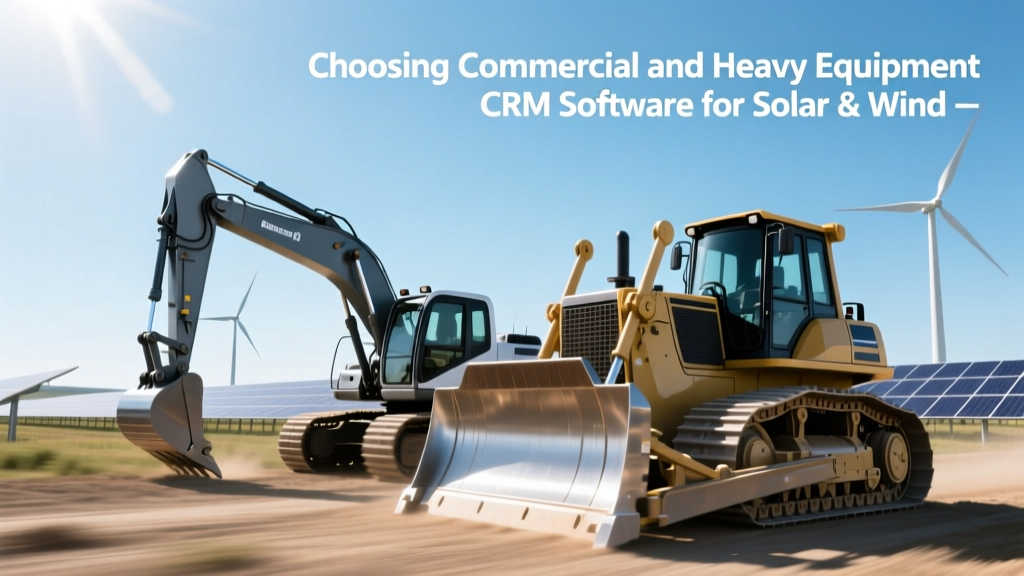
Choosing Commercial and Heavy Equipment CRM Software for Solar & Wind
Discover how to select the right commercial and heavy equipment CRM software to manage solar pile drivers and wind farm crawler cranes in 2026.
Deploying heavy machinery for renewable energy construction is fundamentally different from traditional commercial building. Wind farm installations require 1,700-tonne crawler cranes and complex oversize load logistics, while utility-scale solar arrays demand high-speed, GPS-guided pile drivers. For equipment dealers and rental companies, managing these highly specialized assets requires more than a generic sales pipeline. Selecting the right commercial and heavy equipment CRM software is critical to tracking asset utilization, coordinating transport permits, and winning bids in the booming clean energy sector.
The Renewable Equipment Gap in Standard CRMs
Most out-of-the-box CRM platforms are designed for high-volume, low-complexity sales. They fail catastrophically when applied to heavy equipment for renewable energy. According to data from the American Clean Power Association, the average modern onshore wind turbine now exceeds 3 megawatts, requiring specialized heavy-lift equipment like the Liebherr LR 17000-2.0. Moving this single crane requires over 130 truckloads and specialized route surveys.
A standard CRM tracks 'opportunities' and 'contacts.' A heavy equipment CRM tailored for renewables must track 'asset configurations,' 'attachment compatibility,' and 'transport permit expirations.' If your sales team bids on a 50-turbine wind project without real-time visibility into whether your fleet's luffing jibs are currently deployed on another site, you risk a catastrophic fulfillment failure.
Mandatory Modules for Wind and Solar Fleet Management
When evaluating commercial and heavy equipment CRM software for renewable energy clients in 2026, ensure the platform natively supports the following specialized modules:
Warning: Telematics SilosDo not accept a CRM that requires manual entry of engine hours. The system must support AEMP 2.0 telematics standards to pull real-time API data directly from CAT Connect, John Deere JDLink, and Liebherr LiDAT into the asset's CRM profile.
1. Attachment and Configuration Matrix
Renewable equipment is rarely sold or rented as a single SKU. A Vermeer PD10 solar pile driver might require specific hammer attachments depending on the soil composition (e.g., bedrock vs. sandy loam) identified in the client's geotechnical report. The CRM must allow sales reps to bundle attachments and automatically flag compatibility errors before the quote is generated.
2. Oversize Logistics and Permit Tracking
Wind farm construction relies on massive components. The CRM must integrate with your logistics ERP to track state-by-state oversize transport permits. If a permit expires in 14 days, the CRM should automatically block that specific lowboy trailer from being quoted on a new 30-day rental agreement.
3. Geofence and Utilization Forecasting
Solar farms span thousands of acres. Advanced CRMs now ingest GPS boundary data to track exactly how many linear feet of pile driving a machine has completed versus the project total, allowing for predictive maintenance scheduling based on hydraulic hammer strikes rather than just engine hours.
2026 Software Matrix: Top Contenders for Renewable Fleets
Below is a comparative analysis of the leading platforms handling heavy equipment sales and rentals in the renewable sector this year.
| Platform | Best Application | 2026 Base Pricing | Telematics API | Primary Weakness |
|---|---|---|---|---|
| HCSS HeavyJob + CRM | Contractors managing internal fleets & rentals | ~$250/user/month | Native AEMP 2.0 | Steep learning curve for pure sales teams |
| Dealerware | High-volume equipment rental dealerships | ~$180/user/month | Strong OEM integrations | Lacks deep wind-transport logistics modules |
| Salesforce Heavy Equipment Cloud | Enterprise dealers with complex, multi-year bids | $300+/user/month | Requires MuleSoft middleware | High implementation cost ($40k+) |
Edge Case Scenario: Bidding on a 150-Megawatt Solar Project
To understand the value of specialized commercial and heavy equipment CRM software, consider a real-world bidding scenario for a 150-megawatt utility-scale solar farm in West Texas. The EPC (Engineering, Procurement, and Construction) contractor requires 40,000 steel H-piles driven into highly abrasive caliche soil.
'Generic CRMs treat a pile driver as a simple rental asset. In reality, driving 40,000 piles in caliche requires tracking hammer bit wear rates, scheduling mid-project tooling replacements, and coordinating fuel trucks across a 2,000-acre site. If your software cannot model this operational reality, your bid will either be too high to win or too low to be profitable.'
Here is how a properly configured heavy equipment CRM handles this RFP:
- Asset Allocation: The system checks the availability of four Vermeer PD10s and cross-references their hydraulic hammer strike logs to ensure none are due for a 5,000-strike rebuild during the 90-day project window.
- Consumables Forecasting: Based on the geotechnical soil report uploaded to the CRM opportunity record, the system automatically calculates the required number of sacrificial pile caps and adds them to the quote.
- Maintenance Routing: The CRM triggers a work order for a mobile service technician to be dispatched to the specific GPS coordinates of the solar array at day 45 for preventive hydraulic hose replacement.
Implementation Costs and Hidden Fees
When budgeting for commercial and heavy equipment CRM software, the SaaS licensing fee is only the beginning. Renewable energy equipment dealers must account for data migration and API middleware costs.
Typical 2026 Implementation Budget (Mid-Size Dealer)
- Core SaaS Licensing (15 users): $32,400 / year
- ERP Integration (e.g., SAP to CRM): $18,000 - $25,000 one-time
- Telematics API Mapping: $8,500 one-time
- Custom Wind-Transport Module Build: $12,000 one-time
- Total Year 1 Investment: ~$70,900 to $77,900
According to research from the National Renewable Energy Laboratory (NREL), logistical delays and equipment downtime are among the highest cost drivers in wind plant balance-of-systems construction. Investing heavily in software that prevents these delays yields an ROI typically realized within 14 months through avoided demurrage charges and optimized fleet utilization.
Decision Framework: Which System Fits Your Fleet?
Use this practical framework to select the right platform based on your specific operational profile:
- IF your primary business is short-term rentals of solar trenchers and skid steers to local contractors, THEN choose Dealerware. Its strength lies in rapid contract generation, delivery routing, and high-volume asset turnover.
- IF you are an earthmoving contractor who occasionally rents out your own idle excavators and dozers to wind farm developers, THEN choose HCSS. It bridges the gap between internal job costing and external rental management seamlessly.
- IF you are an enterprise OEM dealer managing multi-million-dollar, multi-year sales and lease agreements for 800-ton crawler cranes and custom heavy-lift attachments, THEN choose Salesforce Heavy Equipment Cloud. The high implementation cost is justified by the need for complex CPQ (Configure, Price, Quote) logic and global supply chain visibility.
Managing heavy equipment for renewable energy construction requires precision, foresight, and deep data integration. By selecting a CRM that understands the physical and logistical realities of wind and solar deployment, equipment dealers can transition from simple vendors to indispensable strategic partners in the global energy transition.