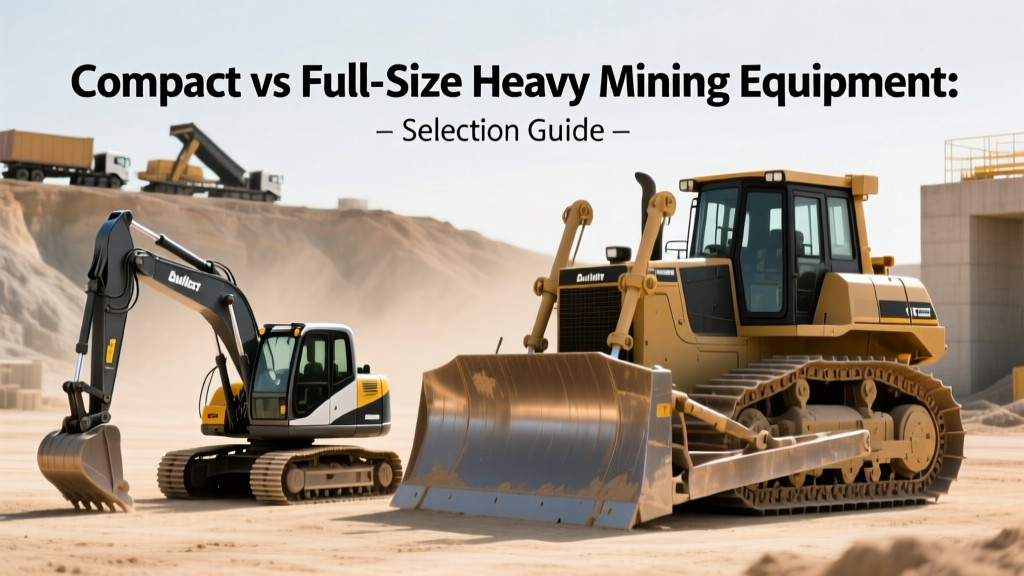
Compact vs Full-Size Heavy Mining Equipment: Selection Guide
Compare compact vs full-size heavy mining equipment. Discover TCO data, model specs, and site-specific selection frameworks for quarry and mine ops.
Scale-Matching in Modern Extraction Operations
Matching equipment scale to extraction geometry and site infrastructure is the primary driver of unit cost per ton in surface mining and quarrying. While 90-ton class excavators and 100-ton articulated dump trucks dominate the primary pit, compact construction machinery plays a critical, high-ROI role in processing plant maintenance, tailings management, and utility trenching. Selecting the wrong scale of heavy mining equipment for a specific task results in catastrophic undercarriage wear, excessive fuel burn, or severe ground compaction in sensitive areas.
2026 Operational Reality: With Tier 4 Final and Stage V emissions standards fully integrated into global fleets, the fuel penalty for idling full-size mining equipment during precision plant maintenance tasks now exceeds $45 per hour in combined fuel and DEF costs. Mine managers are increasingly deploying compact units for non-extraction tasks to protect primary fleet hour-meters and reduce site-wide carbon intensity.The Scale-Matching Decision Matrix
Before evaluating specific models, operations must classify the task. The table below outlines the mechanical and economic thresholds that dictate whether a job requires full-scale mining earthmovers or compact utility equipment.
| Operational Metric | Full-Size Mining Equipment | Compact Construction Equipment |
|---|---|---|
| Primary Application | Overburden removal, primary extraction, main haul roads | Plant cleanup, conveyor skirt-board repair, sump trenching |
| Ground Pressure (PSI) | 18 - 28 PSI (Requires engineered haul roads) | 3.5 - 6.0 PSI (Operates on raw tailings, muddy sumps) |
| Hydraulic Flow Rate | 150+ GPM @ 5,000+ PSI (Dual variable displacement) | 40 - 65 GPM @ 3,500 PSI (Gear or axial piston pumps) |
| Mobilization Footprint | Requires multi-trailer lowboys, escort vehicles, disassembly | Single standard flatbed or tow-behind trailer deployment |
| Capital Cost Range | $1.2M - $2.5M+ per unit | $85,000 - $160,000 per unit |
Full-Size Heavy Mining Equipment: The Primary Movers
Full-size mining excavators and haul trucks are engineered for continuous, high-volume cyclic loading. Machines like the Komatsu PC1250-8 (120-ton class) or the Caterpillar 777G (100-ton ADT) are measured by their swing torque, breakout force, and payload consistency.
Performance and Economics
- Breakout Force: A PC1250-8 generates over 130,000 lbf of bucket breakout force, necessary for penetrating blasted hard rock and heavily consolidated overburden without relying on excessive hydraulic relief valve cycling.
- Fuel Burn & Idle Penalty: These machines consume 50 to 65 gallons of diesel per hour under active load. If deployed for precision tasks like clearing material around a primary jaw crusher, the idle time and low-load fuel inefficiency destroy the unit's cost-per-ton metrics.
- Undercarriage Wear: In abrasive silica and hard rock environments, standard track links on 100-ton excavators require rebuilds every 4,000 to 6,000 hours, costing upwards of $120,000 per undercarriage replacement.
Safety Note: According to NIOSH Mining Equipment Research, blind spots on full-size mining excavators and haul trucks remain a leading cause of fatal site incidents. Deploying 100-ton machines in confined processing plant areas drastically increases the risk of collision with ground-level personnel and light utility vehicles.
Compact Equipment in Mining Contexts: The Precision Tools
Compact construction equipment—specifically Compact Track Loaders (CTLs) and mini-excavators in the 3-to-8-ton range—solves the spatial and ground-bearing limitations of the mine site. Models like the Bobcat T870 CTL and the Kubota KX040-4 mini-excavator are indispensable for maintaining the infrastructure that supports the primary fleet.
Niche Mining Applications
- Conveyor Belt Skirt-Board Maintenance: Replacing worn rubber skirt-boards on overland conveyors requires operating directly beneath the structure. A 4-ton mini-excavator with a zero-tail-swing profile can navigate 8-foot clearances and use a hydraulic tilt-rotator to precisely position steel clamps and rubber seals.
- Tailings Pipe Trenching: Extending HDPE tailings discharge pipes across unconsolidated, saturated sand requires ultra-low ground pressure. A CTL equipped with 20-inch wide polyurethane tracks exerts less than 4.0 PSI, preventing the machine from sinking into the slurry basin while maintaining traction.
- Crusher Grizzly Clearing: When oversize boulders block the primary grizzly, a compact excavator fitted with a 2,000-lb hydraulic hammer can break the rock in situ without requiring the primary 90-ton excavator to abandon the loading face and tram to the plant.
Total Cost of Ownership (TCO) & Hourly Burn Rates
Comparing the TCO of heavy mining equipment against compact alternatives requires isolating the variable costs of ground engagement tools and fuel. The data below reflects 2026 average operational costs for hard rock quarry environments.
| Cost Category (Hourly) | Full-Size (e.g., Cat 777G ADT) | Compact (e.g., Bobcat T870 CTL) |
|---|---|---|
| Fuel & DEF | $210.00 - $260.00 | $14.00 - $18.00 |
| Ground Engagement (Tires/Tracks) | $35.00 (Massive off-road tires) | $4.50 (Rubber track replacement) |
| Scheduled Maintenance Lube/Filters | $28.00 | $3.50 |
| Estimated Total Variable Cost | ~$273.00 - $323.00 / hr | ~$22.00 - $26.00 / hr |
When a mine operation uses a $1.8M articulated dump truck to haul 10 tons of spillage away from the primary crusher, the hourly variable cost exceeds $300 for a task a $135,000 compact track loader can perform for $25 per hour. Furthermore, data tracked by MSHA Mine Statistics and Reports consistently highlights that heavy vehicle traffic in confined plant zones correlates with higher property damage and near-miss incident rates.
Site-Specific Selection Protocol
Mine planners and fleet managers should implement this 4-step protocol before authorizing equipment deployment to a new site zone:
Step 1: Define the Ground Bearing Capacity (GBC)
Test the operating surface. If the zone is a saturated tailings dam or an unengineered access road with a GBC below 15 PSI, full-size heavy mining equipment is strictly prohibited. Deploy wide-track compact loaders.
Step 2: Calculate the Spatial Envelope
Map the overhead and lateral clearances. If the task involves working within 15 feet of active processing plant infrastructure (silos, conveyors, electrical substations), the tail-swing radius of full-size excavators presents an unacceptable collision risk. Utilize zero-tail-swing (ZTS) compact excavators.
Step 3: Match Hydraulic Attachment Requirements
Determine if the task requires high-flow hydraulics. Tasks like operating large-scale diamond wire saws or heavy rock drills require 60+ GPM. If the compact machine's auxiliary flow is insufficient, a mid-size (15-ton class) wheel loader or excavator must bridge the gap between compact and full-size fleets.
Step 4: Evaluate Mobilization Frequency
If the equipment must be relocated across multiple pit benches or distant plant facilities daily, the mobilization cost of full-size equipment (requiring dedicated lowboy trailers and crane lifts) will negate its production advantages. Compact equipment can be moved via standard site service trucks with tilt-bed trailers.
Final Procurement Directive
Do not view compact construction equipment as a mere substitute for scaled-down mining tasks; view it as a specialized precision tool. Allocate capital expenditures (CapEx) to acquire dedicated compact fleets with sealed and lubricated (SALT) track chains and heavy-duty guarding packages specifically designed to survive the abrasive, high-dust environment of the mine site, rather than relying on standard landscaping-spec machines that will suffer premature hydraulic cylinder scoring and track failure.