Diesel and Heavy Equipment Technology: Underground Mining Alternatives
Compare diesel and heavy equipment technology with BEV alternatives for underground mining. Analyze CapEx, ventilation, and TCO for LHDs and haulers.
The Shift in Underground Haulage: Diesel vs. Battery Electric
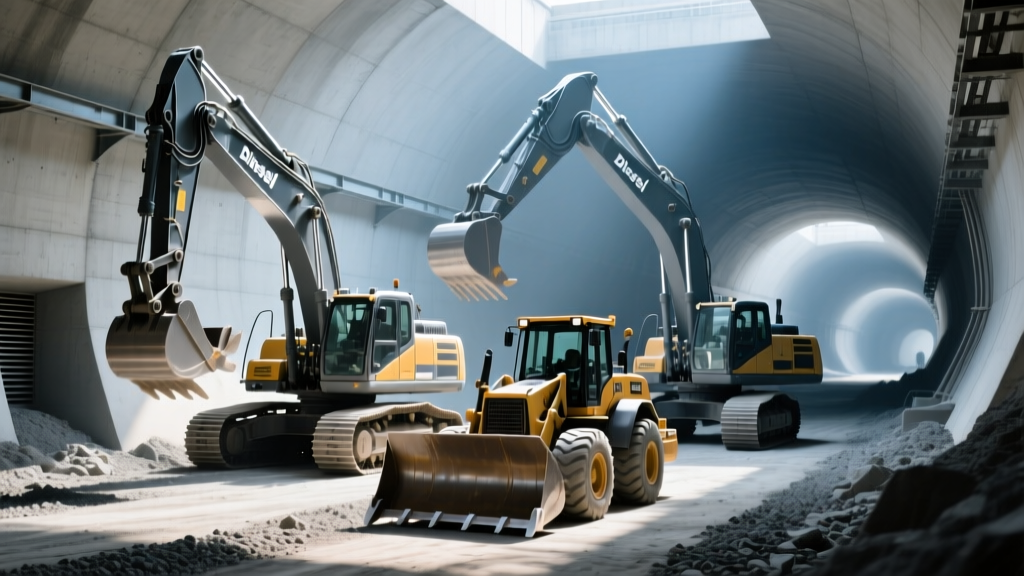
The selection of underground mining equipment types dictates both the operational ceiling and the baseline cost structure of a hard rock mine. For decades, the industry standard has relied heavily on traditional diesel and heavy equipment technology to power Load-Haul-Dump (LHD) loaders and underground haul trucks. However, as mines push past 1,000-meter depths, the thermodynamic and ventilation penalties of internal combustion engines have forced a rigorous comparison with Battery Electric Vehicles (BEV). This analysis breaks down the technical specifications, total cost of ownership (TCO), and failure modes of Tier 4 Final diesel fleets versus LFP (Lithium Iron Phosphate) battery-electric alternatives.
Baseline: Tier 4 Final Diesel Loaders and Haulers
Modern diesel underground equipment, such as the Caterpillar R1700G (10-tonne payload LHD) and the Epiroc Minetruck MT42 (42-tonne capacity haul truck), utilizes advanced Tier 4 Final emissions reduction systems. These machines rely on Diesel Oxidation Catalysts (DOC) and Diesel Particulate Filters (DPF) to scrub particulate matter (PM) and nitrogen oxides (NOx) from the exhaust.
The Ventilation Penalty
The primary operational constraint of diesel equipment is the massive ventilation infrastructure required to dilute exhaust gases and manage heat rejection. According to NIOSH guidelines on diesel exhaust, underground regulations typically mandate a minimum airflow of 0.06 cubic meters per second (m³/s) for every kilowatt (kW) of rated engine power.
- Engine Output: A standard 17-tonne class diesel LHD produces roughly 200 kW.
- Airflow Requirement: 200 kW × 0.06 m³/s = 12 m³/s of continuous fresh air per machine.
- Infrastructure Cost: Sinking a secondary ventilation shaft to support a 10-machine diesel fleet at 1,200 meters depth costs between $12M and $18M USD, alongside $2.5M in annual shaft-fan electricity costs.
In high-humidity underground environments (above 85% RH), unburned hydrocarbons and water vapor condense inside the DPF matrix. This causes rapid passive regeneration failure, forcing operators to pull the LHD from production for active baking or filter replacement every 400-500 hours, costing roughly $3,200 per incident in lost time and parts.
The BEV Alternative: LFP Battery Electric Fleets
Battery Electric Vehicles represent the most viable alternative to diesel in confined subterranean environments. Leading models like the Sandvik Artisan A14 (14-tonne payload) and Epiroc ST7 Battery utilize Lithium Iron Phosphate (LFP) battery chemistry rather than the Nickel Manganese Cobalt (NMC) found in consumer EVs.
Why LFP Chemistry Dominates Underground
LFP batteries offer a lower energy density than NMC but provide superior thermal stability. In an underground mine where ambient rock temperatures can exceed 35°C at depth, the risk of thermal runaway is a critical safety hazard. LFP cells do not release oxygen during decomposition, effectively eliminating the risk of self-sustaining battery fires in confined, poorly ventilated drifts. For deeper technical specifications on electrified fleets, refer to the Sandvik Mining and Rock Solutions technical documentation.
Infrastructure: Battery Swap vs. Fast Charge
BEV operations require a paradigm shift in energy delivery. The industry has largely standardized on automated battery swapping over plug-in fast charging to maintain utilization rates.
- Automated Swap Stations: Cost approximately $150,000 USD per installation. The Sandvik Artisan series can drop and swap a depleted 100 kWh battery pack for a fully charged one in under 6 minutes without the operator leaving the cabin.
- Plug-in Fast Charging: Requires 150 kW DC fast chargers ($45,000 each) and forces a 45-minute downtime penalty per shift, reducing overall equipment effectiveness (OEE) by 12%.
Head-to-Head Comparison Matrix
| Metric | Tier 4 Diesel LHD (e.g., Cat R1700G) | BEV LHD (e.g., Sandvik Artisan A14) |
|---|---|---|
| Base CapEx | $450,000 - $520,000 | $720,000 - $850,000 (includes 1 battery) |
| Energy Cost per Tonne-km | $0.14 - $0.18 (Diesel @ $1.40/L) | $0.04 - $0.06 (Grid Power @ $0.12/kWh) |
| Ventilation Requirement | 12 m³/s per machine | 2 m³/s per machine (heat/brake dust only) |
| Drivetrain Maintenance | High (Engine rebuilds, transmission, DPF) | Low (Electric motors, no fluid changes) |
| Heat Rejection to Mine Air | ~250 kW of waste heat | ~40 kW of waste heat |
Total Cost of Ownership (TCO) Decision Framework
Choosing between diesel and heavy equipment technology versus BEV alternatives is not a matter of environmental preference; it is a strict mathematical calculation based on mine depth, production scale, and local energy tariffs.
The 800-Meter Break-Even Rule
For shallow mines (under 400 meters), the high CapEx of BEV equipment and battery swap stations cannot be recouped before the mine's life ends. However, once a mine descends past 800 meters, the cost of primary ventilation and refrigeration (to combat auto-compression heating and diesel heat rejection) scales exponentially.
The TCO Crossover Point: A 10-machine fleet transitioning from diesel to BEV at 1,000 meters depth will typically offset the $3.5M CapEx premium within 3.2 years. This is achieved by downsizing the main surface ventilation fans by 60%, saving roughly $1.1M annually in fan electricity and shaft maintenance, combined with a 70% reduction in direct machine fuel costs.
When to Retain Diesel
Stick to Tier 4 diesel alternatives if your operation meets any of the following criteria:
- The mine has a remaining life of less than 5 years.
- Grid power is highly unstable or relies on expensive diesel-generated microgrids on the surface (which defeats the purpose of underground electrification).
- The operation utilizes highly fragmented, narrow-vein stoping methods where deploying standardized battery swap infrastructure is spatially impossible.
Real-World Failure Modes and Edge Cases
Both technologies present distinct mechanical and operational vulnerabilities that mine planners must engineer around.
Diesel Vulnerabilities
- EGR Valve Carbon Fouling: In low-speed, high-load tramming applications, Exhaust Gas Recirculation (EGR) valves carbonize rapidly, leading to engine derating. Solution: Mandate 15-minute high-RPM burn-off cycles at the end of every shift.
- Ground Fuel Storage Degradation: Underground diesel day-tanks suffer from microbial growth (diesel bug) in high humidity, clogging injectors. Solution: Implement weekly fuel polishing and biocide dosing.
BEV Vulnerabilities
- Inverter Coolant Leaks: The liquid cooling systems for BEV traction inverters use glycol mixtures. Underground vibrations and hanging wall vibrations from production blasting frequently crack rigid coolant lines, causing inverter short-circuits. Solution: Specify equipment with braided, flexible hose routing for all high-voltage cooling loops.
- Opportunity Charging Degradation: Operators frequently 'top off' LFP batteries during lunch breaks. While LFP tolerates this better than NMC, chronic partial-cycling without periodic 100% calibration cycles confuses the Battery Management System (BMS), leading to premature cell-balancing failures. Solution: Enforce a strict protocol requiring one full 100% charge cycle per week per battery pack.
Sourcing and Implementation Strategy
When transitioning from traditional diesel and heavy equipment technology to electric alternatives, do not attempt a 1:1 fleet replacement. BEVs offer higher utilization rates due to zero engine-warmup times and less planned maintenance downtime. A standard operational ratio dictates that 7 BEV loaders can replace 9 diesel loaders to achieve the same annual tonnage, provided the battery swap infrastructure is located within 200 meters of the active production faces. Procure the battery swap stations concurrently with the mobile fleet, and ensure your mine's electrical reticulation has the capacity for the 250 kW continuous draw required per charging bay.