Heavy Machinery Safety in Underground Mining Equipment Applications
Analyze heavy machinery safety in underground mining equipment applications, featuring LHD proximity case studies, drill jumbo specs, and retrofit costs.
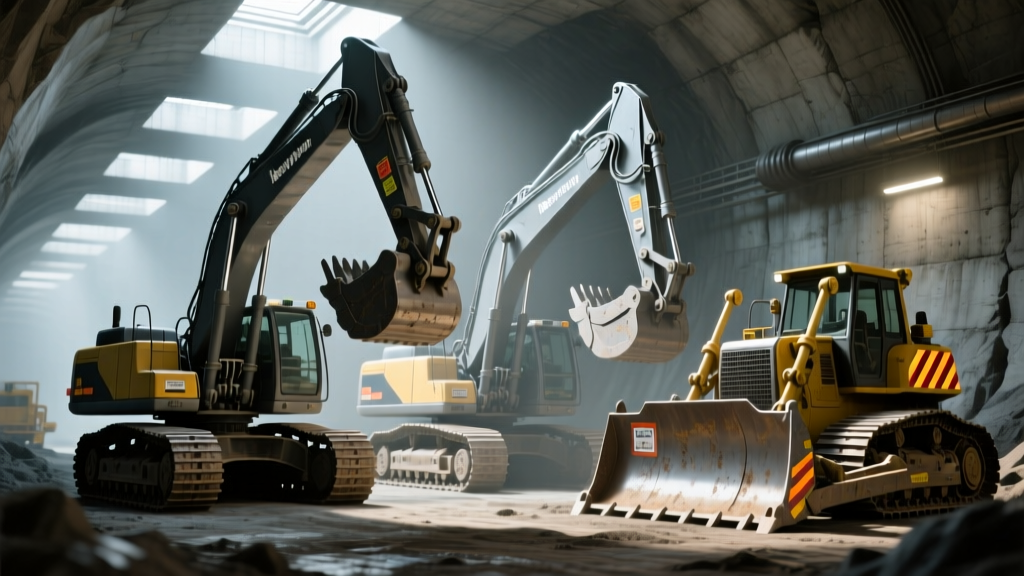
Underground mining environments impose extreme kinetic and environmental constraints on mobile equipment. Confined drifts—typically measuring 5.0 meters wide by 4.5 meters high for main haulages—combined with poor lighting, high dust concentrations, and massive blind spots, elevate the operational risk profile significantly. Achieving rigorous heavy machinery safety in these subterranean applications requires moving beyond basic compliance and integrating advanced proximity detection, automated cabin pressurization, and collision avoidance systems (CAS) directly into the equipment's CAN-bus architecture.
The Core Fleet: Underground Equipment Profiles & Safety Specifications
Modern underground fleets are dominated by specialized loaders, haulers, and drill rigs. The safety architecture of these machines is governed by strict international standards, including ISO 3450 for earth-moving machinery braking systems and EN 15695 for cabin air filtration. Below is a technical breakdown of current Tier-1 underground equipment and their native safety integrations.
| Equipment Model | Classification | Payload / Capacity | Core Safety Architecture | Approx. Base Price (USD) |
|---|---|---|---|---|
| Sandvik TH551i | Underground Haul Truck | 51 Tonnes | AutoMine readiness, ROPS/FOPS certified cabin, integrated weighing & speed monitoring | $1,150,000 |
| Cat R2900G | Load-Haul-Dump (LHD) | 17.2 Tonnes | Command for Underground compatibility, SAHR brakes, pressurized cabin | $890,000 |
| Epiroc Boomer S2 | 2-Boom Drill Jumbo | N/A (Drilling Rig) | EN 15695 Category 4 cabin filtration, RCS 5 control system, anti-collision sensors | $1,350,000 |
| MacLean TM3 | Battery Electric Transmixer | 12 Cubic Meters | Zero-emission drivetrain (eliminates exhaust toxicity), 360-degree camera arrays | $950,000 |
Case Study 1: UWB Proximity Detection in LHD Operations
A persistent hazard in underground development and production is the interaction between pedestrians and Load-Haul-Dump (LHD) loaders. The rear-articulated steering of an LHD like the Cat R2900G creates a severe tail-swing hazard, often exceeding 1.5 meters of lateral displacement in narrow drifts.
In a 2025 application at a high-grade gold operation in Western Australia, mine management retrofitted a fleet of twelve legacy LHDs with an Ultra-Wideband (UWB) Collision Avoidance System. Unlike legacy RFID systems that merely detect presence within a 10-meter bubble, UWB technology provides spatial awareness with 10-centimeter accuracy, allowing the system to map the exact vector and speed of approaching personnel wearing active tags.
Implementation Metrics & ROI
- Retrofit Cost: $18,500 per machine (including UWB node, cabin display, and CAN-bus integration module).
- Tag Distribution: $340 per active personnel tag (battery life: 14 months).
- Result: 68% reduction in vehicle-to-pedestrian near-miss incidents within the first 90 days.
- Machine Intervention: The CAS was hardwired to the LHD's transmission controller to force a neutral-idle state if a tagged worker breached the 3-meter red zone.
According to data published by the NIOSH Mining Program, proximity detection systems that include machine intervention (automatic braking or engine derating) are exponentially more effective at preventing fatalities than alarm-only systems, which suffer from operator alarm fatigue in high-noise environments exceeding 95 dB(A).
Case Study 2: Automated Drill Jumbos and Silica Dust Mitigation
Heavy machinery safety extends beyond kinetic collisions to environmental hazards. Dry drilling into quartzite and sandstone formations generates respirable crystalline silica (RCS). When operating an Epiroc Boomer S2 drill jumbo, the operator is positioned less than four meters from the rock face during drilling and bolting cycles.
The safety intervention here relies on the cabin's HVAC and filtration architecture. The Boomer S2 utilizes a Category 4 pressurized cabin compliant with EN 15695. This standard requires the cabin to maintain a positive pressure of at least 20 Pascals relative to the external environment, ensuring that when the cabin door is opened and closed during shift changes, unfiltered dust cannot infiltrate the operator zone.
'Transitioning from open-canopy legacy jumbos to fully enclosed, pressurized cabins with HEPA-grade filtration reduced operator RCS exposure from an average of 0.18 mg/m³ to below the detectable limit of 0.01 mg/m³, aligning the operation with the stringent ILO C176 Safety and Health in Mines Convention frameworks.'
— 2025 Occupational Hygiene Audit, Tier-1 Base Metals Mine, Canada
Decision Framework: Upgrading Legacy Fleets for ISO 19464 Compliance
Mine operators frequently face the capital allocation dilemma: retrofit legacy iron or purchase new OEM equipment. When evaluating heavy machinery safety upgrades, use the following matrix to determine the optimal path based on machine lifecycle and electrical architecture.
Path A: The Retrofit Route
- Best for: Machines with >40% remaining useful life and modern J1939 CAN-bus networks.
- Pros: Capital expenditure is capped at $25,000–$45,000 per unit. Immediate deployment without waiting for OEM lead times (which can exceed 14 months for underground-spec haul trucks).
- Cons: Integrating third-party safety relays into proprietary OEM transmission controllers often voids powertrain warranties. Sensor placement on older machines is complicated by lack of pre-wired harnesses.
Path B: The OEM Replacement Route
- Best for: Machines approaching 15,000 engine hours or lacking electronic engine management.
- Pros: Native integration of AutoMine or Command systems. Telematics and safety data are unified in a single dashboard. Full compliance with ISO 19464 (Earth-moving machinery — Collision warning and avoidance systems).
- Cons: High CapEx ($900,000+ per unit). Requires extensive underground infrastructure upgrades, such as Wi-Fi 6 or 5G leaky feeder networks, to support the data throughput of autonomous safety features.
Real-World Failure Modes: What Happens When Safety Protocols Bypass
Designing a safety system is only half the battle; understanding how it fails in a subterranean environment is critical for maintenance and engineering teams. Below are three documented failure modes of underground proximity and safety systems.
- Multipath Signal Interference (UWB): In development headings freshly sprayed with wet shotcrete, UWB signals bounce off the moisture-dense walls and steel mesh ground support. This 'multipath' effect can cause the CAS receiver to calculate a pedestrian tag's location up to 2 meters away from their actual physical position. Mitigation: Install secondary overhead leaky-coaxial antennas to provide a direct line-of-sight signal path.
- Cabin Pressurization Degradation: The positive pressure in drill jumbo cabins relies on intact door seals and floor grommets. In high-vibration environments, hydraulic hose routing grommets degrade, dropping cabin pressure below the 20 Pa threshold and allowing silica infiltration. Mitigation: Mandate weekly digital manometer checks by the shift supervisor, logging data directly into the maintenance ERP.
- Magnetic Sensor Blinding: Proximity sensors relying on magnetic fields or standard radar can be blinded by the dense steel reinforcement in concrete ventilation walls or the magnetic interference generated by high-voltage (1000V+) trailing cables powering continuous miners. Mitigation: Utilize dual-technology sensors (combining LiDAR with UWB) to cross-verify obstacles.
Critical Warning: The Danger of 'Alarm-Only' Systems
Never deploy a proximity detection system that relies solely on audible or visual alarms in the cabin without machine intervention capabilities. In an environment where ambient noise regularly exceeds 95 dB(A) and operator cognitive load is maxed out by navigating tight muck piles, alarm fatigue sets in within 72 hours. If the CAS cannot automatically cut the machine's travel hydraulics, it is a monitoring tool, not a safety device.
Optimizing heavy machinery safety in underground mining requires a synthesis of rigorous mechanical standards, advanced spatial awareness technology, and strict environmental controls. By selecting the right equipment architecture and understanding the physical limitations of safety sensors in confined, wet, and steel-heavy environments, operations can drastically reduce both kinetic trauma and long-term occupational disease liabilities.