Heavy Snow Removal Equipment for Renewable Energy Construction
Technical specifications and operational frameworks for heavy snow removal equipment used in renewable energy construction across wind and solar sites.
The Engineering Challenge of Cold-Climate Renewable Sites
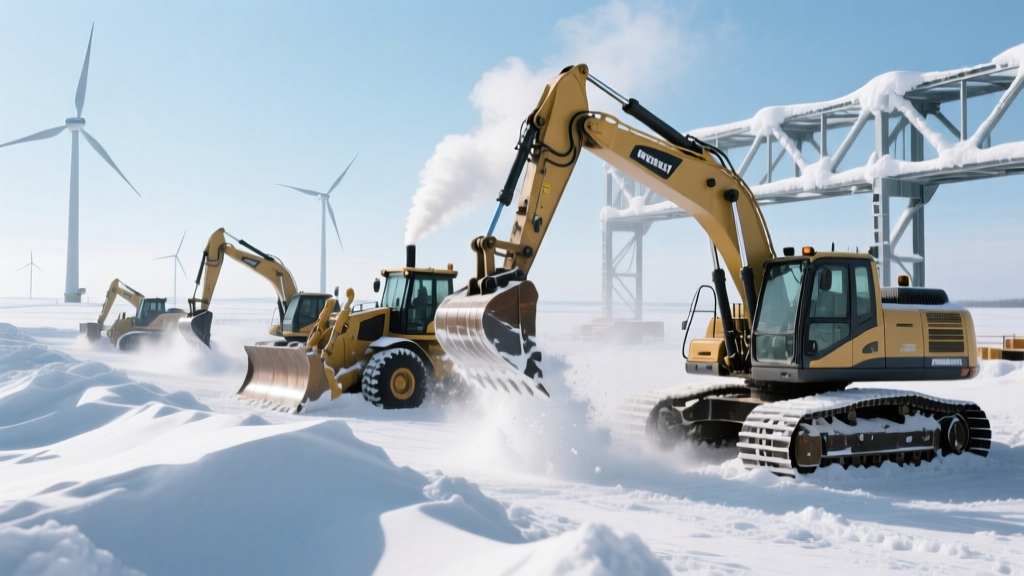
Constructing utility-scale wind and solar farms in high-latitude or high-altitude regions introduces severe logistical bottlenecks. According to the U.S. Department of Energy (DOE), cold-climate wind energy projects face up to 20% higher operational and maintenance costs, largely driven by winter access limitations. Standard municipal plows are entirely inadequate for the 12% to 15% grades of turbine access roads or the sheer volume of drifts that accumulate around crane pads. Deploying specialized heavy snow removal equipment in renewable energy construction is not merely a convenience; it is a critical path requirement to keep 400-ton crawler cranes and prefabricated solar racking deliveries on schedule during Q1 and Q4 build windows.
Rotary Snowblowers for Wind Turbine Crane Pads
Wind turbine crane pads require massive, flat, and completely clear surfaces to support outrigger loads exceeding 1,500 psi. When 4 to 6 feet of hard-packed snow and ice accumulate, heavy-duty rotary snowblowers (such as the Oshkosh H-Series or Wausau-Everest airport-grade blowers adapted for off-highway use) are the only viable solution.
Technical Specifications and Mechanics
- Powertrain: Typically powered by a dedicated rear-mounted engine (e.g., Caterpillar C18 or C27) producing 700 to 900 HP, separate from the carrier vehicle's drivetrain.
- Cutting Mechanism: Features a ribbed steel auger (10 to 14 feet wide) that fractures the ice crust, feeding it into a high-speed impeller rotating at 1,200 to 1,500 RPM.
- Throwing Capacity: Capable of moving 4,000 to 6,000 tons of snow per hour, with a hydraulic chute deflector casting the snow up to 150 feet away from the pad.
- 2026 Capital Cost: $550,000 to $950,000 per unit, depending on carrier integration and telematics packages.
When clearing remote turbine pads, hidden glacial erratics (boulders) buried under snowdrifts can instantly snap standard PTO shear pins. Site managers must specify heavy-duty slip clutches or torque-limiting hydraulic couplings on the impeller drive shaft to prevent catastrophic gearbox destruction, which can halt construction for weeks in remote areas.
Track-Driven Snowcats for Steep-Grade Solar Arrays
Utility-scale solar farms built on undulating terrain require access roads between panel arrays that often feature 15-degree to 20-degree side slopes. Wheeled equipment loses traction and causes severe soil compaction or rutting in thawing conditions. Track-driven snowcats, such as the Prinoth Husky T8 or PistenBully 600, are engineered specifically for this low-impact, high-traction environment.
Ground Pressure and Hydrostatic Drive
The primary advantage of a track-driven snowcat in solar construction is its ground pressure. The Prinoth Husky T8, for example, exerts a mere 0.75 psi of ground pressure across its 32-inch wide rubber tracks. This allows the machine to clear 10-foot wide access lanes between solar rows without damaging underlying drainage culverts or compacting the topsoil, which is critical for post-construction vegetation compliance.
The hydrostatic drive system provides infinite speed control from 0 to 15 mph, allowing the operator to feather the throttle when pushing snow with a 10-foot, 6-way angled blade. The low center of gravity permits safe operation on side-slopes up to 35 degrees, a common requirement for hillside solar installations.
Equipment Comparison Matrix: Wind vs. Solar Site Clearance
| Equipment Type | Primary Application | Horsepower | Clearance Width | Ground Pressure | Est. 2026 Cost |
|---|---|---|---|---|---|
| Heavy Rotary Blower | Wind turbine crane pads | 700 - 900 HP | 10 - 14 ft | N/A (Wheeled) | $550k - $950k |
| Track Snowcat | Steep solar array access | 350 - 450 HP | 10 ft blade | 0.75 - 1.2 psi | $400k - $650k |
| Motor Grader w/ V-Plow | Main 40ft haul roads | 280 - 350 HP | 14 ft moldboard | N/A (Wheeled) | $750k - $900k |
Motor Graders with Articulated V-Plows for Haul Roads
The main arterial roads of a wind farm must support 200-foot-long blade transport trucks. These 40-foot-wide gravel haul roads require continuous maintenance during winter. A standard straight blade merely pushes snow to the edges, creating massive berms that block drainage and narrow the road. Heavy snow removal equipment in this context relies on large motor graders (like the CAT 16 or John Deere 872P) fitted with articulated V-plows and underbody scrapers.
The V-plow geometry fractures hard-packed ice berms, while the 14-foot moldboard is angled to cast the snow completely off the road shoulder. Modern graders utilize All-Wheel Drive (AWD) with electronic traction control, engaging the front wheels automatically when rear wheel slip exceeds 5%. The circle turn mechanism allows the blade to be positioned at extreme angles (up to 65 degrees) to maintain a clean crown on the gravel road, ensuring water runoff when the spring thaw begins.
Real-World Failure Modes and Cold-Weather Mitigation
Operating heavy snow removal equipment on renewable energy sites at temperatures dropping below -30°C introduces specific mechanical failure modes that site superintendents must engineer around.
1. Hydraulic Fluid Gelling and Cavitation
Standard ISO VG 46 hydraulic fluid becomes viscous and gel-like at -20°C, leading to pump cavitation and blown seals during cold starts. Mitigation: Fleet managers must drain standard fluids in Q4 and replace them with ISO VG 15 or MIL-PRF-83282 synthetic hydraulic fluids, which maintain a pour point below -50°C. Additionally, installing 120V or 240V hydraulic tank immersion heaters on the equipment is mandatory for sites experiencing sub-zero overnight temperatures.
2. Track Tension and Grouser Ice-Balling
On track-driven snowcats, wet snow can pack tightly between the track grousers and the drive sprocket, a phenomenon known as "ice-balling." This increases track tension violently, potentially snapping the steel track cables or stripping the sprocket teeth. Mitigation: Equip snowcats with self-cleaning polyurethane track pads or open-center steel grousers (minimum 1.5-inch height) that allow packed ice to fracture and eject under the machine's weight.
"Winterizing a renewable construction fleet isn't just about swapping to winter-blend diesel. It requires a complete audit of seal elastomers. Standard nitrile seals will shatter at -35°C under dynamic load. We mandate Viton or specialized polyurethane seals on all hydraulic cylinders for our northern wind farm projects."
— Fleet Reliability Engineer, Major US Wind Developer
Strategic Deployment for Construction Schedules
The National Renewable Energy Laboratory (NREL) emphasizes that weather-related delays are a primary driver of budget overruns in wind energy deployment. Integrating heavy snow removal equipment into the initial site logistics plan—rather than treating it as an emergency rental—ensures that foundation pouring and tower erection continue uninterrupted. By matching the specific machine architecture (rotary blowers for pads, track cats for arrays, graders for roads) to the unique topographical demands of the renewable site, project managers can eliminate winter downtime and secure grid interconnection deadlines.