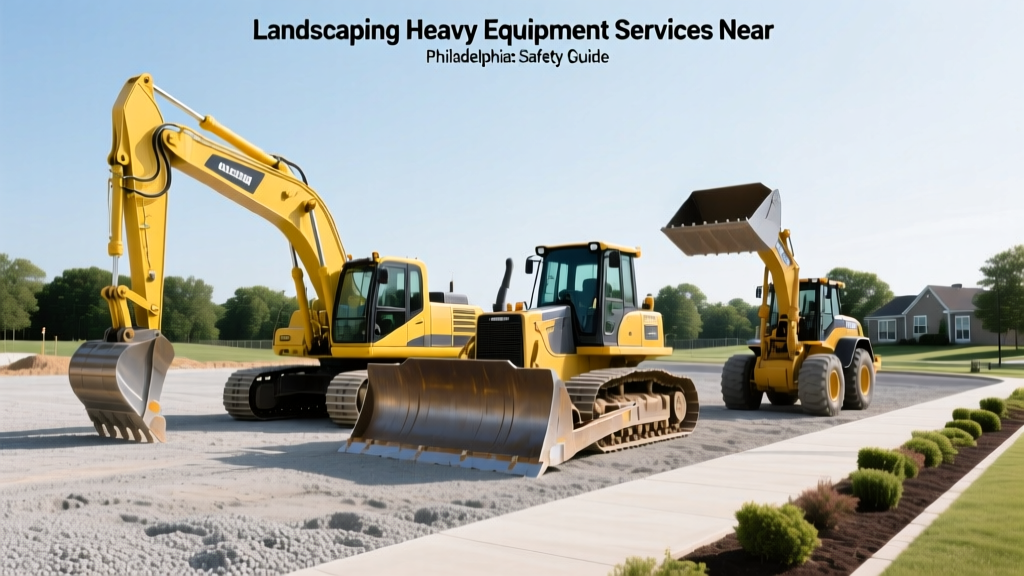
Landscaping Heavy Equipment Services Near Philadelphia: Safety Guide
Master OSHA safety standards for landscaping heavy equipment services near Philadelphia. Covers CTLs, mini excavators, and trenching compliance.
Operating landscaping fleets in the Delaware Valley requires navigating a complex matrix of federal OSHA mandates, Pennsylvania Department of Labor & Industry (L&I) regulations, and municipal right-of-way restrictions. When sourcing or managing landscaping heavy equipment services near Philadelphia, contractors must prioritize ANSI and OSHA compliance to mitigate severe financial and operational risks. The dense urban environment, aging subsurface infrastructure, and specific Mid-Atlantic soil profiles demand rigorous adherence to safety protocols across all equipment categories.
Compact Track Loaders (CTLs): ROPS, FOPS, and Interlock Mandates
Compact Track Loaders, such as the Bobcat T770 and Caterpillar 299D3 XE, are the workhorses of Philadelphia landscaping. However, their high center of gravity and frequent operation on uneven, sloped residential properties make them prime candidates for rollover incidents. Under OSHA 1926.602, all earthmoving equipment must be equipped with certified Roll-Over Protective Structures (ROPS) and Falling Object Protective Structures (FOPS) that meet SAE J1040 and SAE J231 performance criteria.
Compliance Warning: Removing or modifying the factory-installed ROPS canopy to fit under low-clearance obstacles (like porches or dense tree canopies) is a direct OSHA violation. In 2026, inflation-adjusted penalties for serious safety violations exceed $16,500 per instance. If vertical clearance is an issue, contractors must utilize low-profile FOPS mesh screens rather than bypassing the ROPS frame entirely.Beyond structural protection, operational interlocks are heavily scrutinized during site inspections. Modern CTLs utilize a multi-node safety matrix: the seat bar must be lowered, the seat switch must register the operator's weight, and the hydraulic lockout must be disengaged before the drive motors or lift arms will respond. Bypassing these switches with zip-ties or jumper wires—a dangerous shortcut sometimes seen on rushed job sites—results in immediate equipment impoundment during an OSHA audit.
CTL Daily Inspection Compliance Matrix
| Inspection Point | Regulatory Standard | Common Failure Mode | Corrective Action & Cost |
|---|---|---|---|
| ROPS/FOPS Mounting Hardware | SAE J1040 / OSHA 1926.602 | Sheared or stretched Grade 8 mounting bolts | Replace with OEM torque-spec bolts ($45-$120) |
| Seat Bar Interlock Sensor | ANSI/ITSDF B56.1 | Debris jamming the proximity sensor | Clean sensor housing; recalibrate if faulty ($250) |
| Hydraulic Hose Routing | SAE J1237 | Hoses rubbing against the lift arm pivot | Install spiral wrap or reroute clamps ($30) |
| Track Tension & Idler Wear | OEM Maintenance Specs | Over-tensioning causing premature sprocket wear | Adjust to 1.5-2.0 inches of sag per OEM manual |
Mini Excavators: Subpart P and Mid-Atlantic Soil Profiles
Mini and compact excavators like the Kubota KX040-4 and CAT 305 CR are essential for utility trenching, drainage installation, and hardscape demolition. The primary compliance hurdle for these machines in the Philadelphia region is OSHA 1926 Subpart P (Excavations).
Philadelphia's native soil is predominantly composed of dense, clay-heavy glacial till and silty clays, which OSHA classifies as Type B or Type C soil depending on moisture content and fissuring. Type C is the most unstable, requiring a 1.5:1 (34 degrees) sloping ratio or engineered trench boxes for any excavation deeper than 5 feet. Relying on the perceived stability of dry clay in July is a fatal error; a sudden Mid-Atlantic thunderstorm can rapidly transition Type B soil into a fluid Type C state, leading to catastrophic trench wall collapse.
"The majority of trenching fatalities in the Mid-Atlantic occur in excavations between 5 and 15 feet deep, where contractors falsely assume the clay will hold. The NIOSH Trenching Safety guidelines emphasize that a single cubic yard of saturated clay can weigh over 3,000 pounds—enough to cause immediate crush asphyxiation."
— Regional Safety Director, Mid-Atlantic Excavation Safety Council
Swing Radius and Zero Tail Swing (ZTS) Protocols
In Philadelphia's narrow rowhome neighborhoods, managing the excavator's swing radius is a critical compliance issue. Conventional tail-swing models require a calculated exclusion zone to prevent the counterweight from striking fences, structures, or pedestrians. Zero Tail Swing (ZTS) models keep the counterweight within the track width, but operators must be trained to understand that ZTS does not eliminate the front swing radius hazard of the boom and bucket. OSHA mandates that the entire swing radius be barricaded or that a dedicated spotter be utilized when operating near public rights-of-way.
Articulated Wheel Loaders: Load Charts and Rigging Compliance
For larger commercial landscaping projects, material handling, and bulk mulch or aggregate movement, articulated wheel loaders like the John Deere 444P are deployed. A frequent compliance violation occurs when contractors use standard pallet forks on a wheel loader to lift suspended loads (such as bundles of pavers or precast retaining wall blocks) without adhering to rigging standards.
Under OSHA 1926.602, using a loader as a crane requires specific manufacturer-approved lifting attachments, documented load charts for the exact attachment configuration, and rigging hardware (slings, shackles) that are inspected daily and color-coded by quarter. Lifting a 4,000 lb pallet of permeable pavers with worn, uncertified nylon straps is a citable offense. Operators must also account for dynamic load shifting; the articulated pivot point of a wheel loader changes the center of gravity mid-turn, drastically reducing the safe lifting capacity compared to static load charts.
Auditing Heavy Equipment Services Near Philadelphia
When general contractors or property management firms subcontract earthmoving and landscaping tasks, they assume joint liability for safety violations. Vetting heavy equipment services near Philadelphia requires a systematic audit of the vendor's compliance infrastructure, not just a review of their hourly rates.
Vendor Audit Framework: Before signing a service agreement, request the vendor's OSHA 300 log for the past three years. A reputable fleet operator will readily provide their Experience Modification Rate (EMR). An EMR above 1.0 indicates a worse-than-average safety record and suggests systemic maintenance or training deficiencies that will inevitably cause project delays.5-Point Fleet Compliance Checklist
- Documentation: Verify that every machine on-site has the OEM operator's manual physically present in the weatherproof cab storage compartment (an OSHA requirement).
- Operator Certification: Ensure operators hold current, equipment-specific certifications. A generic "heavy equipment" card is insufficient; operators must be evaluated on the exact class of machine (e.g., compact excavator vs. skid steer) they are running.
- Pre-Shift Audits: Require the vendor to submit digitized daily pre-shift inspection reports. Paper checklists are easily "pencil-whipped" and hold up poorly in post-incident litigation.
- Attachment Compatibility: Confirm that all hydraulic attachments (augers, trenchers, breakers) are matched to the host machine's auxiliary hydraulic flow (GPM) and pressure (PSI) ratings to prevent hose ruptures.
- Spill Contingency: Verify that machines operating near Philadelphia's stormwater management systems or the Schuylkill River watershed are equipped with onboard spill kits and biodegradable hydraulic fluid (e.g., Mobil EAL EnviroSyn 46H) where mandated by local environmental ordinances.
Strict adherence to these safety and compliance frameworks ensures that landscaping operations remain efficient, legally protected, and capable of navigating the unique topographical and regulatory challenges of the Philadelphia metropolitan area.