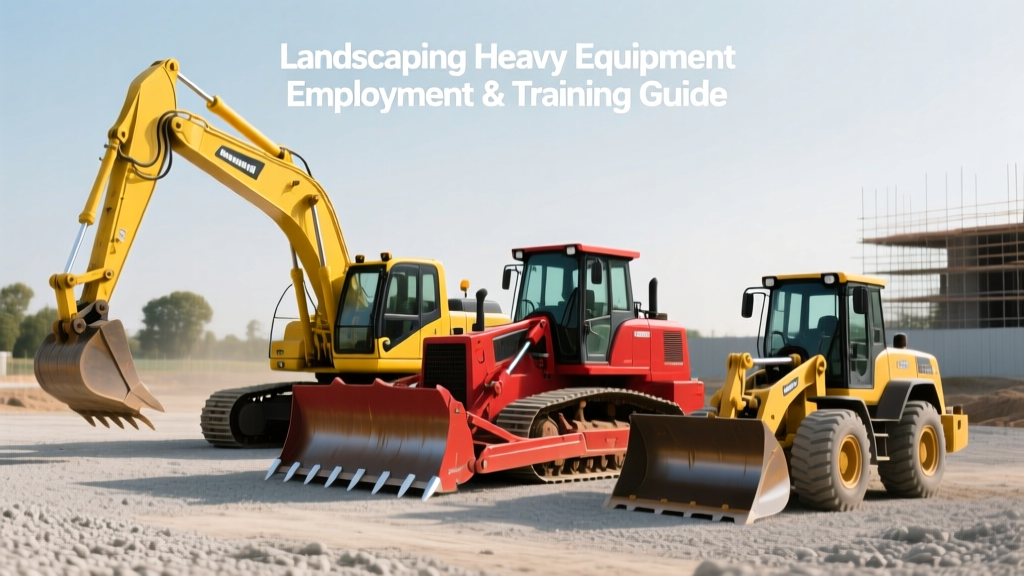
Landscaping Heavy Equipment Employment & Training Guide
Discover how to secure heavy equipment employment in landscaping. Master CTLs, mini excavators, and operator training best practices for 2026.
Securing heavy equipment employment in the landscaping sector requires more than just knowing how to push joysticks. Modern landscape contracting firms manage fleets of highly computerized, high-dollar machinery, and hiring managers actively filter out candidates who lack technical machine knowledge. In 2026, the integration of machine control telematics, advanced hydraulic systems, and specialized attachments means that operators must understand both the agronomic goals of the job site and the mechanical limitations of their equipment.
According to the Bureau of Labor Statistics, the demand for skilled operating engineers continues to outpace the supply of qualified candidates, particularly in specialized sectors like commercial landscaping and hardscaping. Firms are willing to pay a premium for operators who can maximize machine efficiency while minimizing undercarriage wear and hydraulic fatigue. This guide breaks down the core landscaping equipment categories, the specific technical competencies employers test for, and the training frameworks required to advance your career.
Core Landscaping Equipment Categories & Operator Competencies
Landscaping fleets differ significantly from general earthmoving fleets. The focus is on precision grading, tight-radius maneuvering, and multi-tool hydraulic versatility. Mastering the following three categories is mandatory for serious heavy equipment employment in this niche.
1. Compact Track Loaders (CTLs)
CTLs have largely replaced rubber-tire skid steers in landscaping due to their lower ground pressure (often under 5 PSI), which prevents turf destruction on finished grades. The Bobcat T770 and Caterpillar 259D3 are industry staples, typically featuring 74 HP engines and rated operating capacities (ROC) between 2,400 and 3,000 lbs.
- Technical Edge Case: Operating a CTL on abrasive surfaces (like asphalt or rocky sub-base) without proper track tensioning accelerates sprocket and idler wear. Replacing a CTL undercarriage costs between $8,000 and $12,000. Employers will watch how you tension tracks during a practical test—over-tensioning causes power loss and roller bearing failure, while under-tensioning leads to track de-tracking during sidehill turns.
- Attachment Mastery: Landscapers frequently use hydraulic augers for tree planting and trenchers for irrigation. Operators must know how to engage the continuous hydraulic flow switch and monitor the relief valve pressure to prevent burning out the auxiliary hydraulic pump when the auger hits bedrock.
2. Mini Excavators (Compact Excavators)
For hardscaping, retaining wall footings, and precise drainage trenching, mini excavators (3 to 5 metric tons) are indispensable. Models like the Kubota KX040-4 and John Deere 50G offer zero-tail-swing (ZTS) profiles, allowing operators to work flush against existing structures without damaging the machine or the property.
- Tilt Rotator Integration: The most highly compensated operators in 2026 are proficient with tilt rotators (e.g., Engcon or Steelwrist). These attachments allow the bucket to tilt 45 degrees side-to-side and rotate 360 degrees continuously. Grading a swale or sloping a patio base with a tilt rotator reduces manual labor by up to 40%, but requires advanced joystick mapping and simultaneous multi-axis control.
- Blade Usage: Novice operators use the dozer blade merely for backfilling. Expert operators use the blade to stabilize the machine on uneven terrain, lifting the tracks slightly to shift the center of gravity when lifting heavy boulders or precast retaining wall blocks near the machine's maximum lift capacity.
3. Compact Utility Tractors (CUTs)
Tractors in the 25 to 60 HP range (e.g., Kubota L Series or John Deere 4R/5R Series) are the backbone of softscaping and turf management. They utilize a Power Take-Off (PTO) shaft to drive implements like rotary cutters, tillers, and wood chippers.
⚠ Safety Warning: PTO Entanglement & Over-SpeedPTO shafts operate at 540 or 1,000 RPM. A missing master shield or a frayed driveline guard is an immediate fail on any job site safety audit. Furthermore, engaging a high-inertia implement (like a heavy-duty tiller) at high engine RPMs will strip the tractor's internal clutch or shatter the PTO stub shaft. Always engage the PTO at low idle, then throttle up to the operating speed.
The Pre-Shift Inspection: Proving Your Competence
During a hiring practical exam, the foreman is not just watching how you dig; they are watching your walkaround. A disciplined pre-shift inspection is the fastest way to prove you respect the capital investment of the fleet. Documenting these checks in a digital logbook (via platforms like Fleetio or MachineMax) is a major resume booster for heavy equipment employment.
| Inspection Zone | Specific Action & Tolerance | Failure Consequence |
|---|---|---|
| Undercarriage | Check track sag. Proper deflection is typically 1 to 1.5 inches at the mid-point between the front idler and carrier roller. | Accelerated pin/bush wear; track snapping under load. |
| Hydraulics | Inspect quick-disconnect couplers for dirt ingress. Wipe flat-face couplers before attaching auxiliary tools. | System contamination; scored valve spools; $3,000+ pump rebuild. |
| Cooling System | Blow out radiator and hydraulic oil cooler screens with compressed air (low PSI) to remove cottonwood and dust. | Engine derating; hydraulic fluid overheating and seal blowout. |
| Fluids & DEF | Check Diesel Exhaust Fluid (DEF) levels. Ensure no diesel cross-contamination in the DEF tank. | DEF crystallization; SCR catalyst destruction ($2,500+ replacement). |
Hydraulic Flow Matching: A Critical Hiring Filter
One of the most common reasons landscaping firms reject candidates during practical tests is improper hydraulic attachment matching. Landscaping requires swapping between standard-flow and high-flow attachments daily.
💡 Pro-Tip: High-Flow vs. Standard-FlowStandard-flow auxiliary hydraulics typically deliver 18 to 22 Gallons Per Minute (GPM) at roughly 3,000 PSI. This is sufficient for hydraulic breakers, standard augers, and tilt cylinders. However, forestry mulchers and heavy-duty brush cutters require high-flow systems (30 to 45 GPM). If you connect a 40 GPM mulcher head to a 20 GPM standard-flow machine, the hydraulic fluid will bypass the relief valve continuously, generating massive heat that will degrade the hydraulic oil and destroy the machine's main pump within hours. Always verify the attachment's GPM/PSI requirements against the machine's flow plate before pinning it on.
Salary Expectations and Career Progression in 2026
Compensation for landscaping equipment operators has scaled significantly as machines have become more complex. According to industry wage data and reports from the National Association of Landscape Professionals (NALP), the gap between a basic 'joystick pusher' and a certified machine control operator is widening.
| Experience Level | Core Competencies | Est. 2026 Hourly Wage |
|---|---|---|
| Entry-Level Operator | Basic trenching, loading trucks, safe transport, standard-flow attachments. | $22 - $28 / hr |
| Mid-Level Hardscape Operator | Precision grading, laser-level operation, tilt rotator proficiency, rigging. | $29 - $36 / hr |
| Lead Operator / Fleet Tech | GPS machine control, hydraulic diagnostics, site layout, crew management. | $38 - $45+ / hr |
Common Operator Mistakes That Cost Firms Thousands
To stand out in an interview, articulate your awareness of these specific failure modes. Hiring managers want operators who actively prevent capital loss.
- Sidehill Trenching with Mini Excavators: Digging parallel to a slope with the sprocket (drive motor) on the downhill side places extreme lateral stress on the swing bearing and final drive. The correct technique is to track straight up the fall line, dig the trench, and back out, or use a trenching box.
- Using the Bucket as a Hammer: Slamming the bucket curl to break up frost or compacted clay transmits shock loads directly through the cylinder pins and into the boom structure, causing micro-fractures in the welds over time.
- Ignoring Telematics Alerts: Modern machines from the Association of Equipment Manufacturers (AEM) member brands broadcast real-time fault codes. Ignoring a 'DEF Quality' or 'Hydraulic Oil Temp' warning on the digital display to finish a trench results in forced engine derates that halt the entire crew's production.
Strategic Steps to Secure Employment
Do not rely solely on online job boards. Landscaping is a relationship-driven, highly localized industry. Take the following actionable steps to secure premium heavy equipment employment:
- Build a Machine Log: Keep a personal spreadsheet of every machine model you have operated, the specific attachments used, and your approximate hours. Present this during the interview.
- Obtain NCCCO or Equivalent Certification: While not always legally required for compact equipment under 2,000 lbs, holding a National Commission for the Certification of Crane Operators (NCCCO) articulating boom loader crane certification or formal OSHA safety cards instantly elevates your resume above the general applicant pool.
- Master the CDL-A Requirement: The bottleneck in landscaping is rarely the machine operation; it is the transport. Earning your Class A Commercial Driver's License (CDL-A) to legally tow a 15,000 lb equipment trailer with a 3-ton mini excavator and CTL makes you an indispensable, dual-threat asset to any contracting firm.
By focusing on the mechanical realities of the equipment, respecting the hydraulics, and treating maintenance as a primary job function, you transition from a temporary laborer to a career equipment professional. Firms are actively searching for this exact profile to protect their margins and deliver precision hardscapes and softscapes in a competitive market.