EPA Compliance: Wash Bays for Heavy Equipment in Renewable Energy
Discover EPA compliance standards and design specs for wash bays for heavy equipment used in wind and solar renewable energy construction projects.
The Environmental Paradox of Green Energy Construction
Building renewable energy infrastructure requires some of the largest, most fluid-dependent machinery on earth. Erecting a 5MW wind turbine demands 1,000-ton crawler cranes like the Liebherr LR 13000, while utility-scale solar farms require fleets of piling rigs such as the Bauer BG 28 to drive thousands of steel H-piles. These machines operate in sensitive, undeveloped greenfield sites—often near protected wetlands, agricultural watersheds, or arid ecosystems.
When these massive machines require maintenance, track decontamination, or end-of-project cleaning, washing them on bare soil is a direct violation of federal environmental law. This is where engineered wash bays for heavy equipment become a critical compliance asset. Designing and operating these wash systems on remote renewable energy sites requires strict adherence to the Clean Water Act (CWA) and the EPA’s Spill Prevention, Control, and Countermeasure (SPCC) protocols.
Regulatory Framework: SPCC and the Clean Water Act
Any renewable energy construction site that stores, handles, or captures oil and hydraulic fluid must comply with EPA SPCC Guidance under 40 CFR Part 112. The threshold for requiring a formal SPCC plan is an aggregate above-ground oil storage capacity of more than 1,320 gallons. A single Liebherr LR 13000 crawler crane holds over 600 gallons of hydraulic fluid and engine oil. When combined with the site’s fuel storage and the wash bay’s capture sumps, renewable sites easily exceed this threshold.
⚠️ Compliance Warning: CWA PenaltiesUnder the Clean Water Act Overview, discharging untreated wash water containing oil, grease, or heavy metals into navigable waters or adjacent soil can result in civil penalties exceeding $64,000 per day, per violation. Criminal negligence for deliberate bypassing of wash bay containment systems carries federal prison time.
Furthermore, OSHA Construction Standards mandate that wash areas must be engineered to prevent slip hazards and protect workers from high-pressure hose recoil and chemical exposure. A compliant wash bay is not just an environmental tool; it is a dual-purpose safety and regulatory enclosure.
Engineering Wash Bays for Remote Renewable Sites
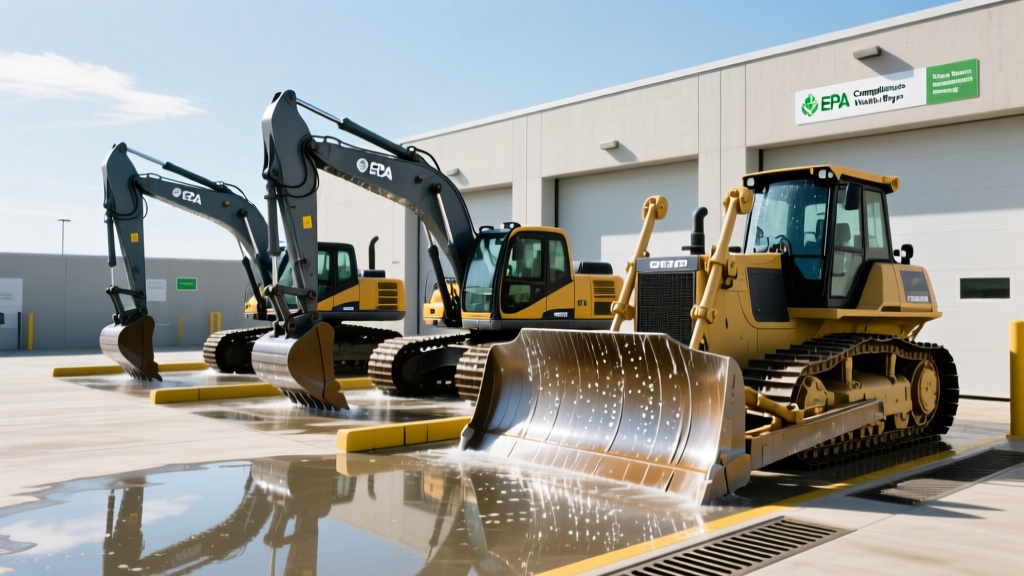
Remote wind and solar sites rarely have access to municipal sewer connections. Therefore, wash bays for heavy equipment in these environments must be self-contained, portable, and capable of handling extreme volumes of contaminated runoff. A standard compliant setup includes a modular steel-grating deck, a primary settling sump, and a multi-stage oil-water separator (OWS).
Core Components of a Compliant Wash Bay
- Modular Wash Deck: Typically 40x60 feet, constructed from heavy-duty galvanized steel grating capable of supporting 80,000 lbs per axle to accommodate fully ballasted crawler cranes.
- Primary Sump & Settling Tank: A 10,000 to 20,000-gallon subterranean or above-ground frac tank that captures gross solids (mud, bentonite drilling slurry, and silica sand).
- Coalescing Plate Pack OWS: Utilizes gravity and surface tension to separate free-floating hydrocarbons from the water, achieving effluent oil concentrations below the EPA’s 15 ppm discharge limit for authorized stormwater systems.
- pH Neutralization Dosing: Automated injection systems that balance the alkalinity of wash water contaminated by concrete washout or drilling muds.
System Configurations for Off-Grid Renewable Projects
Choosing the right water management strategy depends on the site's water availability, local evaporation rates, and budget. Below is a comparison of the three primary configurations used in renewable energy construction.
| System Type | CapEx Estimate | OpEx / Maintenance | Best Renewable Application |
|---|---|---|---|
| Closed-Loop Recirculation | $180,000 - $260,000 | Filter changes, OWS skimming ($1.50/wash) | Arid solar sites with zero municipal water access. |
| Evaporation / Thermal | $120,000 - $150,000 | High energy/fuel costs for heaters ($8.00/wash) | Small-scale geothermal or remote wind staging. |
| Haul-Off / Vacuum | $45,000 - $75,000 | Vacuum truck disposal ($1,200+ per 5k gal load) | Short-duration wind farm crane pads near urban centers. |
Equipment-Specific Wash Protocols & Failure Modes
Washing heavy machinery is not a one-size-fits-all process. The extreme forces and specialized components of renewable energy construction equipment require highly specific wash protocols to prevent catastrophic mechanical failures during critical lifts or piling operations.
1. Crawler Cranes (e.g., Liebherr LR 13000)
The undercarriage of a 1,000-ton crawler crane operates under immense stress. A common and devastating mistake made by inexperienced wash crews is using high-pressure water (>3,000 PSI) to blast mud from the track chains and idlers.
💡 Expert Insight: Track Seal DestructionHigh-pressure nozzles force silica sand and water past the Duo-Cone floating seals inside the track rollers and idlers. Once contaminated, the internal grease degrades, leading to seized rollers. A single seized roller on a LR 13000 can cause the track chain to snap during a turbine nacelle lift, resulting in millions of dollars in dropped-load damages. Protocol: Wash bays must be equipped with pressure-regulated manifolds capped at 1,200 PSI, utilizing high-volume, low-pressure (HVLP) hot water to gently melt grease and mud without compromising the seals.
2. Piling Rigs (e.g., Bauer BG 28)
Solar and wind foundation piling rigs generate massive amounts of bentonite drilling mud and concrete slurry. Bentonite is highly alkaline (pH 9-11). If this runoff enters a standard wash bay sump without treatment, it emulsifies the oil-water separator’s coalescing plates, rendering the OWS useless and allowing oil to pass into the environment.
Protocol: Wash bays servicing piling rigs must include an automated pH monitoring and dosing skid. As wash water enters the primary sump, the system injects CO2 or dilute sulfuric acid to drop the pH to a neutral 7.0. This breaks the bentonite emulsion, allowing the heavy clay particles to flocculate and settle, while the free oil rises to the surface for skimming.
3. Self-Propelled Modular Transporters (SPMTs)
Transporting wind turbine blades and tower sections requires Goldhofer or Scheuerle SPMTs. These vehicles feature exposed hydraulic steering rams and electronic control units (ECUs) located inches from the ground. Wash bays must incorporate under-chassis shielding and directed drainage trenches to ensure that water does not pool around the ECU junction boxes, preventing short circuits that can disable the multi-axle steering synchronization.
Financial Analysis and Procurement Strategy
Procuring a compliant wash bay for a 24-month wind farm construction project requires balancing upfront capital expenditure against long-term operational savings and risk mitigation.
For a mid-sized wind project requiring the washing of 40 heavy transport vehicles and 5 crawler cranes weekly, a Closed-Loop Recirculation System is the most financially sound choice. While the initial procurement and installation cost sits around $215,000, it eliminates the need for continuous water trucking (which can cost $3,000+ per week in remote areas) and vacuum haul-off fees.
Furthermore, investing in a fully permitted, SPCC-compliant wash bay acts as an insurance policy. The average legal defense and remediation cost for a single EPA Clean Water Act violation regarding soil contamination exceeds $400,000. By integrating engineered wash bays for heavy equipment into the site’s environmental management plan from day one, renewable energy developers protect both the local ecosystem and the project's bottom line.