Ag vs Construction Specs in the Heavy Equipment Industry
Compare agricultural and construction heavy equipment specs. Explore powertrain, hydraulic pressure, and chassis differences for optimal machine selection.
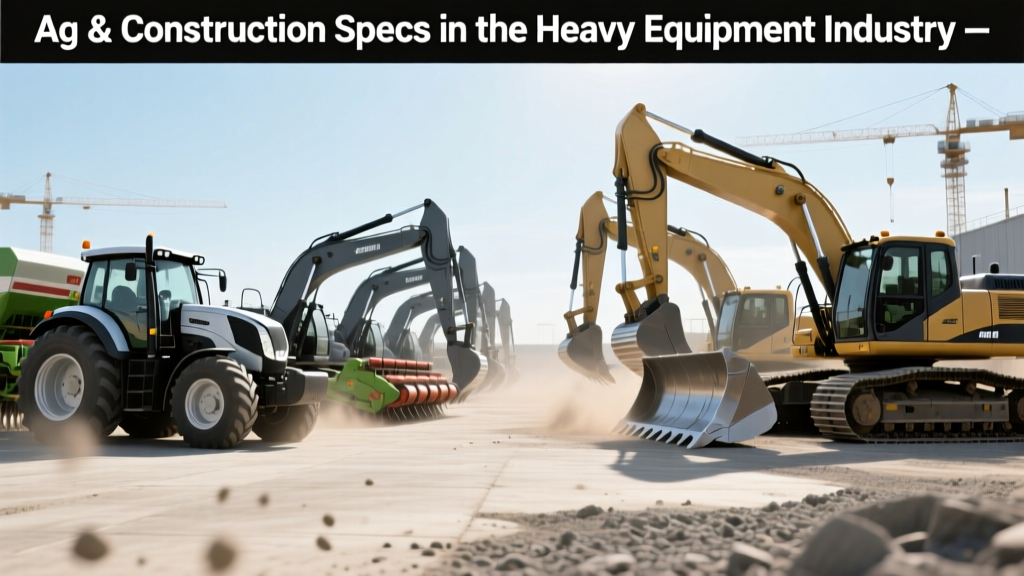
The engineering divergence between agricultural and construction machinery within the heavy equipment industry is not merely a matter of paint color or attachment points. It is a fundamental difference in thermodynamic priorities, load-bearing geometries, and hydraulic architectures. While a high-horsepower row-crop tractor and a mid-sized wheel loader may share similar gross engine outputs (typically 300–400 hp), their internal power distribution systems are optimized for entirely different physics.
Understanding these technical specifications is critical for fleet managers, heavy equipment mechanics, and procurement specialists. Misapplying an agricultural platform for continuous earthmoving, or vice versa, leads to catastrophic drivetrain failures and accelerated depreciation. This technical breakdown examines the exact mechanical differences between modern agricultural and construction heavy equipment.
The Powertrain Divide: PTO Architecture vs. Torque Conversion
The most distinct mechanical boundary in the heavy equipment industry lies in how engine torque is transmitted to the ground and to auxiliary implements. Agricultural machines prioritize continuous, variable-speed ground engagement and rotational power take-off (PTO), while construction machines prioritize massive static thrust and directional reversing.
Agricultural Spec: Continuous Variable & PTO Output
Modern agricultural tractors, such as the John Deere 8R 410, utilize Continuously Variable Transmissions (CVT) or highly complex powershift gearboxes (like the e23 PowerShift) paired with a rear PTO. The PTO is governed by strict ASABE standards, typically outputting 1,000 RPM via a 1-3/4 inch, 20-spline shaft. This architecture allows the engine to maintain a constant, fuel-efficient RPM (often around 1,600–1,800 RPM) while the transmission infinitely adjusts ground speed from 0 to 25 mph without interrupting torque to a PTO-driven implement like a baler or mixer wagon.
Construction Spec: Lockup Clutches & Breakout Force
Construction wheel loaders, such as the Caterpillar 966 GC, reject CVTs in favor of Automatic Powershift transmissions integrated with a lockup torque converter. The torque converter multiplies engine torque by up to 2.5:1 at stall speed, providing the instantaneous thrust required to penetrate a compacted gravel pile. Once the machine reaches travel speed, the lockup clutch engages, creating a 1:1 direct mechanical drive to eliminate parasitic heat generation and improve fuel efficiency during load-and-carry cycles.
Data Highlight: Drivetrain Comparison Matrix
| Specification | Ag Tractor (JD 8R 410) | Construction Loader (Cat 966 GC) |
|---|---|---|
| Engine Displacement | 9.0L (PowerTech) | 9.3L (C9.3B) |
| Primary Transmission | IVT / e23 PowerShift | Automatic Powershift w/ Lockup |
| Torque Multiplication | 1:1 (Mechanical/PTO) | Up to 2.5:1 (Stall) |
| Max Travel Speed | 25 mph (40 km/h) | 24 mph (38.5 km/h) |
Hydraulic Systems: Flow Volume vs. System Pressure
Hydraulic architecture represents the second major divergence. Both sectors use load-sensing, variable-displacement axial piston pumps, but their tuning parameters are polar opposites.
Agricultural SCV (Selective Control Valves)
Agricultural hydraulics are engineered for high flow and moderate pressure. A top-tier row-crop tractor can deliver up to 114 gpm (432 L/min) of hydraulic flow through its rear SCVs. This massive volume is required to drive continuous-duty hydraulic motors on modern 60-foot planters, air seeders, and forage harvesters. However, the system pressure is typically capped between 3,000 and 3,500 psi. The priority is moving large volumes of fluid over long durations without overheating the hydraulic oil.
Construction Load-Sensing & Pilot Controls
Conversely, construction equipment prioritizes extreme system pressure over raw flow volume. A wheel loader's implement pump may only flow 74 to 87 gpm, but the system pressure is pushed to 5,076 psi (35,000 kPa) or higher. This extreme pressure is necessary to generate the 35,000+ lbf of static breakout force required to curl a fully loaded rock bucket out of a blasted shale face. The duty cycle is short and violent, requiring heavy-duty cylinder seals and reinforced hydraulic hoses rated for extreme pressure spikes.
Chassis, Axles, and Ground Engagement Mechanics
The structural metallurgy and suspension geometries of the heavy equipment industry are dictated by the center of gravity and the terrain.
Oscillating Front Axles vs. Rigid Frame Articulation
Agricultural tractors utilize a rigid rear chassis paired with a front axle that oscillates up to 20 degrees. This pivot mechanism ensures all four tires maintain ground contact when traversing uneven furrows, maximizing traction and minimizing soil compaction. The front axle is not designed to bear heavy static vertical loads; it is a stabilization and steering mechanism.
Construction machines rely on rigid frame articulation. The front and rear frames are connected by a massive central hinge pin (often 4 to 6 inches in diameter) backed by tapered roller bearings. Both the front and rear axles are rigidly bolted to their respective frames. This allows the machine to transfer the immense weight of the loaded bucket directly through the front axle housing into the main frame, rather than relying on suspension pivots that would sheer under a 15,000 lb static load.
Tire Compounding: R-1W Ag vs. L-5 Construction
Tire engineering highlights another stark contrast. Agricultural machines use R-1W (deep tread) radial tires with flexible sidewalls and high natural rubber content. These tires are designed to 'flex and bite' at low pressures (12–18 psi) to maximize the contact patch and reduce soil compaction.
Construction equipment utilizes L-5 (rock/extra deep tread) bias or radial tires. These tires feature heavily reinforced steel belts, thick cut-resistant synthetic rubber compounds blended with high carbon black, and stiff sidewalls. They are inflated to 70–95 psi to resist punctures from sharp aggregate and to support immense static axle loads without sidewall deflection.
Warning: Cross-Application Failure Modes
A common and costly mistake in the heavy equipment industry is mounting a front-end loader bucket onto an agricultural tractor for light dirtmoving. Because the ag front axle relies on a central pivot pin for oscillation, applying 8,000 lbs of downward breakout force will rapidly elongate the pivot pin bore, leading to catastrophic axle housing failure. Furthermore, the ag transmission lacks a torque converter, meaning 'power-shifting' between forward and reverse while pushing dirt will strip the clutch packs and burn out the transmission control module within 500 hours.
Maintenance Realities and Fluid Capacities
The operational maintenance schedules reflect the differing environments of these machines. According to OSHA guidelines for heavy earthmoving equipment, construction machinery operating in high-silica dust environments requires aggressive air filtration and cooling system maintenance.
- Air Filtration: Construction loaders use multi-stage radial seal air cleaners with ejector valves that purge dust continuously. Ag tractors use high-capacity primary/secondary filters but face organic chaff that can clog radiator cores, requiring daily reverse-air blowing of the cooling pack.
- Fluid Capacities: An Ag tractor (e.g., JD 8R) holds approximately 115 gallons of hydraulic/transmission fluid, utilizing a common sump to lubricate the wet brakes, PTO clutches, and transmission. A construction loader separates these systems; the Cat 966 GC holds roughly 50 gallons in the transmission/hydraulic tank and a separate 15 gallons in the axle housings for the wet disc brakes, preventing brake friction material from contaminating the high-pressure implement hydraulics.
Procurement Decision Framework
When specifying machinery, procurement teams must align the machine's internal architecture with the primary duty cycle. If the application requires continuous rotary power, high-flow hydraulics for remote motors, and low ground pressure, the agricultural powertrain is the only viable engineering solution. If the application demands high-static thrust, extreme hydraulic pressure for breakout force, and rigid load-bearing axles, construction-spec machinery is mandatory. Attempting to bridge this gap with aftermarket modifications inevitably results in metallurgical failure and voided OEM warranties.