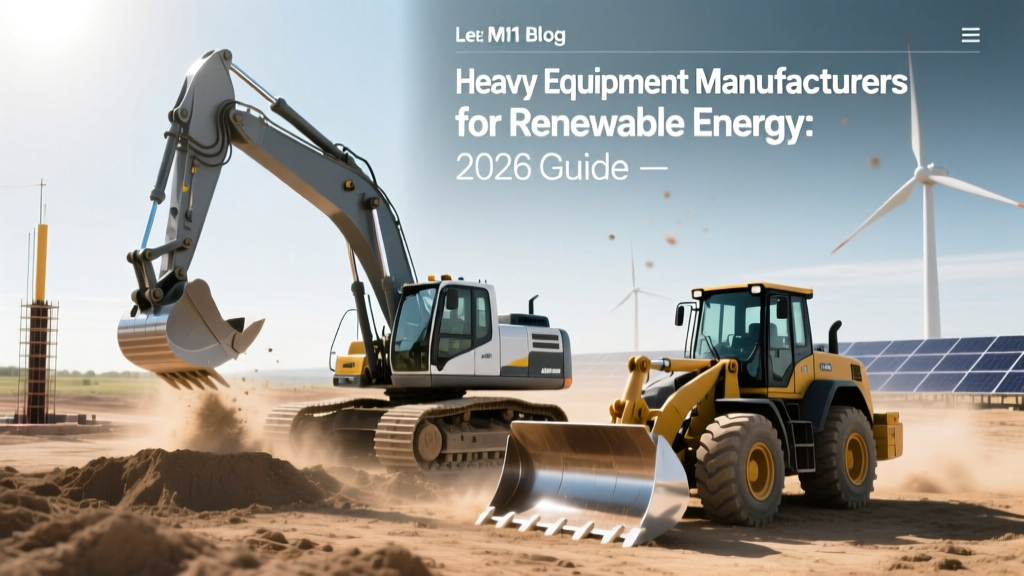
Heavy Equipment Manufacturers for Renewable Energy: 2026 Guide
Compare top heavy equipment manufacturers for renewable energy construction. Get 2026 pricing, model specs, and buying strategies for solar and wind sites.
Terrain and Load Challenges in Green Energy Infrastructure
Utility-scale renewable energy projects demand highly specialized machinery that diverges sharply from traditional commercial building or highway construction. When evaluating heavy equipment manufacturers for solar arrays, wind farms, or geothermal plants, procurement teams must account for extreme low-ground-pressure (LGP) requirements and massive point-loads. According to the U.S. Department of Energy, modern utility-scale solar facilities often span thousands of acres of sensitive topsoil, requiring machinery that grades without compacting the earth to ensure post-lease agricultural viability. Conversely, wind turbine erection requires lifting 150-tonne nacelles to hub heights exceeding 300 feet, demanding crawler cranes with immense counterweight capacities and precise micro-slew controls.
Procurement Insight: Standard earthmoving fleets fail in renewable environments. A standard dozer exerting 6.5 psi of ground pressure will cause deep rutting in soft desert or wetland solar sites, leading to costly remediation. Buyers must specifically target manufacturers offering dedicated LGP and high-reach configurations.Top Heavy Equipment Manufacturers & Model Specifications
Selecting the right partner requires matching specific manufacturer engineering strengths to your project's primary phase: site preparation, foundation pouring, or component erection.
Caterpillar: Dominating Solar Site Prep and Grading
Caterpillar remains the benchmark for solar farm earthmoving, primarily due to their advanced LGP track systems and integrated GPS grading technology. The CAT D5 LGP Dozer is the industry standard for solar array grading.
- Operating Weight: ~44,000 lbs
- Ground Pressure: 3.7 psi (using 34-inch wide single-grouser shoes)
- 2026 Base Price Range: $320,000 – $345,000
- Key Advantage: The D5's fully automatic transmission and CAT Grade with GPS allow operators to achieve the precise 1% to 2% grading tolerances required for optimal solar panel racking drainage without over-excavating.
Liebherr: Heavy Lifting for Wind Turbine Erection
For multi-megawatt wind farms, Liebherr's crawler cranes are virtually mandatory. The Liebherr LR 13000 is engineered specifically for the latest generation of 5MW+ onshore and offshore turbines.
- Max Lift Capacity: 3,000 tonnes
- Main Boom Length: Up to 120 meters (with luffing jib)
- 2026 Capital Cost: $14,000,000+ (Typically procured via specialized heavy-lift leasing agreements)
- Key Advantage: The LICCON 3 crane control system calculates real-time wind shear and load moment limits, automatically restricting slew speeds when hoisting 250-foot turbine blades in marginal weather conditions.
Komatsu: Geothermal and Battery Storage Excavation
Geothermal loop trenching and utility-scale battery energy storage system (BESS) pad construction require high-flow hydraulics and extreme durability. The Komatsu PC210LC-11 excavator is heavily favored by geothermal contractors.
- Operating Weight: 49,000 lbs
- Engine: Tier 4 Final, 158 HP
- 2026 Base Price Range: $265,000 – $285,000
- Key Advantage: Features a high-flow hydraulic auxiliary circuit (up to 105 gpm) necessary for running heavy-duty trenching attachments and hydraulic breakers used in hard-rock geothermal wellhead preparation.
2026 Procurement Comparison Matrix
Use this matrix to align manufacturer offerings with your specific renewable energy vertical and capital expenditure strategy.
| Manufacturer & Model | Primary Application | Critical Metric | Est. 2026 Cost | Procurement Strategy |
|---|---|---|---|---|
| CAT D5 LGP | Solar Farm Grading | 3.7 psi Ground Pressure | $330,000 | Outright Purchase (High utilization across multiple solar sites) |
| Liebherr LR 13000 | Wind Turbine Erection | 3,000t Capacity / 120m Boom | $14M+ | Short-term Lease (Specialized erection contractor) |
| Komatsu PC210LC-11 | Geothermal / BESS Pads | 105 gpm Aux Hydraulics | $275,000 | Rent-to-Own or Operating Lease |
The 3-Tier Vendor Assessment Matrix for Fleet Buyers
According to market data from the Association of Equipment Manufacturers (AEM), equipment downtime on remote renewable sites costs contractors upwards of $15,000 per day in delayed milestone penalties. When selecting a manufacturer, evaluate them against this 3-tier framework:
Tier 1: Telematics and Remote Diagnostics
Does the manufacturer offer satellite-linked telematics (e.g., CAT VisionLink or Komatsu KOMTRAX) capable of transmitting fault codes from off-grid solar sites with no cellular coverage? Remote renewable sites require satellite fallback to prevent diagnostic delays.
Tier 2: Dealer Mobile Service Radius
Wind farms are frequently located in rural corridors. Verify that the local authorized dealer guarantees a mobile service truck response within a 150-mile radius. Manufacturers with sparse regional dealer networks should be disqualified, regardless of machine specs.
Tier 3: Component Commonality
For mid-sized contractors, select a manufacturer whose engine and hydraulic pump architectures are shared across multiple machine classes. This allows you to stock a single brand of Tier 4 Final DEF filters and hydraulic fluid across your entire dozer, excavator, and loader fleet, reducing inventory holding costs by up to 22%.
Edge Cases & Failure Modes in Renewable Construction
Renewable energy environments introduce severe operational hazards that standard equipment configurations cannot survive. Buyers must specify the following factory-installed or aftermarket modifications when ordering from manufacturers:
1. Silica Dust Ingress in Desert Solar Farms
Utility-scale solar projects in the Mojave or Sonoran deserts generate massive amounts of fine silica dust during grading. Standard radial seal engine air filters will clog and trigger engine derating within 400 hours. The Fix: Mandate heavy-duty pre-cleaners (such as the Donaldson Top Spin) and cabin HEPA pressurization systems when ordering excavators and dozers for arid solar sites. Data from the National Renewable Energy Laboratory (NREL) highlights that site-specific environmental factors drastically alter O&M cost baselines; ignoring dust mitigation will inflate engine rebuild costs by 40% over a 5-year project lifecycle.
2. High Wind Shear Downtime for Crawler Cranes
Wind farm erection sites are inherently windy. Standard crane anemometers often trigger false lockouts due to localized rotor wash from nearby operational turbines. The Fix: Specify cranes equipped with multi-axis wind sensing arrays and boom-tip accelerometers that differentiate between steady-state wind loads and dangerous gust shear, maximizing safe lifting windows.
3. Electrical Interference near BESS and Substations
When grading and trenching immediately adjacent to high-voltage battery storage substations, the electromagnetic interference (EMI) can corrupt standard machine control GPS signals, leading to grading errors. The Fix: Require manufacturers to install shielded wiring harnesses and dual-constellation (GPS + GLONASS) RTK receivers with inertial measurement unit (IMU) backups to maintain grading accuracy in high-EMI zones.
Strategic Fleet Sizing for 2026 Renewable Pipelines
The shift toward 800V DC architectures in solar farms and larger 15MW+ turbines in wind means the physical footprint and weight of components are increasing. Procurement teams must stop sizing fleets based on 2020-era project parameters. When negotiating with heavy equipment manufacturers, prioritize modular attachment interfaces and scalable lift capacities. A fleet optimized for low ground pressure, high-flow auxiliary hydraulics, and advanced machine control will secure a distinct competitive advantage in the bidding process for next-generation renewable infrastructure contracts.