Maintenance Schedules for Scrapers Heavy Equipment in Quarry Operations
Master maintenance schedules for scrapers heavy equipment in quarry and aggregate processing. Reduce downtime with expert service intervals and tips.
The Abrasive Reality of Quarry and Aggregate Operations
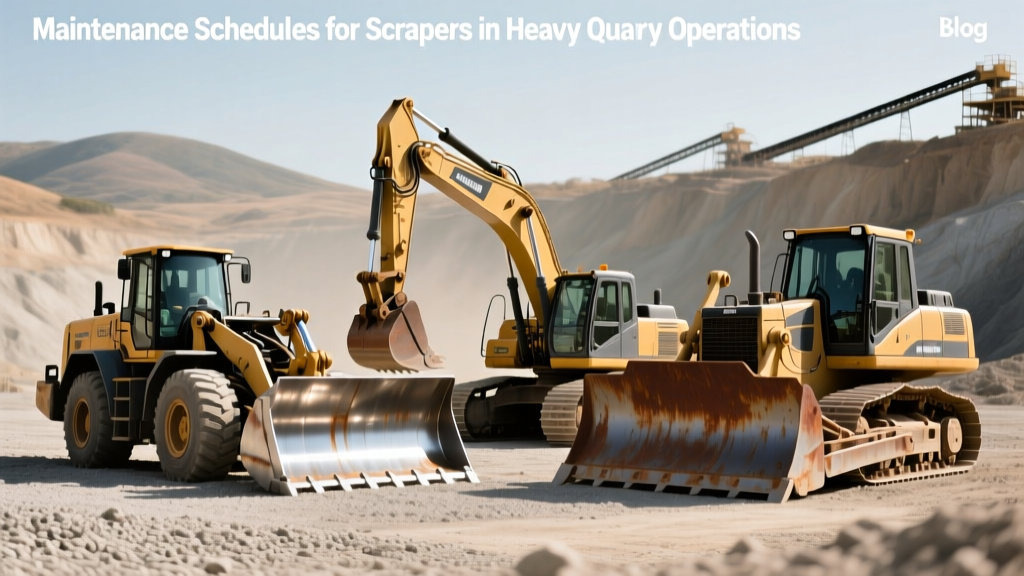
In the quarry and aggregate processing sector, earthmoving machinery is subjected to some of the most punishing environments in construction. When operators deploy scrapers heavy equipment for stripping overburden, site preparation, or hauling shot rock to primary crushers, the machinery faces continuous exposure to high-silica dust, extreme impact loading, and abrasive wear. Unlike standard highway grading, quarry applications involve highly compacted, fragmented limestone, granite, and basalt. This environment accelerates the degradation of ground engaging tools (GET), powertrain components, and hydraulic seals.
Establishing a rigorous, hour-based maintenance schedule for models like the Caterpillar 637K twin-engine scraper or the Cat 627K single-engine scraper is not merely a recommendation; it is a financial necessity. A starved primary jaw crusher due to a downed scraper can halt an entire aggregate processing plant, resulting in severe revenue losses. This guide details the exact maintenance intervals, wear thresholds, and troubleshooting frameworks required to keep heavy scrapers operational in high-production quarry environments.
Daily Pre-Shift Walkaround: The 15-Minute Downtime Preventer
Before the ignition is turned, a meticulous 15-minute walkaround is mandatory. According to OSHA Standard 1926.600 regarding earthmoving equipment, daily inspections are a regulatory requirement, but in a quarry, they must go far beyond basic compliance checks.
- Bowl Apron Hinges and Cylinders: Inspect for grease purging or micro-fractures around the apron pivot pins. In rock-loading scenarios, oversized boulders frequently strike the apron, transferring shock loads directly to the hinge castings.
- Cutting Edge and Router Bit Wear: Measure the remaining material on the base edge. If the cutting edge is worn within 25 mm (1 inch) of the bolt holes, immediate replacement is required to prevent catastrophic gouging of the base edge moldboard.
- Tire Pressure and Sidewall Integrity: Quarry floors are littered with sharp, fractured aggregate. Check for embedded rocks in the tread and inspect the inner sidewalls for rock-cutting damage caused by tight turning radii in confined loading zones.
- Torque Converter and Retarder Cooling Lines: Scrapers in quarries frequently utilize engine retarders on steep, loaded haul grades. Verify that the retarder cooling lines show no signs of chafing or thermal degradation.
Quarry operations generate massive amounts of respirable crystalline silica. The NIOSH Mining program highlights the severe health and mechanical risks of silica dust. Mechanically, if the primary air filter restriction indicator reaches the 6.2 kPa (25 inches of water) threshold, the engine is starved of air, leading to incomplete combustion, elevated exhaust gas temperatures (EGT), and accelerated cylinder liner wear. Never blow out quarry air filters with compressed air; the microscopic silica particles will embed deeper into the media. Always replace them.
Hour-Based Service Intervals for Aggregate Scrapers
The following service matrix is calibrated for severe-duty aggregate applications. Standard OEM intervals must be reduced by 20% when operating in continuous high-dust, high-impact rock formations.
| Interval | System / Component | Action & Specifications |
|---|---|---|
| 250 Hours | Engine Crankcase & Bowl Hydraulics | Sample engine oil (API CK-4 15W-40). Check hydraulic tank sight glass for ISO VG 46 fluid. Grease all bowl linkage and ejector carriage rollers with molybdenum disulfide (MoS2) EP2 grease. |
| 500 Hours | Powertrain & Final Drives | Check transmission and torque converter oil levels. Sample final drive gear oil (SAE 80W-90). Inspect the bowl ejector chain or cable for tension and elongation. |
| 1,000 Hours | Cooling & Air Systems | Replace primary and secondary air filters. Clean the engine radiator and hydraulic oil cooler cores using low-pressure water (max 500 psi) to remove impacted limestone dust. |
| 2,000 Hours | Hydraulic & Powertrain Flush | Replace hydraulic tank breather caps. Drain and refill the transmission and torque converter with OEM-specified TDTO-TMS fluid. Inspect the torque converter lockup clutch solenoid. |
High-Wear Component Tracking and Replacement Thresholds
In aggregate processing, the scraper bowl takes a relentless beating. Fleet managers must implement a strict tracking system for Ground Engaging Tools (GET) and structural wear plates.
Cutting Edges and End Bits
When loading fragmented blast rock, the center cutting edge wears fastest due to the crown of the haul road. Rotate center and edge sections every 300 hours if using reversible edges. For quarries processing highly abrasive quartzite or granite, upgrade to tungsten carbide-impregnated (TCI) router bits. While TCI bits cost approximately 40% more upfront, they extend service life by up to 250%, reducing the frequency of dangerous, roadside change-outs.
Bowl Floor and Ejector Blade
The ejector blade scrapes the bowl floor during the spreading phase. If the quarry material contains high-moisture clay (common in overburden stripping), material packing will increase the friction coefficient between the ejector and the floor. Install ultra-high-molecular-weight (UHMW) polyethylene wear strips on the ejector blade to reduce friction and prevent the hydraulic ejector cylinders from stalling or bending under extreme pressure.
Troubleshooting Matrix: Hydraulic and Powertrain Faults
When a scraper fails in the pit, rapid diagnosis is critical. Use this decision framework to isolate common faults specific to heavy aggregate loading.
Symptom: Bowl Apron Fails to Close Fully or Drifts Open
Root Cause Analysis: In quarry applications, oversized rock frequently lodges in the apron hinge area, or the apron cylinder seals blow out due to shock loading when dropping the bowl onto solid bedrock.
Corrective Action: Check the apron cylinder holding valve (counterbalance valve) for internal leakage. If the cylinder drifts down when the machine is parked, the piston seals are compromised. Replace the cylinder seal kit and verify the hydraulic relief pressure is set to exactly 24,000 kPa (3,480 psi) to prevent future blowouts.
Symptom: Transmission Overheating on Loaded Haul Grades
Root Cause Analysis: The torque converter lockup clutch is failing to engage, forcing the machine to operate entirely in hydrodynamic drive, generating massive heat. This is often caused by contaminated transmission oil from a failing steering pump seal.
Corrective Action: Pull a transmission oil sample and perform a particle count (ISO 4406). If the silica particle count is elevated, flush the transmission cooler and replace the lockup clutch control valve spool. Ensure the operator is utilizing the correct gear selection and not lugging the engine on 8%+ quarry ramps.
The Economics of Scraper Downtime in Aggregate Processing
Understanding the financial impact of poor maintenance is crucial for justifying the budget for premium lubricants and proactive GET replacement. According to industry benchmarks tracked by the National Stone, Sand & Gravel Association (NSSGA), the average large-scale aggregate plant processes between 800 and 1,500 tons per hour (tph).
If a primary haulage scraper like the Cat 637K goes down, and the primary crusher is starved of feed, the plant's throughput drops immediately. Assuming a conservative profit margin of $3.50 per ton on processed crushed stone, a plant running at 1,000 tph loses $3,500 in gross revenue for every hour the scraper is offline. When factoring in the idle labor of the crushing crew, fuel waste, and the $150-$250 per hour operating cost of the downed scraper itself, the true cost of an unplanned maintenance event easily exceeds $4,000 per hour.
By adhering to the stringent hour-based intervals and daily walkaround protocols outlined above, fleet managers can shift from reactive, high-cost repairs to predictable, scheduled component rebuilds. In the unforgiving environment of quarry and aggregate processing, meticulous maintenance of scrapers heavy equipment is the most direct lever for protecting the site's bottom line.