Heavy Equipment Operating for Utility Pipelines: Field Case Studies
Explore real-world case studies of heavy equipment operating in utility and pipeline construction, featuring sidebooms, GPS excavators, and trenchers.
The Evolution of Pipeline Right-of-Way (ROW) Preparation
Constructing 42-inch high-pressure transmission pipelines or navigating 6-inch urban water mains requires drastically different approaches to heavy equipment operating. The margin for error in utility trenching is measured in millimeters for gravity-fed sewers and tensile stress limits for pressurized gas lines. In 2026, the shift toward Tier 5 emission-compliant engines and RTK (Real-Time Kinematic) GPS machine control has fundamentally altered fleet deployment strategies for pipeline contractors.
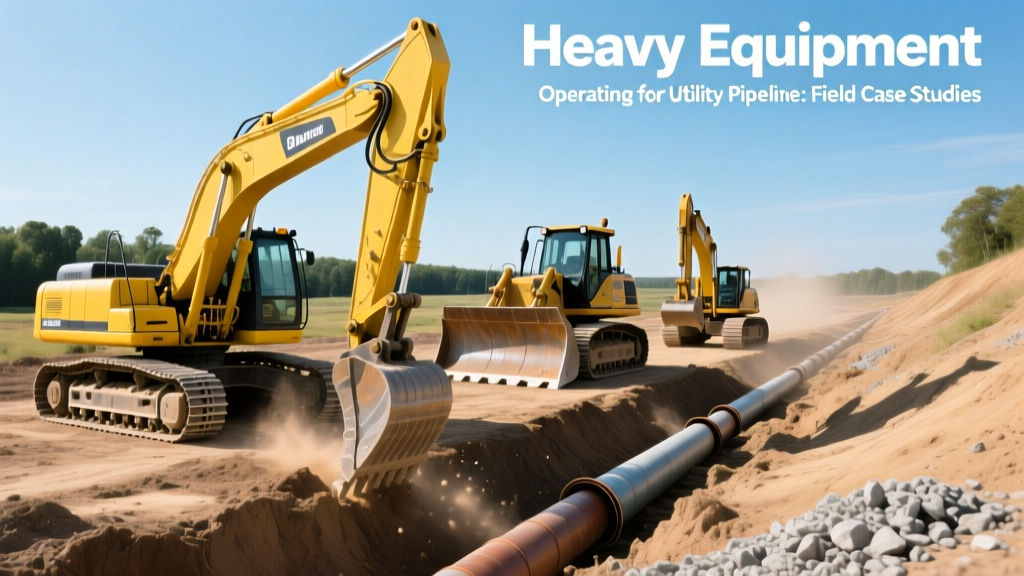
Rather than relying on brute force, modern pipeline contractors optimize heavy equipment operating costs by pairing specialized attachments with intelligent grade control. This article examines two distinct field case studies—cross-country Appalachian gas transmission and dense urban water main replacement—to illustrate how specific machinery is deployed, managed, and maintained in active pipeline corridors.
Industry Insight: The transition from conventional surveying to 3D machine control in pipeline trenching has reduced over-excavation by an average of 18%, saving contractors up to $4.50 per linear foot in backfill and compaction costs.Case Study 1: Cross-Country Natural Gas Transmission (Appalachian Terrain)
Laying a 24-inch natural gas transmission line through the fractured shale and sandstone of the Appalachian region requires a fleet capable of extreme gradeability and high winch-line pull. The primary challenge in this environment is not just digging the trench, but safely lowering 40-foot sections of coated steel pipe weighing over 3,200 pounds each into a 6-foot-deep trench on a 35% side-slope.
Equipment Fleet & Sideboom Operating Techniques
For this project, the contractor deployed a synchronized fleet of Caterpillar 583T Sidebooms and Cat D9T Track-Type Tractors. The heavy equipment operating techniques required for sidebooms are highly specialized; operators must manage the boom hoist, load line, and tractor steering simultaneously to keep the pipe parallel to the trench edge without exceeding the machine's tipping load limit.
| Equipment Model | Role in Pipeline ROW | 2026 Est. Daily Rental Rate | Fuel Burn (Gal/Hr) |
|---|---|---|---|
| Cat 583T Sideboom | Pipe stringing, bending, lowering-in | $1,850 - $2,100 | 8 - 11 |
| Cat D9T Dozer (w/ Ripper) | ROW clearing, rock ripping, backfilling | $2,400 - $2,800 | 12 - 16 |
| John Deere 850L Crawler | Winching, auxiliary lifting, cleanup | $1,200 - $1,450 | 7 - 9 |
| CRC-Evans Bending Tractor | Hydraulic cold-bending of 24-inch pipe | $3,500+ (Specialized) | 10 - 14 |
The Lowering-In Sequence
The most critical phase of cross-country pipeline construction is the lowering-in operation. Certified heavy equipment operating personnel execute this in a precise, multi-machine choreography:
- Stringing: Sidebooms travel the ROW, unloading pipe from trucks and placing it on skids exactly 2 meters from the trench lip.
- Bending: If the terrain dictates a vertical curve, a specialized bending tractor applies up to 400,000 lbs of hydraulic force to cold-bend the pipe to the exact survey radius.
- Lowering-In: Three to four sidebooms drive abreast along the trench. Operators synchronize their load-line winches (each possessing a 180,000 lb line pull capacity) to lift the welded pipe string, swing it over the trench, and lower it onto the laser-graded bedding without damaging the anti-corrosion coating.
Case Study 2: Urban Water Main Replacement (Chicago Metro Corridor)
Urban utility construction presents an entirely different set of constraints. In a recent Chicago municipal project to replace 3.2 miles of failing 12-inch cast iron water mains with 16-inch ductile iron, the right-of-way was restricted by active traffic lanes, existing fiber-optic bundles, and strict municipal noise ordinances.
GPS Machine Control & Trench Box Integration
The contractor utilized a Cat 336 Next Generation Excavator equipped with Cat Grade with 3D and a tiltrotator attachment. In urban environments, heavy equipment operating relies heavily on spatial awareness. The 3D GPS system allowed the operator to view the exact trench profile, depth to the frost line (42 inches in this zone), and the location of marked underground utilities directly on the in-cab monitor.
'By integrating RTK machine control, we eliminated the need for a grade checker inside the trench box. From a safety and efficiency standpoint, keeping personnel out of the excavation zone while maintaining sub-inch grade accuracy is the most significant advancement in urban utility trenching over the last decade.' — M. Kowalski, Senior Pipeline Superintendent
Continuous Trenching vs. Conventional Excavation
For the long, straight runs outside the immediate downtown grid, the contractor transitioned to a Ditch Witch RT115 Quad Trencher. Unlike excavators that cycle through dig-swing-dump motions, the RT115 uses a continuous cutting chain capable of excavating a 24-inch wide trench at depths up to 84 inches in mixed soils.
- Production Rate: The RT115 averaged 450 linear feet per hour in clay-loam, compared to 180 linear feet per hour with the Cat 336.
- Spoil Management: The trencher's integrated conveyor deposited spoil directly into a tandem-axle dump truck driving parallel to the machine, eliminating the need for a secondary wheel loader to stockpile dirt.
- Limitation: Trenchers cannot easily navigate around unmarked boulders or existing utility crossings, requiring the excavator to pre-pothole and clear the path.
Decision Matrix: Selecting Pipeline Equipment by Soil Type
Choosing the wrong excavation method for the local geology is a primary cause of pipeline project overruns. Use this matrix to align your heavy equipment operating strategy with the subsurface conditions.
| Soil / Geology Type | Primary Excavation Equipment | Required Attachments / Modifications | Estimated Trenching Cost (per LF) |
|---|---|---|---|
| Loose Sand / Topsoil | Ditch Witch RT115 Trencher | Standard chain, carbide-tipped teeth | $4.50 - $6.00 |
| Heavy Clay / Glacial Till | Cat 336 Excavator | Hydraulic thumb, 36-inch ditching bucket | $8.00 - $11.50 |
| Fractured Shale / Soft Rock | Cat D9T Dozer + 336 Excavator | Single-shank ripper, hydraulic hammer (Hoe Ram) | $14.00 - $19.00 |
| Solid Granite / Bedrock | Drill & Blast + Cat 390F Excavator | Rock bucket, ripper-tooth profile | $25.00 - $40.00+ |
Trench Safety and Compliance in Modern Pipeline Projects
Regardless of the machinery deployed, trench collapse remains a fatal hazard in utility construction. According to OSHA trenching and excavation standards, any trench deeper than 5 feet requires a protective system unless the excavation is made entirely in stable rock. In pipeline construction, where trenches routinely exceed 6 to 8 feet, contractors must utilize engineered trench boxes or hydraulic shoring.
Modern heavy equipment operating protocols dictate that excavators must be equipped with quick-coupler safety locks to prevent accidental bucket detachment while lifting trench shields. Furthermore, the Pipeline and Hazardous Materials Safety Administration (PHMSA) mandates strict backfill compaction standards to prevent pipe stress and coating damage. Contractors now use GPS-enabled vibratory compactors that map the exact number of passes and compaction force applied over the pipe bedding, generating a digital as-built record that satisfies both municipal and federal inspectors.
Final Operational Takeaways
Success in utility and pipeline construction hinges on matching the machine to the specific phase of the ROW lifecycle. While sidebooms remain irreplaceable for cross-country pipe handling, the integration of 3D GPS on standard excavators has revolutionized urban utility trenching. Fleet managers who invest in machine control subscriptions (averaging $3,500 annually per machine) and specialized operator training consistently see a 15-20% reduction in overall earthmoving costs and a drastic decrease in utility strike incidents.