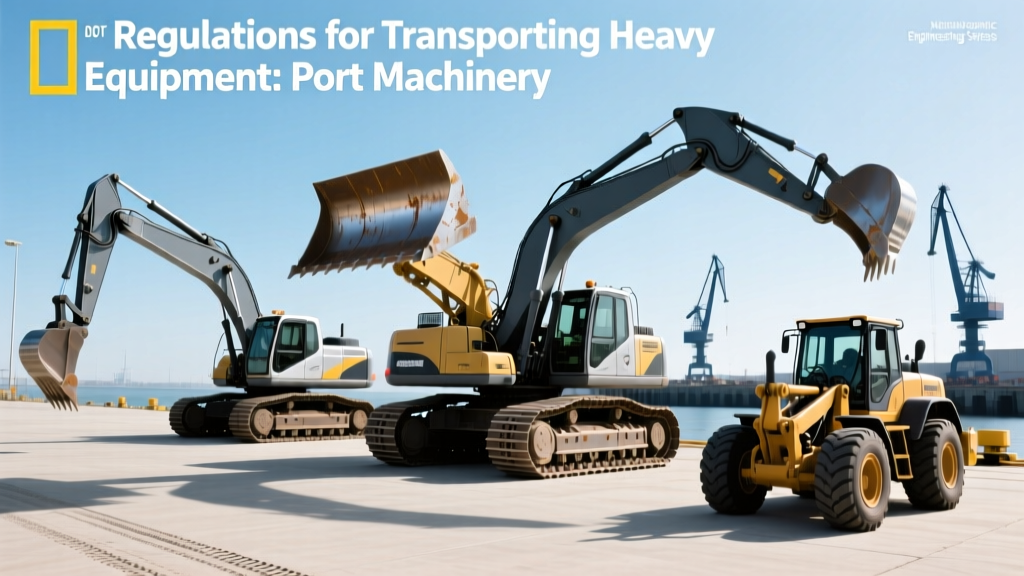
DOT Regulations for Transporting Heavy Equipment: Port Machinery
Compare over-the-road, barge, and RoRo methods while navigating DOT regulations for transporting heavy equipment like reach stackers and STS cranes.
The Weight of the Move: Why Port Equipment Defies Standard Limits
Moving marine and port machinery from the manufacturer to the terminal is a logistical puzzle where physics collides with federal law. A standard Kalmar DRF450-70S5 reach stacker weighs approximately 154,000 pounds in operating condition. A Liebherr LHM 550 mobile harbor crane exceeds 300 tons. When project managers and terminal operators evaluate how to relocate these assets, understanding the precise dot regulations for transporting heavy equipment is the dividing line between a predictable transit and a six-figure impoundment penalty.
The standard U.S. Interstate Highway System enforces an 80,000-pound Gross Vehicle Weight (GVW) limit. Port machinery inherently shatters this ceiling. Consequently, logistics teams must perform a rigorous comparison of transport alternatives—weighing the friction of over-the-road (OTR) permitting against the capital expenditure of maritime alternatives like barge or Roll-on/Roll-off (RoRo) shipping.
Quick Specs: Transport Weights of Common Port Machinery
- Kalmar DRT450 Reach Stacker: ~158,000 lbs (Requires 9-13 axles for OTR compliance)
- Konecranes SMV 286 TC Terminal Tractor: ~22,000 lbs (Fits standard OTR, but exceeds width limits)
- STS (Ship-to-Shore) Crane Components: 200,000+ lbs per modular boom section (Mandatory specialized haul or barge)
Decoding Federal and State DOT Restrictions
The regulatory framework governing heavy haul on public roads is not a single document, but a layered matrix of federal baseline rules and state-specific permitting. The Federal Motor Carrier Safety Administration (FMCSA) and the Federal Highway Administration (FHWA) dictate the baseline physics of road wear, while state Departments of Transportation issue the actual movement permits.
The Federal Bridge Formula in Practice
To prevent catastrophic bridge failures, the FHWA enforces the Federal Bridge Formula: W = 500 [LN/(N-1) + 12N + 36]. This mathematical mandate dictates that as weight increases, the number of axles (N) and the distance between them (L) must scale proportionally. According to Federal Highway Administration freight guidelines, moving a 160,000-pound load (tractor, multi-axle lowboy trailer, and reach stacker) legally across an Interstate bridge requires a minimum of 6 axles, but practically demands a 9-axle to 13-axle configuration to avoid overweight penalties on localized spans.
Dimensional Nightmares: Width and Height
Weight is only half the regulatory battle. The federal standard width limit is 8.5 feet (102 inches). Empty container handlers and terminal tractors frequently exceed 12 feet in width to accommodate stability and turning radii. This triggers 'Superload' classifications in most states, mandating route surveys, utility wire lifts, and certified pilot escorts. Navigating these dimensional FMCSA regulatory frameworks adds an average of 14 to 21 days to the pre-transit planning phase for cross-state port equipment moves.
Transport Alternatives Matrix: OTR vs. Barge vs. RoRo
When DOT regulations for transporting heavy equipment make OTR hauls prohibitively expensive or legally impossible, logistics managers must pivot to maritime alternatives. Below is a comparative analysis of the three primary transport methods for port machinery.
| Transport Method | DOT Permit Burden | Estimated 2026 Cost | Transit Speed | Best Application |
|---|---|---|---|---|
| Over-the-Road (OTR) | Extreme (State-by-State Superload permits) | $18 - $28 / mile + $5k permits | Slow (Night moves only) | Inland river ports, short-haul dealer transfers |
| Deck Barge Charter | Zero (USCG maritime rules apply instead) | $45,000 - $85,000 per voyage | Moderate (Tide/Weather dependent) | Coastal port-to-port, STS crane booms |
| RoRo (Roll-on/Roll-off) | Low (Standard port terminal access) | $300 - $500 per RT (Revenue Ton) | Fast (Scheduled shipping lanes) | Wheeled port tractors, smaller reach stackers |
When to Abandon OTR: The Barge Alternative
Over-the-road heavy haul is the default for inland terminals, but for coastal marine ports, OTR often fails the cost-benefit analysis. Consider the relocation of a decommissioned Liebherr mobile harbor crane from the Port of Savannah to a new facility in Charleston. The OTR route requires crossing dozens of aging county bridges, necessitating structural engineering assessments and temporary bridge shoring—costs that can exceed $120,000 before the crane even moves.
By utilizing a 250x60 foot deck barge, the transport entirely bypasses state DOT weight and dimensional restrictions. The capital expenditure shifts from highway permitting and escort vehicles to maritime logistics: tugboat charter, marine surveyors, and sea-fastening (welding the crane to the barge deck). While barge transport requires navigating U.S. Coast Guard (USCG) regulations and Jones Act compliance for crewing, it eliminates the unpredictable variable of local municipal road closures and bridge weight limits.
Pros and Cons of Barge Transport for Port Machinery
Advantages
- Completely bypasses state DOT weight limits and bridge formulas.
- No width or height restrictions for STS crane booms.
- Eliminates road-wear liability and municipal infrastructure damage claims.
- Allows for simultaneous transport of multiple units (e.g., three reach stackers on one deck).
Disadvantages
- Requires deep-water access and heavy-lift shore cranes at both origin and destination.
- Highly susceptible to weather delays and tidal draft restrictions.
- Sea-fastening engineering and welding add $10,000+ in prep costs.
- Not viable for inland river terminals lacking barge docking infrastructure.
Dimensional Friction: Escort and Route Survey Costs
When OTR is the only viable option, the hidden costs of dimensional compliance drastically alter the project budget. Moving a Konecranes empty container handler (often exceeding 14 feet in width and 15 feet in height) triggers Superload status in 42 U.S. states.
A 2026 logistical analysis of a 400-mile Superload move reveals the following auxiliary costs that sit entirely outside the trucking company's line-haul rate:
- Route Surveys: $3,500 - $6,000 for private engineering firms to measure overhead clearances and turning radii.
- Utility Lifts: $1,200 per day to coordinate with local telecom and power companies to raise or de-energize lines.
- Law Enforcement Escorts: $85 - $150 per hour, per state trooper, often mandated for loads exceeding 14 feet in width.
- Curfew Delays: Most states restrict Superload movement to nighttime hours (e.g., 9:00 PM to 5:00 AM), stretching a 12-hour drive into a multi-day operation due to mandatory rest periods.
Strategic Decision Framework for Terminal Operators
To determine the optimal transport method for marine and port equipment, logistics managers should apply the following decision matrix before issuing a Request for Proposal (RFP):
- Calculate the Axle Requirement: Run the equipment's GVW through the Federal Bridge Formula. If the required axle count exceeds 11, OTR costs will scale exponentially due to specialized trailer availability.
- Map the Waterway Access: Does the origin dealer and the destination terminal both possess deep-water ro-ro ramps or heavy-lift shore crane capabilities? If yes, immediately pivot to barge or RoRo quoting.
- Audit the Bridge Envelopes: Use state-specific GIS routing software to identify weight-restricted bridges on the OTR route. If the route requires more than two bridge structural assessments, the maritime alternative will yield a higher ROI.
- Factor in Commissioning Timelines: OTR allows for precise, scheduled delivery dates (weather permitting). Barge transport introduces a 15% variance in arrival times due to maritime traffic and weather. Align the transport choice with the terminal's operational go-live deadline.
Ultimately, mastering the intersection of port machinery specifications and federal transport law requires abandoning the assumption that the highway is the default path. By rigorously comparing OTR permitting friction against maritime alternatives, terminal operators can protect their capital budgets and ensure critical cargo-handling equipment arrives ready for deployment.