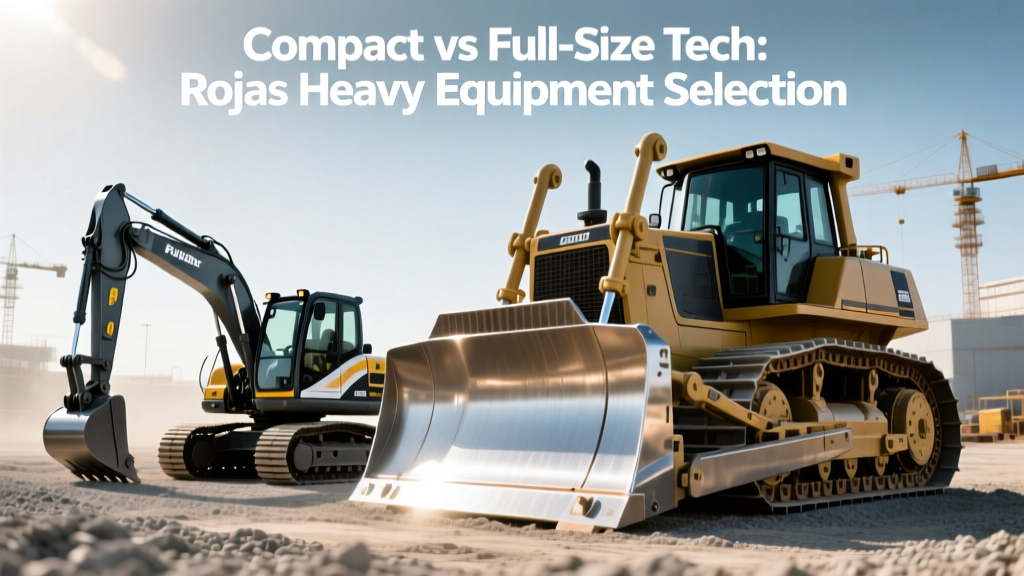
Compact vs Full-Size Tech: Rojas Heavy Equipment Selection
Compare compact vs full-size construction equipment tech trends. Explore electrification, 3D machine control, and fleet selection strategies.
The Paradigm Shift in Iron Selection
Selecting between compact and full-size construction equipment is no longer a simple calculation of physical footprint versus breakout force. In 2026, the decision hinges on a complex matrix of digital integration, powertrain architecture, and site-specific telemetry. While full-size machinery continues to push the boundaries of semi-autonomous grading and high-voltage hybrid hydraulics, compact equipment has leapfrogged into advanced electrification and LiDAR-based spatial awareness. For fleet managers and procurement teams utilizing the Rojas Heavy Equipment allocation framework, understanding these divergent technological trajectories is critical for maximizing utilization rates and minimizing idle-time depreciation.
2026 Fleet Tech Snapshot
- Compact Electrification: 48V and 800V battery-electric systems now account for 34% of new compact excavator deliveries in urban markets.
- Full-Size Autonomy: RTK GNSS-enabled 3D machine control is standard on 78% of new 30-ton+ excavators and dozers.
- Telematics ROI: Fleet-wide API integration reduces fuel and maintenance waste by an average of 18% annually.
Electrification Asymmetry: Battery vs. Diesel-Hydraulic
The most pronounced technological divergence between compact and full-size equipment lies in powertrain architecture. Compact equipment has fully embraced battery-electric platforms, driven by municipal emission mandates and indoor operational requirements. Models like the Bobcat E10e and Volvo ECR25 Electric utilize 48V lithium-ion battery packs, delivering zero-tail-swing profiles with 4 to 6 hours of active runtime. Priced between $85,000 and $120,000, these units eliminate localized particulate matter and reduce acoustic output to under 70 decibels, allowing for night-shift work in noise-restricted urban zones.
Conversely, full-size equipment (30-ton excavators, large wheel loaders, and heavy dozers) remains tethered to diesel, though the integration of high-voltage hydraulic hybrids and regenerative swing drives has drastically altered the efficiency curve. A Caterpillar 336 or John Deere 380P operating in 2026 utilizes advanced electro-hydraulic valves that recover kinetic energy during the boom-down and swing-braking phases, storing it in ultracapacitors to assist the next dig cycle. This reduces fuel consumption by up to 25% compared to legacy open-center hydraulic systems, but the base acquisition cost remains steep, typically ranging from $450,000 to $650,000. According to data from the Association of Equipment Manufacturers (AEM), the total cost of ownership (TCO) for full-size hybrid-hydraulic machines reaches parity with older diesel models only after 4,500 operating hours, making them viable strictly for high-production, multi-shift environments.
Machine Control and Autonomy Gradients
The application of spatial awareness technology scales inversely with machine size. Full-size equipment relies heavily on Real-Time Kinematic (RTK) Global Navigation Satellite Systems (GNSS) for millimeter-accurate 3D machine control. Systems like Cat Grade with 3D or John Deere SmartGrade integrate dual GNSS receivers directly into the cab roof, feeding digital terrain models (DTMs) directly to the hydraulic valves. This allows operators to execute complex sub-grade sloping and trenching without manual grade stakes, cutting rework costs by an estimated 40%.
Compact equipment, however, operates primarily in 'GNSS-denied' or 'GNSS-degraded' environments—such as dense urban infill, indoor demolition, or deep utility trenches where satellite multipath errors render RTK useless. Instead of satellite grading, compact tech focuses on localized LiDAR, ultrasonic proximity sensors, and sonar-based payload weighing. These systems prioritize collision avoidance, underground utility mapping (when paired with ground-penetrating radar attachments), and precise spatial navigation in confined footprints. The Associated General Contractors of America (AGC) frequently highlights that while full-size autonomy boosts raw production volume, compact sensor arrays are the primary drivers of site safety and asset protection in congested work zones.
| Feature Dimension | Compact Equipment (Under 8 Tons) | Full-Size Equipment (20+ Tons) |
|---|---|---|
| Primary Powertrain | 48V/800V Battery Electric, Micro-Diesel | Tier 4 Final Diesel, Hydraulic-Hybrid |
| Spatial Tech Focus | LiDAR, Ultrasonic Avoidance, GPR Integration | RTK GNSS, 3D Machine Control, Drone Mapping |
| Telematics Priority | Battery State-of-Health (SoH), Geofencing | Payload Weighing, Fuel Burn, Cycle Times |
| Typical Acquisition Cost | $65,000 - $140,000 | $350,000 - $750,000+ |
| Best 2026 Use Case | Urban utility, indoor demo, emission-restricted zones | Mass earthmoving, highway grading, quarry production |
The Rojas Heavy Equipment Fleet Allocation Framework
When structuring mixed fleets, procurement specialists referencing the Rojas Heavy Equipment allocation model prioritize 'task-technology fit' over raw spec-sheet comparisons. The framework dictates that equipment selection must be driven by the data-gathering requirements of the specific project phase.
Strategic Deployment Rule
Phase 1 (Site Prep & Mass Excavation): Deploy full-size machinery equipped with 3D GNSS machine control to establish digital baselines and execute bulk material movement. The ROI on the $50,000+ machine control mast is realized through the elimination of manual survey crews and grade rework.
Phase 2 (Utility Tie-ins & Finishing): Transition to compact, LiDAR-equipped electric excavators. The smaller footprint prevents soil compaction on newly laid sub-bases, while the electric powertrain allows for operation inside enclosed structures or near sensitive municipal infrastructure without vibration or exhaust damage.
Edge Cases: When Tech Specs Fail in the Dirt
Theoretical specifications often degrade in real-world operational environments. Fleet managers must account for specific failure modes inherent to both compact and full-size technology stacks.
Battery Thermal Throttling in Compact Electrics
A common miscalculation when spec'ing compact electric excavators is assuming the published 5-hour runtime holds true under continuous high-load hydraulic demands. In ambient temperatures exceeding 95°F (35°C), the battery management system (BMS) on 48V compact units will aggressively throttle hydraulic pump RPMs to prevent thermal runaway. This can reduce effective breakout force by up to 30% and drop active runtime to 2.5 hours. To mitigate this, sites must deploy mobile DC fast-chargers or rotate units during mid-day heat peaks, rather than relying on a single machine for continuous trenching.
Mitigating GNSS Multipath in Urban Infill
Full-size excavators relying on RTK GNSS for 3D machine control frequently experience 'multipath errors' in dense urban corridors, where satellite signals bounce off glass skyscrapers and steel structures before reaching the cab receiver. This results in the machine control system falsely reading the bucket elevation by 2 to 4 inches, leading to severe sub-grade over-excavation. The required fix is not a software patch, but a hardware one: equipping full-size machines in urban zones with total-station robotic tracking prisms (e.g., Leica iCON) mounted to the boom, bypassing satellite reliance entirely and maintaining millimeter accuracy via localized laser triangulation.
Finalizing the Procurement Matrix
The choice between compact and full-size equipment is ultimately a decision about data architecture and energy density. Full-size machines are high-capacity data and material processors, justified only when the site geometry allows for continuous, high-volume material movement. Compact machines are highly specialized, sensor-dense tactical units designed for precision, access, and environmental compliance. By evaluating the specific telemetry, powertrain, and spatial requirements of your upcoming docket, you can align your capital expenditures with the exact technological tools required to execute the scope efficiently.