Troubleshooting Heavy Machinery Moving Equipment in Charleston SC
Expert troubleshooting guide for earthmoving and heavy machinery moving equipment in Charleston SC. Fix hydraulics, undercarriage wear, and transport issues.
Environmental Stressors on Earthmovers in the Lowcountry
Operating earthmoving equipment in the coastal plains of South Carolina introduces a unique matrix of mechanical stressors. When troubleshooting heavy machinery moving equipment in Charleston, SC, fleet managers must account for the region's high water table, abrasive silica sand in the uplands, and the highly corrosive salt air prevalent near the harbor and barrier islands. Standard OEM maintenance intervals often fall short in these conditions, leading to premature failure of hydraulic seals, undercarriage components, and electrical sensors.
⚠️ Coastal Corrosion Warning: Equipment operating within 5 miles of the Charleston coastline (e.g., Mount Pleasant, Sullivan's Island, James Island) experiences a 30-40% increase in electrical connector oxidation and hydraulic cylinder pitting compared to inland operations. Dielectric grease application on all sensor harnesses must be increased from annual to quarterly intervals.Hydraulic System Diagnostics for Coastal Excavators
Excavators like the Caterpillar 320 GC and Komatsu PC210LC-11 are staples for trenching and foundation work in Charleston's loamy, high-moisture soils. The ambient humidity, often exceeding 75% year-round, accelerates hydraulic fluid degradation if breathers are compromised. Below is a diagnostic matrix for common hydraulic failures observed in local fleets.
| Symptom | Probable Cause (Lowcountry Specific) | Diagnostic Step | Resolution Spec |
|---|---|---|---|
| Boom/Arm Drift (Cylinder Creep) | Scored cylinder walls from microscopic sand ingress via damaged rod wipers. | Perform internal leak-down test; measure drift over 15 mins at 50% load. | Replace rod seals and wipers; max allowable drift is 3mm/15 min. |
| Pump Cavitation (Whining Noise) | Hydraulic tank breather clogged with humid, salt-laden dust, creating a vacuum. | Check tank vacuum gauge; inspect breather desiccant for color change. | Replace breather; maintain tank pressure at 0.5 - 1.0 psi. |
| System Overheating (>180°F) | Hydraulic oil cooler fins packed with coastal marsh grass and cottonwood debris. | Thermal imaging of cooler core; measure delta-T across the cooler. | Air-blow core from inside out; flush with low-pressure water. |
According to For Construction Pros earthmoving analysis, switching to synthetic hydraulic fluids (such as Mobil DTE 10 Excel 46) can improve thermal stability and resist oxidation in high-humidity environments, extending fluid life by up to 3,000 hours compared to standard mineral-based AW46 oils.
Undercarriage Degradation in Sandy and Marsh Soils
The undercarriage represents up to 50% of a dozer's total repair costs over its lifespan. In Charleston, contractors frequently transition between highly abrasive, dry upland sands and the corrosive, acidic mud of salt marshes. This dual-environment operation wreaks havoc on track links, idlers, and sprockets.
Adjusting Track Tension on the John Deere 850L
Incorrect track tension is the leading cause of premature undercarriage wear. In soft marsh mud, tracks must be run slightly looser to prevent mud packing from snapping the track chain. Conversely, in dry sandy soil, tighter tracks prevent derailment. Here is the precise procedure for adjusting the John Deere 850L track tension for Charleston's mixed terrains:
- Preparation: Park the dozer on a level, hard surface. Cycle the tracks forward and reverse for three minutes to clear debris from the sprockets.
- Measurement: Place a straight edge across the track shoes between the front idler and the first track roller. Measure the sag at the midpoint. The OEM specification for standard conditions is 1.2 to 1.6 inches (30-40mm).
- Marsh Mud Adjustment: If operating in the ACE Basin or coastal marshes, increase the sag to 1.8 inches (45mm) to allow mud to purge from the links.
- Grease Valve Operation: To loosen the track, open the track adjuster grease valve exactly one-half turn. Never open the valve fully, as the high-pressure grease (up to 10,000 psi) can cause severe injection injuries.
- Tightening: To tighten, use a manual grease gun to pump Mobilgrease XHP 461 into the adjuster valve until the 1.2-inch sag is achieved. Do not use an air-powered grease gun, as it can easily over-pressurize and blow the recoil spring seals.
Electrical Faults in Grade Control Systems
Modern earthmovers rely heavily on 3D machine control systems (e.g., Trimble Earthworks, Topcon X-53i) to achieve sub-inch grading accuracy. In the Charleston area, the combination of high salinity and extreme humidity leads to rapid galvanic corrosion on the CAN bus connectors and GNSS receiver mounts.
"We see a 22% higher failure rate on machine control IMU sensors in coastal South Carolina compared to our inland Piedmont fleets. The salt air penetrates standard IP67 seals over time. We now mandate dielectric compound packing on every sensor connector during the bi-annual calibration."
— Fleet Maintenance Director, Regional Civil Contractor
Troubleshooting Intermittent GNSS Signal Loss:
If the grade control system frequently loses RTK fix in the Charleston harbor area, first inspect the coaxial cable routing. Ensure the GNSS antenna cable is routed at least 6 inches away from the machine's main alternator power lines to prevent electromagnetic interference (EMI). Next, check the SMA connector at the receiver base for green copper oxidation. Clean with isopropyl alcohol and apply a marine-grade silicone sealant over the connection boot.
Transporting Earthmovers: SC DOT Bridge Limits & Rigging
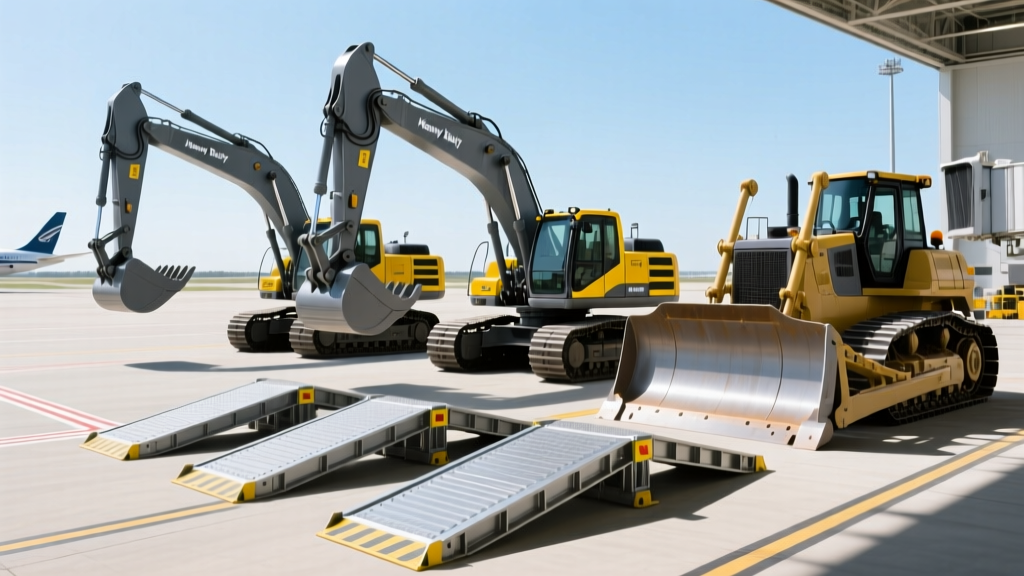
The phrase "heavy machinery moving equipment" also encompasses the critical logistics of transporting these massive assets between job sites. Moving a 45-ton excavator or a 50-ton dozer through Charleston requires strict adherence to South Carolina Department of Transportation (SC DOT) regulations, particularly regarding the aging infrastructure of the I-526 corridor and the Don Holt Bridge.
📋 SC DOT Transport Checklist for Heavy Earthmovers:- Gross Vehicle Weight (GVW): Standard limit is 80,000 lbs on the National System of Interstate and Defense Highways. Moving a Cat 336 (approx. 80,000 lbs operating weight) requires a lowboy trailer with a spread-axle configuration or an overweight permit.
- Permitting: Oversize/overweight permits must be secured via the SC DOT Trucking Permits portal at least 48 hours in advance for non-routine moves.
- Bridge Restrictions: Verify route-specific bridge postings. The Wando River Bridge and older spans on US-17 have strict axle-weight distributions that prohibit concentrated loads typical of 3-axle lowboy trailers carrying dozers.
- Tie-Down Specs: Use a minimum of four 5/8-inch Grade 70 transport chains with a working load limit (WLL) of 18,100 lbs each. Ensure binders are lever-type or ratchet-type, secured with safety lock pins to prevent vibration loosening on the corrugated steel deck plates of the Ravenel Bridge approach.
Preventative Maintenance Scheduling
To mitigate the accelerated wear caused by the Charleston environment, standard 500-hour service intervals must be adapted. Fleet managers should implement a localized maintenance matrix:
- Every 250 Hours: Grease all undercarriage pivot points and bucket linkage pins using a lithium-complex EP2 grease with molybdenum disulfide (MoS2) to resist water washout in trenching applications.
- Every 500 Hours: Sample hydraulic oil and engine oil. Specifically test for sodium and chloride levels to detect early-stage cooler breaches or salt-air ingestion.
- Annually: Inspect all structural welds on the boom and stick for stress cracking, utilizing magnetic particle inspection (MPI) on machines with over 8,000 hours operating in high-vibration rocky or hardpan conditions.
For comprehensive safety and operational standards regarding equipment transport and site operation, always refer to the OSHA Heavy Equipment Guidelines. Proper troubleshooting and localized maintenance are not merely about preventing downtime; they are critical to ensuring operator safety and structural integrity in one of the most demanding coastal construction environments in the United States.