Heavy Equipment Mats Rentals: Troubleshooting Pipeline Ground Failures
Troubleshoot pipeline right-of-way ground failures and rutting. Learn how heavy equipment mats rentals stabilize utility sites and prevent costly delays.
Diagnosing Right-of-Way (ROW) Subgrade Failures
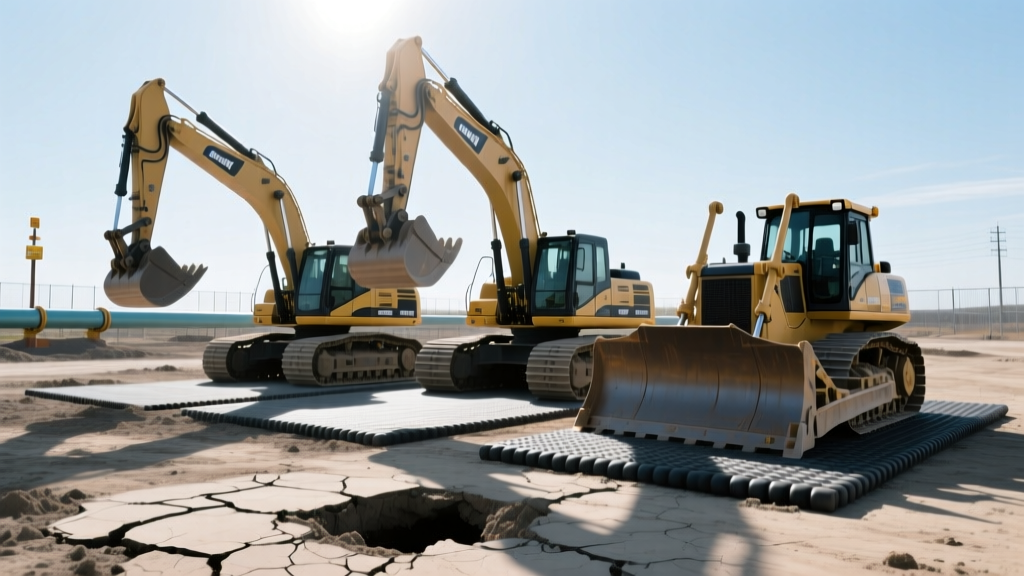
Pipeline construction spreads operate in some of the most unforgiving terrain in North America. When utility contractors deploy 75,000-pound Caterpillar 583T Sidebooms or CRC-Evans bending machines onto saturated clay or peat, subgrade failure is not a possibility; it is an imminent operational threat. Ground bearing failures on the right-of-way (ROW) manifest in three distinct phases: initial rutting (exceeding 3 inches), differential settlement (track slippage and lateral shift), and catastrophic punch-through (where the mat and equipment sink below the water table).
Before sourcing heavy equipment mats rentals, site superintendents must accurately diagnose the failure mode. Relying on visual inspection alone is insufficient. A California Bearing Ratio (CBR) below 3 indicates that the native soil cannot support the dynamic loads of pipeline stringing and lowering-in operations without a engineered load-distribution platform.
⚠️ Regulatory Warning: Wetland Rutting LimitsAccording to the U.S. Environmental Protection Agency (EPA) and standard U.S. Army Corps of Engineers Nationwide Permit 12 conditions, rutting exceeding 6 inches in jurisdictional wetlands constitutes a violation. Fines under the Clean Water Act Section 404 can escalate rapidly, making proactive mat deployment a financial necessity, not just an operational one.
The Troubleshooting Matrix: Matching Soil Failure to Mat Specifications
Not all ground failures require the same solution. A common mistake in utility construction is over-specifying mats for stable terrain or under-specifying them for muskeg. When evaluating heavy equipment mats rentals for utility corridors, use this diagnostic matrix to match the subgrade condition to the correct rental inventory.
| Subgrade Condition | CBR Value | Primary Failure Mode | Required Mat Specification | Estimated 2026 Rental Rate |
|---|---|---|---|---|
| Compacted Clay / Dry Sand | 8 - 12 | Surface abrasion, minor rutting | Laminated Timber (8x14 ft, 4-inch thick Oak) | $8 - $12 / day |
| Saturated Loam / Silt | 4 - 7 | Differential settlement, edge curling | UHMWPE Composite (Spartan Mat or TuffTrak) | $18 - $24 / day |
| Peat / Muskeg / Wetlands | 1 - 3 | Catastrophic punch-through, lateral shift | Steel Road Plates or Heavy-Duty Crane Mats (12-inch timber) | $35 - $50 / day |
Calculating Ground Bearing Pressure (GBP) for Pipeline Spreads
Troubleshooting a failing access road requires understanding the exact pressure the equipment exerts on the mats. Ground Bearing Pressure (GBP) is calculated by dividing the equipment's operating weight by the total track footprint.
Consider a Liebherr PR 736 pipeline dozer with an operating weight of 55,000 lbs and a track footprint of approximately 45 square feet. The bare GBP is roughly 1,222 PSF. If deployed on a 20-foot wide UHMWPE mat road, the load distributes over a wider area, but dynamic loading (pushing dirt, winching) can spike the localized pressure by 40%. If the subgrade yields under 1,700 PSF, the mat road will fail. In these scenarios, contractors must interlock two layers of composite mats in a cross-hatch (brick) pattern to double the moment of inertia and distribute the load laterally.
Field Troubleshooting: Rigging, Pinning, and Extraction Failures
The most frequent delays on pipeline spreads do not occur because the mats failed to support the load, but because the mat connections failed during deployment or extraction.
Camlock and Poly-Pin Shearing
UHMWPE composite mats utilize integrated camlock or poly-pin connection systems. When heavy equipment mats rentals arrive on site, operators often force pins into misaligned holes using excavator buckets, micro-fracturing the polyethylene. The Fix: Never use an excavator to drive pins. Use a manual sledge or a pneumatic post driver. If a camlock housing is cracked, drill a 1.5-inch hole through both overlapping mats and secure them with a Grade 8 steel bolt and a large fender washer. This field-expedient repair restores 85% of the lateral shear strength.
Mud-Packed Joint Extraction
During demobilization, clay and silt pack tightly into the interlocking joints, effectively gluing the mats together. Ripping them apart with a dozer often tears the connection flanges. The Fix: Deploy a vacuum excavator (vac-truck) with a 1,500 CFM blower and a 3,000 PSI water lance to hydro-blast the joints before extraction. This reduces demobilization damage by up to 60%, saving thousands in end-of-rental damage fees.
Geotextile Separation Layer Failures
Mats alone cannot stabilize a failing ROW; they require a geotextile underlay. A frequent troubleshooting scenario involves mats sinking uniformly into soft soil. This is almost always caused by geotextile bunching or tearing during mat deployment. If the non-woven fabric is not pulled taut and anchored at the leading edge, the friction of the mats being dragged across it will cause the fabric to accordion, creating voids where mud boils up between the mat joints. Always specify a minimum 6 oz/sq yd non-woven geotextile, and anchor it with 3-foot steel rebar pins every 20 feet along the centerline before laying the first mat.
2026 Cost-Benefit Analysis: Rentals vs. Environmental Remediation
Project managers frequently attempt to cut costs by minimizing the footprint of their heavy equipment mats rentals. This false economy inevitably leads to environmental remediation costs that dwarf the rental invoices. According to guidelines monitored by the Federal Energy Regulatory Commission (FERC), unauthorized soil displacement and wetland compaction trigger immediate stop-work orders.
| Cost Category | Proactive Mat Deployment (Per Mile) | Reactive Remediation (Post-Rutting) |
|---|---|---|
| Mat Rental & Freight | $45,000 - $60,000 | $15,000 (Insufficient coverage) |
| Soil Excavation & Disposal | $0 | $85,000 (Contaminated mud removal) |
| Regulatory Fines & Delays | $0 | $120,000+ (Stop-work & EPA fines) |
| Total Project Impact | $45,000 - $60,000 | $220,000+ |
For utility and pipeline contractors, the data is unambiguous. Properly spec'd composite mats, paired with correct geotextile deployment and careful rigging practices, are the only reliable method to prevent subgrade failures on the ROW. Sourcing high-quality inventory and training operators on proper connection and extraction techniques ensures the spread keeps moving without triggering catastrophic environmental liabilities.