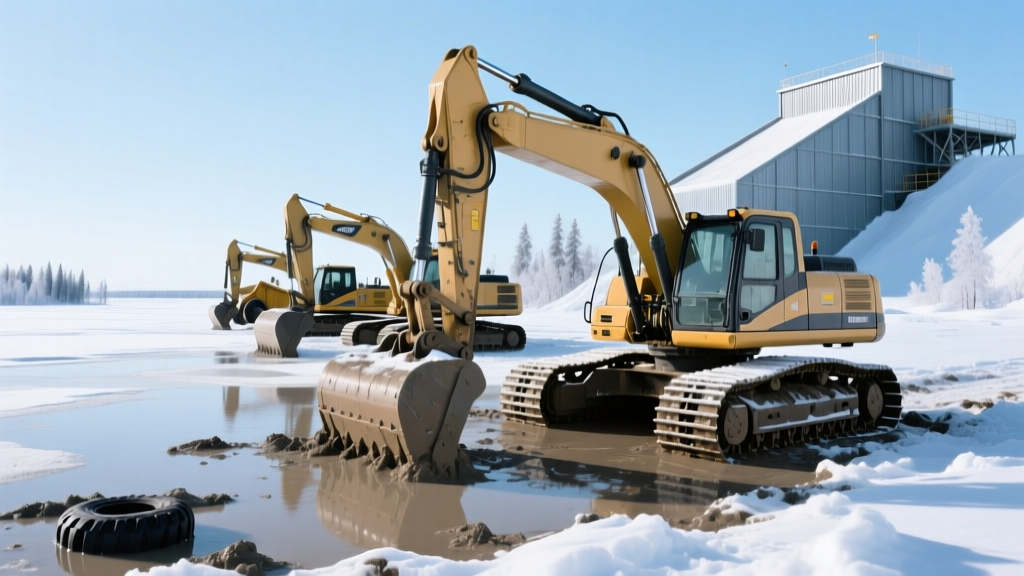
Maintaining Snow Fleets: Swamp Mats for Heavy Equipment Dump Sites
Learn how to maintain snow removal fleets and deploy swamp mats for heavy equipment at dump sites. Includes winter service schedules and fluid specs.
The Hidden Toll of Winter Ops on Snow Removal Fleets
Snow removal operations extend far beyond plowing routes; the logistical bottleneck of any municipal or commercial winter contract is snow hauling and dumping. When articulated haulers and wheel loaders transport thousands of tons of snow to designated staging areas, the ground rapidly degrades into a corrosive slurry of mud, ice, and road salt. Fleet managers often focus on blade wear and hydraulic hose brittleness, but the staging ground itself dictates machine survivability. Operating heavy machinery in unprepared, thawing dump sites leads to catastrophic undercarriage sinkage, track tension failures, and severe galvanic corrosion from concentrated brine runoff.
As of the 2026 winter season, advanced fleet maintenance protocols require integrating ground protection into the operational workflow. Deploying swamp mats for heavy equipment at municipal snow dump sites is no longer an optional environmental courtesy—it is a critical maintenance strategy that prevents six-figure recovery costs and extends undercarriage life by up to 40% in high-mud, high-salt environments.
Snow Dump Site Staging: Deploying Swamp Mats for Heavy Equipment
When selecting and maintaining swamp mats for heavy equipment in snow management applications, contractors must account for extreme thermal cycling. A mat deployed at -10°F in January may be sitting in 45°F slush by March. Cross-Laminated Timber (CLT) mats and High-Density Polyethylene (HDPE) composite mats behave differently under these conditions.
- CLT Mats (8x14 ft, 8,000 lb capacity): Ideal for heavy articulating haulers and loaded wheel loaders. Costing approximately $1,200 to $1,500 per mat, CLT provides superior traction in icy slush. However, the steel cables binding the timber must be inspected weekly for salt-induced oxidation.
- HDPE Composite Mats: Lighter and easier to deploy with a skid steer, but standard composites can suffer impact brittleness at temperatures below -20°F. If a loaded Caterpillar 966M wheel loader strikes a frozen composite mat edge at 15 mph, the mat can shatter, sending shrapnel into the machine's radiator core.
Sub-Zero & High-Salt Service Schedules
Standard OEM maintenance intervals are designed for temperate, clean environments. Winter snow removal demands an aggressive, accelerated service schedule to combat magnesium chloride (MgCl2) and sodium chloride (NaCl) infiltration. Below is the mandatory winter-ops service matrix for snow hauling and dumping fleets.
| Component | Standard Interval | Winter/Salt Interval | Required Action |
|---|---|---|---|
| Undercarriage & Frame Wash | As needed | Every 48 hours / 250 mi | High-pressure (2500 PSI) hot water (150°F) to dissolve brine. |
| Pivot Pins & Bushings | 500 hours | 250 hours | Purge old grease until clean NLGI #1 synthetic is visible. |
| Electrical Harnesses | 1000 hours | Weekly Visual | Apply dielectric grease to all exposed connectors to halt galvanic corrosion. |
| Track/Tire Tension | Monthly | Daily (Pre-shift) | Clear packed ice from sprockets; ice expansion can snap track chains. |
Equipment-Specific Maintenance Profiles
Wheel Loaders (e.g., Cat 966M) at the Dump Site
Wheel loaders operating on swamp mats at snow dump sites face unique lateral stress. When a 966M pushes a 12-yard snow pusher attachment across the seam of two CLT mats, the differential traction can torque the center pivot hitch beyond standard tolerances. Maintenance Directive: Inspect the center pivot hitch bearings and articulation limiters every 100 hours. Furthermore, the heat generated by the transmission during constant pushing in deep slush can degrade standard transmission fluid. Upgrade to synthetic SAE 10W-30 or OEM-equivalent synthetic drivetrain fluids rated for continuous -30°F cold starts and high-load thermal stability.
Articulated Haulers (e.g., Volvo A40G) on the Haul Route
Haulers moving snow from the city center to the mat-lined dump sites endure the worst of the road salt exposure. The primary failure mode for these units in 2026 is the corrosion of the load-sensing hydraulic lines running beneath the chassis. Maintenance Directive: Wrap all exposed hydraulic hoses in abrasion-resistant, salt-blocking spiral guard sleeves. Additionally, the retarder systems on haulers work overtime on icy downhill routes to dump sites; check retarder cooling fluid specific gravity weekly to ensure it hasn't been diluted by condensation.
Motor Graders (e.g., John Deere 872) on the Plow Route
While graders rarely enter the deep mud of the dump site, their circle moldboards and cutting edges take massive impact damage from frozen manhole covers and ice ridges. Maintenance Directive: Grease the circle turn pins daily using a heated grease gun. Standard grease becomes a solid block at -15°F, leading operators to believe the zerk fitting is full when it is actually empty, resulting in catastrophic moldboard galling within a single shift.
Fluid Viscosity and Grease Selection in Extreme Cold
The Federal Highway Administration (FHWA) frequently notes that improper winterization of heavy equipment fluids leads to hydraulic cavitation and pump destruction during morning startups. Fleet managers must strictly adhere to temperature-based fluid swaps:
- Hydraulic Fluid: Switch from standard ISO VG 46 to ISO VG 32 synthetic when ambient temperatures drop below 10°F. For extreme arctic conditions or high-altitude mountain passes (-20°F and below), ISO VG 15 is mandatory to prevent pump starvation on cold startup.
- Grease Selection: Abandon standard NLGI #2 Lithium Complex greases. They harden and channel in sub-zero temperatures. Mandate the use of NLGI #1 or #0 Synthetic Polyurea greases, which maintain a semi-fluid consistency down to -40°F, ensuring continuous lubrication of bucket linkage and steering cylinders.
- Coolant: Verify OAT (Organic Acid Technology) antifreeze concentration is at a 60/40 ratio to protect down to -62°F. A 50/50 mix only protects to -34°F, which risks freezing the heater core and engine block in severe polar vortex events.
"A single cold-start with ISO VG 46 fluid at -10°F can cause hydraulic pump cavitation, scoring the internal gears and generating metallic particulate that destroys the entire valve bank within 50 hours. Fluid viscosity is not a suggestion; it is the lifeblood of winter hydraulics."
Cost-Benefit Analysis: Mats vs. Mud-Out Recovery
Fleet managers often push back on the upfront capital expenditure of ground protection mats. However, when evaluating the total cost of ownership (TCO) and operational uptime, the math heavily favors proactive mat deployment at snow dump sites.
| Scenario | Estimated Cost | Downtime Impact |
|---|---|---|
| Deploying 50 CLT Swamp Mats | $70,000 (Capital/Lease) | 0 hours (Continuous ops) |
| Single Hauler Mud-Out Recovery | $4,500 - $12,000 (Crane, lowboy, rigging) | 12 - 24 hours per incident |
| Undercarriage Track Replacement (Ice/Mud damage) | $18,000 - $25,000 per machine | 3 - 5 days in the shop |
By integrating swamp mats for heavy equipment into the snow management plan, contractors protect the municipality's turf, comply with environmental runoff mandates, and eliminate the hidden maintenance costs associated with extracting sunken machinery from frozen, salt-laden mud pits. Winter fleet survival relies on treating the ground beneath the machine with the same mechanical respect as the engine inside it.