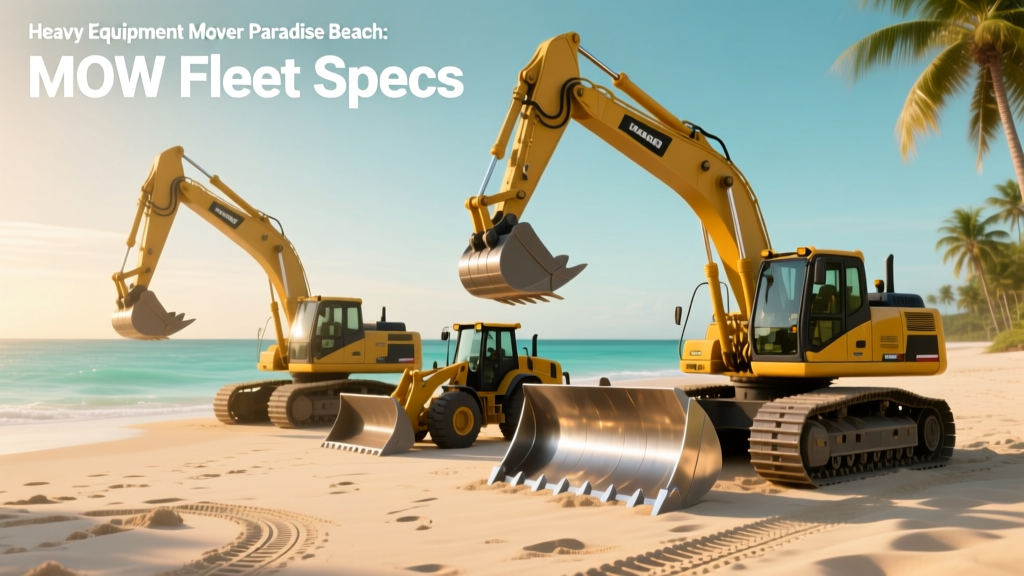
Heavy Equipment Mover Paradise Beach: MOW Fleet Specs
Technical specs and logistics for moving railroad maintenance equipment to coastal zones. Explore MOW machinery, hi-rail mechanics, and transport data.
The Logistics Challenge: Moving MOW Fleets to Coastal Corridors
Transporting Maintenance of Way (MOW) machinery to environmentally sensitive, geographically constrained coastal routes requires precise logistical engineering. When a heavy equipment mover, Paradise Beach rail corridor managers, and track contractors coordinate, the primary obstacle is subgrade bearing capacity. Coastal sand and high water tables cannot support the concentrated axle loads of 100-ton track geometry vehicles without specialized load-spreading transport solutions.
Mobilizing a full MOW fleet to a beachside right-of-way typically adds 18% to 22% to standard transport costs due to the requirement for hydraulic modular trailers (HMTs). Standard lowboys are insufficient; movers must deploy Goldhofer or Scheuerle modular units with pendulum axles to distribute the load of a Plasser & Theurer tamping machine across 12 to 16 axle lines, reducing ground pressure to under 12 tons per axle line. This prevents the trailer from sinking into the sandy shoulder access roads typical of coastal resort zones.
Transport Data Highlight: A standard continuous action tamping machine weighs approximately 85,000 lbs (38,500 kg). To traverse soft coastal access roads, a 6-axle modular trailer with a 45-degree steering angle is required to navigate the tight, 30-foot turning radii of beachfront service roads.Core Railroad Maintenance Equipment: Technical Specifications
Modern MOW equipment relies on Tier 4 Final / Stage V compliant diesel engines, LiDAR-assisted track scanning, and automated hydraulic controls. Below is a technical breakdown of the primary machines deployed for coastal track rehabilitation.
1. Continuous Action Tamping Machines (Plasser & Theurer 09-3X)
The 09-3X Tamping Express is the industry standard for restoring track geometry. Unlike older step-tamping machines, the 09-3X utilizes three independent tamping units that work simultaneously, allowing for continuous forward motion without stopping at each sleeper.
- Squeeze Pressure: Up to 120 kN per tine, ensuring ballast is packed tightly beneath the sleeper to prevent voiding—a critical factor in sandy coastal environments where ballast migration is common.
- Alignment System: Utilizes an Automatic Guiding Computer (ALC) integrated with front-and-rear laser references and inertial measurement units (IMUs) to correct lateral alignment to within 1.5 mm tolerance.
- Working Speed: Up to 2.2 km/h (1.37 mph) in continuous mode, processing roughly 1,800 sleepers per hour.
- Capital Cost: New units range from $3.2 million to $4.5 million depending on dynamic track stabilizer (DTS) attachments.
2. High-Speed Rail Grinders (Loram RGI Series)
Rail grinding removes rolling contact fatigue (RCF) and corrugations. In dry, brush-heavy coastal zones like Paradise Beach, spark suppression is a mandatory operational parameter to prevent wildfires.
- Grinding Modules: Typically equipped with 48 grinding stones (24 per rail), powered by individual 15 kW electric motors.
- Material Removal: Capable of removing 0.15 mm to 0.3 mm of rail head material per pass at operating speeds up to 10 km/h.
- Articulation: Grinding heads can articulate up to 45 degrees to target the gauge corner, where RCF cracks predominantly initiate on curved coastal tracks.
- Fire Suppression: High-volume water misting systems flank the grinding heads, consuming up to 500 gallons of water per hour to neutralize sparks before they reach dry beach grass.
Equipment Deployment Matrix
| Equipment Type | Model Example | Operating Weight | Transport Requirement | Max Working Speed |
|---|---|---|---|---|
| Continuous Tamping | Plasser 09-3X | 85,000 lbs | 8-Axle Hydraulic Modular | 2.2 km/h |
| Rail Grinder | Loram RGI 48 | 145,000 lbs | 12-Axle Modular + Escort | 10.0 km/h |
| Hi-Rail Excavator | Cat M323F | 52,000 lbs | Standard Lowboy Trailer | 30 km/h (Rail Travel) |
| Track Geometry Car | ENSCO T-12 | 68,000 lbs | Standard Flatcar / Lowboy | 130 km/h (Inspection) |
Hi-Rail Conversion Mechanics: How Road-Rail Vehicles Work
For localized coastal track repairs where massive MOW trains cannot be staged, hi-rail (highway-railroad) excavators are the primary asset. The latest generation of hi-rail gear utilizes hydraulic guide wheels that drop onto the inside of the rail head.
The mechanics of load transfer are critical. When a Cat M323F excavator engages its hi-rail gear, the pneumatic rubber tires are not lifted entirely off the ground. Instead, the hydraulic suspension compresses the tires to maintain roughly 20% of the machine's weight on the rubber. This provides essential traction for braking and steering, while the steel flanged guide wheels bear the remaining 80% to keep the machine aligned on the 1,435 mm (standard gauge) track. Deployment from road to rail mode takes exactly 45 to 60 seconds via in-cabin electro-hydraulic controls.
⚠️ Corrosion Warning for Coastal Operations: Salt-spray environments rapidly degrade standard hydraulic cylinders. Unpainted or poorly sealed hydraulic rams on hi-rail guide wheels will experience micro-pitting within 6 months of beachside operation. This pitting tears the polyurethane wiper seals, leading to catastrophic hydraulic fluid loss. Contractors operating in Paradise Beach corridors must specify nickel-chromium plated cylinders or install heavy-duty polyurethane bellows boots over all exposed rams.Track Geometry and Subgrade Stabilization
According to the Federal Railroad Administration's Track Safety Standards, track geometry defects are exacerbated by poor drainage—a chronic issue in low-lying coastal zones. To combat this, MOW fleets deploy Dynamic Track Stabilizers (DTS) immediately behind tamping machines.
A DTS applies controlled horizontal vibrations (typically 30-35 Hz) combined with vertical downward pressure (up to 150 kN) to the track grid. This simulates the passage of a 500,000-ton freight train, settling the freshly tamped ballast and locking the sleepers in place. Without DTS, coastal tracks would require immediate 20 km/h slow orders until natural traffic settled the ballast, severely disrupting passenger and freight schedules.
Furthermore, guidelines from AREMA dictate strict tolerances for cross-level and alignment. Modern MOW fleets use 3D LiDAR mounted on the roof of the operator's cabin to map the track bed in real-time, feeding point-cloud data directly to the machine's PLC (Programmable Logic Controller) to automate the lifting and lining cylinders.
FAQ: Heavy Equipment Mover Paradise Beach Operations
What permits are required to move 100-ton MOW equipment on coastal highways?
Oversize/overweight (OSOW) permits are mandatory. Because coastal routes often have weight-restricted bridges, movers must submit engineered route surveys proving that axle loads will not exceed bridge shear capacities. Temporary steel bridge matting is frequently required to cross culverts near beach access points.
How does saltwater intrusion affect ballast tamping operations?
Saltwater degrades the angularity of crushed stone ballast over time, turning it into a rounded, mud-like consistency that loses its interlocking shear strength. Tamping machines struggle to achieve adequate squeeze pressure in fouled, salt-degraded ballast. In these scenarios, shoulder ballast cleaners or complete undercutting machines must be deployed prior to tamping.
Can hi-rail excavators operate on wet, sandy track shoulders?
Yes, but with strict limitations. The flange clearance on hi-rail guide wheels is typically 2 inches. If the sandy shoulder builds up above the rail base due to wind drift, the excavator's flanges can climb the rail, causing a derailment. Regular shoulder blowing and sweeping must precede hi-rail excavator deployment in sandy coastal environments.