
Heavy Equipment Signage for Quarry Crusher Maintenance Schedules
Discover how heavy equipment signage optimizes quarry crusher maintenance schedules, reducing downtime through visual tracking and LOTO compliance.
For quarry operations managers and heavy equipment maintenance supervisors, recognizing machine alerts before breakdown in quarry environments is critical to avoiding catastrophic failures. The core alerts preceding a quarry crusher breakdown include telemetric warnings—such as main bearing temperature spikes exceeding 105°C, abnormal vibration frequencies above 45 Hz, and hydraulic pressure drops of 15% or more—alongside physical indicators like fluid leaks and acoustic anomalies. However, detecting these alerts is only half the battle. Proper heavy equipment signage ensures operators immediately recognize these warnings, execute safe shutdowns, and initiate crusher maintenance protocols before a minor fault escalates into a $42,000-per-hour downtime event.
Key Takeaways
- Telemetric alerts (temperature, vibration, pressure) provide the earliest warning of crusher component fatigue.
- Physical and auditory cues require trained operators to identify and report anomalies immediately.
- Heavy equipment signage and Lockout/Tagout (LOTO) protocols dictate the safe response to these machine alerts.
- Integrating digital condition monitoring with physical safety signage prevents unplanned quarry downtime.
Telemetric and Sensor Alerts Before Crusher Breakdown
Modern quarry crushers rely on automated sensors to detect internal degradation long before a mechanical seizure occurs. Understanding these early warning signs of crusher failure allows maintenance teams to schedule interventions during planned shifts.
Vibration and Temperature Anomalies
Bearing failure is the leading cause of cone and jaw crusher downtime. According to engineering data published by Metso, continuous vibration monitoring can detect bearing defects weeks before catastrophic failure. When accelerometer data shows vibration amplitudes consistently exceeding 45 Hz on the main shaft, it indicates severe internal misalignment or raceway spalling. Similarly, main bearing temperatures spiking above 105°C under standard load conditions signal inadequate lubrication or excessive friction.
Condition Monitoring System (CMS): An integrated network of Internet of Things (IoT) sensors and analytical software that continuously tracks heavy equipment health metrics, such as vibration, temperature, and fluid quality, to predict mechanical failures before they occur in demanding environments like mineral extraction quarries.
Hydraulic Pressure and Lubrication Drops
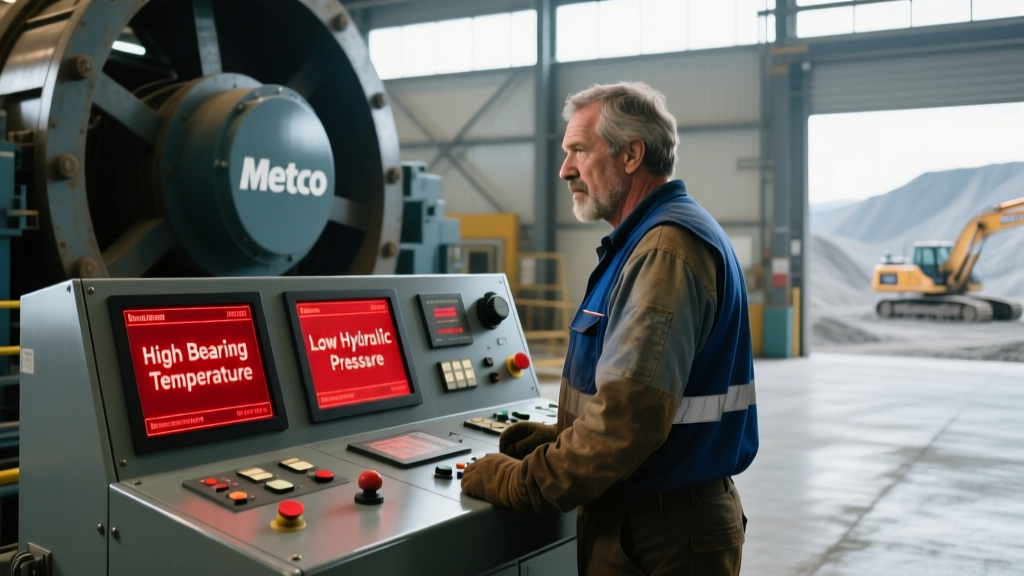
Hydraulic systems maintain the crusher's closed-side setting and provide tramp iron relief. A sudden hydraulic pressure drop of 15% or more from the baseline operating pressure indicates a blown seal, internal valve leakage, or pump degradation. If the automated Condition Monitoring System (CMS) registers a loss of lubrication flow for more than 30 seconds, the machine should automatically trigger a high-priority shutdown alert to prevent dry-running the eccentric bushings.
Physical Indicators and Operator-Level Alerts
While telemetry is highly effective, operators on the quarry floor must also recognize physical and auditory machine alerts before breakdown.
Auditory and Visual Cues
Changes in the acoustic profile of a crusher often precede mechanical failure. A rhythmic knocking or grinding noise emanating from the crushing chamber suggests that a mantle or concave liner has loosened, or that uncrushable material (tramp iron) is wedged in the chamber. Visually, operators should look for hydraulic fluid weeping from cylinder rods, excessive dust generation indicating seal failure, or visible cracking on the crusher's main frame weldments.
The Role of Heavy Equipment Signage in Alert Response
Identifying an alert is useless if the operator does not know how to respond. Heavy equipment signage bridges the gap between machine alerts and safe crusher maintenance execution.
Mandatory Warning and Lockout/Tagout (LOTO) Signage
When a machine alert triggers a shutdown, the immediate environment becomes a maintenance zone. The Mine Safety and Health Administration (MSHA) mandates clear, durable signage to protect workers responding to these alerts. Danger signs must be placed at all access points to the crusher, detailing the specific hazard (e.g., 'High Pressure Hydraulic Fluid' or 'Stored Mechanical Energy in Flywheel').
Lockout/Tagout (LOTO): A formal safety procedure mandated by occupational regulatory bodies that ensures heavy quarry equipment is completely shut off, isolated from all hazardous energy sources, and physically tagged to prevent accidental startup during crusher maintenance or repair operations.
Furthermore, standardized LOTO signage must be affixed directly to the electrical disconnects and hydraulic isolation valves. This ensures that once an operator responds to a telemetry alert and shuts down the machine, maintenance personnel can safely lock out the energy sources without risking an accidental restart from the central control room.
Quarry Crusher Pre-Breakdown Alert Checklist
Use this framework to audit your quarry's readiness to detect and respond to crusher failure indicators. This aligns with the 2026 ISO 45001 occupational health and safety management standards for heavy machinery.
| Alert Category | Specific Indicator | Required Action & Signage Protocol |
|---|---|---|
| Thermal | Bearing temp > 105°C | Auto-shutdown; Apply 'Hot Surface' warning tags. |
| Vibration | Shaft vibration > 45 Hz | Reduce feed rate; Schedule immediate bearing inspection. |
| Hydraulic | Pressure drop > 15% | Halt operations; LOTO valves; Inspect seals and hoses. |
| Acoustic | Rhythmic chamber knocking | Clear chamber; Post 'Falling Object' signs above hopper. |
Frequently Asked Questions
What are the most common early warning signs of crusher failure?
The most common early warning signs include elevated main bearing temperatures, increased vibration amplitudes on the main shaft, unexpected drops in hydraulic clamping pressure, and changes in the acoustic profile of the crushing chamber during operation.
How do quarry equipment telemetry warnings prevent downtime?
Quarry equipment telemetry warnings provide real-time data to control rooms, allowing operators to reduce feed rates or initiate controlled shutdowns before a minor component fault cascades into a catastrophic structural failure that requires weeks of repairs.
What safety signage is required for crusher maintenance after an alert?
After a breakdown alert, MSHA-compliant sites require Lockout/Tagout (LOTO) tags on all energy isolation points, 'Danger: Authorized Personnel Only' barricade signs, and specific hazard placards (such as high-pressure fluid or stored kinetic energy warnings) at the crusher access points.
Conclusion
Preventing catastrophic quarry downtime requires a dual approach: leveraging digital machine alerts before breakdown and enforcing rigorous physical safety responses. Telemetric sensors provide the critical early warnings, while heavy equipment signage and LOTO protocols ensure the subsequent crusher maintenance is executed safely and efficiently. As a concrete next step, conduct a site audit this week to verify that your crusher's Condition Monitoring System thresholds are calibrated to manufacturer specifications and that all physical LOTO signage at energy isolation points is legible, intact, and fully compliant with current MSHA regulations.