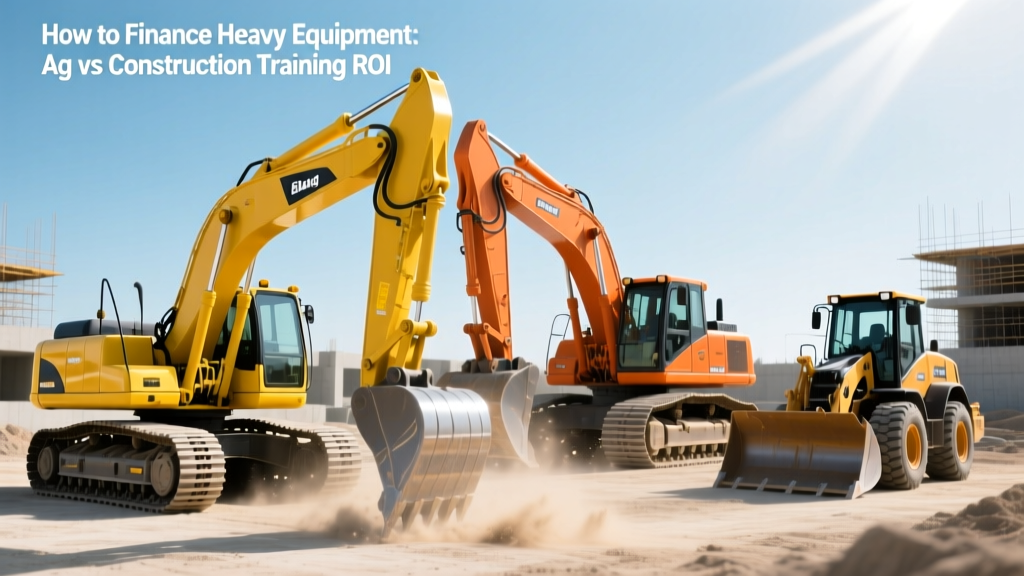
How to Finance Heavy Equipment: Ag vs Construction Training ROI
Learn how to finance heavy equipment by aligning operator training with Ag and construction asset depreciation to secure better 2026 lender rates.
The Underwriter's Lens: Why Training Dictates Financing Terms
Securing capital for heavy iron is no longer just about balancing sheets and credit scores. In the 2026 lending environment, underwriters heavily scrutinize operational risk—specifically, the competency of the personnel operating the financed assets. When you finance heavy equipment, the lender’s primary concern is asset preservation and residual value. An untrained operator can accelerate depreciation by 20% to 30%, turning a profitable asset into a distressed liability before the loan term matures.
However, the training requirements, depreciation curves, and optimal financing structures differ vastly between agricultural and construction fleets. Understanding these distinctions is critical for fleet managers and owner-operators looking to negotiate favorable lease rates, secure lower interest premiums, and maximize equipment lifecycle ROI.
Lender Risk Alert: Captive finance arms (like John Deere Financial or Cat Financial) and independent lessors now routinely integrate telematics data into their risk models. If your financed equipment shows erratic operational patterns indicative of untrained operators, you may face penalties or lose eligibility for favorable refinancing at the end of your term.Agricultural Equipment: Precision Tech and Seasonal Cash Flow
Agricultural heavy equipment, such as the John Deere 8R 410 row-crop tractor or the Case IH Magnum 400, represents a massive capital expenditure, often exceeding $380,000 for a fully specced base unit. The financing and training dynamics for Ag equipment are driven by seasonality and rapid technological obsolescence.
The Training Imperative: Precision Ag Software
Modern Ag equipment depreciation is rarely caused by mechanical engine failure; it is driven by the misuse of complex precision agriculture systems. Operator training must focus heavily on ISOBUS compatibility, AutoTrac Turn Automation, and variable-rate application software. An operator who fails to properly calibrate a StarFire 7000 GPS receiver will cause overlapping passes, leading to a 12% increase in fuel consumption and excessive implement wear.
Lenders know that well-trained operators preserve the technological integrity of the machine, which sustains higher resale values at auction. To prove this to underwriters, fleet managers should mandate documented, OEM-certified precision ag training modules prior to taking delivery of financed machinery.
Financing Structures for Ag Fleets
Because farming revenue is highly seasonal, standard monthly amortization schedules often create cash flow bottlenecks. When looking to finance heavy equipment for agriculture, consider these specialized structures:
- USDA FSA Direct Farm Ownership Loans: As detailed by the USDA Farm Service Agency, these loans offer up to 40-year terms with down payments as low as 5%, specifically designed to accommodate the cyclical nature of farming income.
- Skip-Payment Captive Leases: Manufacturers often offer financing that aligns with harvest cycles, allowing operators to skip payments during planting and winter months.
- Technology-Step-Up Leases: A 36-month operating lease that allows you to trade in the tractor specifically to upgrade to the next generation of precision software, avoiding the steep depreciation curve of outdated tech.
Construction Equipment: High Utilization and Compliance
Construction machinery, such as the Caterpillar 320 GC excavator or the Komatsu PC210LC-11, operates in a fundamentally different environment. These machines face year-round utilization, extreme physical stress, and stringent regulatory oversight. Base prices for a mid-size excavator hover around $250,000, but the operational costs can eclipse the capital costs if training is neglected.
The Training Imperative: Wear-and-Tear Mitigation
In construction, operator training is directly tied to physical asset preservation. The undercarriage of a tracked excavator accounts for up to 50% of total machine maintenance costs over its lifespan. An untrained operator who habitually travels in reverse or operates on uncompacted, abrasive terrain can destroy a $15,000 track and roller system in under 1,000 hours.
Furthermore, construction training is legally mandated. Compliance with OSHA construction standards (specifically 29 CFR 1926 Subpart O for motor vehicles and mechanized equipment) is non-negotiable. Lenders view OSHA citations not just as regulatory fines, but as indicators of poor fleet management, which increases the likelihood of catastrophic machine damage and project delays that could jeopardize loan repayments.
Telematics Integration: When negotiating your construction equipment lease, require the inclusion of OEM telematics (e.g., Cat Product Link or Komatsu KOMTRAX). Use this data to run weekly idle-time and fault-code reports. Presenting this proactive maintenance data to your lender during annual reviews can secure you a 25 to 50 basis point reduction on your next financing agreement.Financing Structures for Construction Fleets
Construction equipment financing prioritizes utilization rates and tax advantages over seasonal flexibility.
- Fair Market Value (FMV) Operating Leases: Ideal for contractors who want to maintain a modern fleet without the burden of disposal. You pay for the equipment's use over 36 to 60 months and return it, avoiding the steep back-half depreciation of heavy earthmovers.
- Capital Leases with Section 179 Expensing: If your goal is ownership and immediate tax relief, a capital lease allows you to claim the equipment as an asset and utilize Section 179 deductions to offset the financing costs in the first year.
Ag vs. Construction: Financing and Training Matrix
Use the following comparison matrix to align your operator training protocols with the correct financial instruments for your specific fleet type.
| Parameter | Agricultural Fleet (e.g., JD 8R, Case IH Magnum) | Construction Fleet (e.g., Cat 320, Komatsu PC210) |
|---|---|---|
| Primary Financing Vehicle | USDA FSA Loans, Seasonal Skip-Payment Leases | FMV Operating Leases, Section 179 Capital Leases |
| Key Training Focus | Precision Ag software, ISOBUS, variable-rate calibration | Undercarriage preservation, OSHA compliance, trench safety |
| Primary Depreciation Driver | Technological obsolescence (outdated GPS/software) | Physical wear-and-tear (undercarriage, hydraulic abuse) |
| Lender Risk Metric | Harvest yield efficiency, seasonal cash flow coverage | Machine utilization hours, telematics fault-code frequency |
| Avg 2026 Financing Premium | 6.25% - 8.50% APR (highly credit/season dependent) | $16 - $24 per $1,000/month (lease rate factor) |
Decision Framework: Building a Training-Backed Financing Proposal
When approaching the Equipment Lessors & Financiers Association (ELFA) member institutions or captive lenders, do not just present your balance sheet. Present a comprehensive asset-management plan that proves your operators will protect the collateral. Follow this four-step framework:
- Map Operator Certifications to Assets: Create a matrix linking every financed machine to a specifically certified operator. For construction, list NCCCO or OSHA 30-hour certifications. For Ag, list OEM precision-ag software completions.
- Implement Telematics Geofencing and Lockouts: Show the lender that your financed equipment has digital guardrails. Configure the OEM software to restrict maximum RPMs or disable advanced hydraulic modes for operators with junior clearance levels.
- Schedule Mid-Term Maintenance Audits: Commit to a 24-month fluid and undercarriage audit (for construction) or a precision-ag calibration check (for Ag). Invite the lender’s asset manager to review the results.
- Negotiate the Residual Guarantee: If you can prove your training and maintenance protocols exceed OEM standards, negotiate a higher guaranteed residual value on an FMV lease, which directly lowers your monthly payment.
Strategic Alignment for Long-Term Fleet Viability
The cost of capital in 2026 demands a holistic approach to fleet management. Treating operator training as a separate silo from equipment procurement is a financial leak. By explicitly tying your training protocols to the specific wear profiles and utilization patterns of your agricultural or construction assets, you transition from a high-risk borrower to a premium fleet operator. This strategic alignment not only secures better financing terms but ensures the iron pays for itself well before the final lien is released.