Quarry Case Study: How to Learn to Run Heavy Equipment for Aggregates
Discover how quarry operators learn to run heavy equipment for aggregate processing through simulator training and real-world case studies.
The High-Stakes Environment of Aggregate Processing
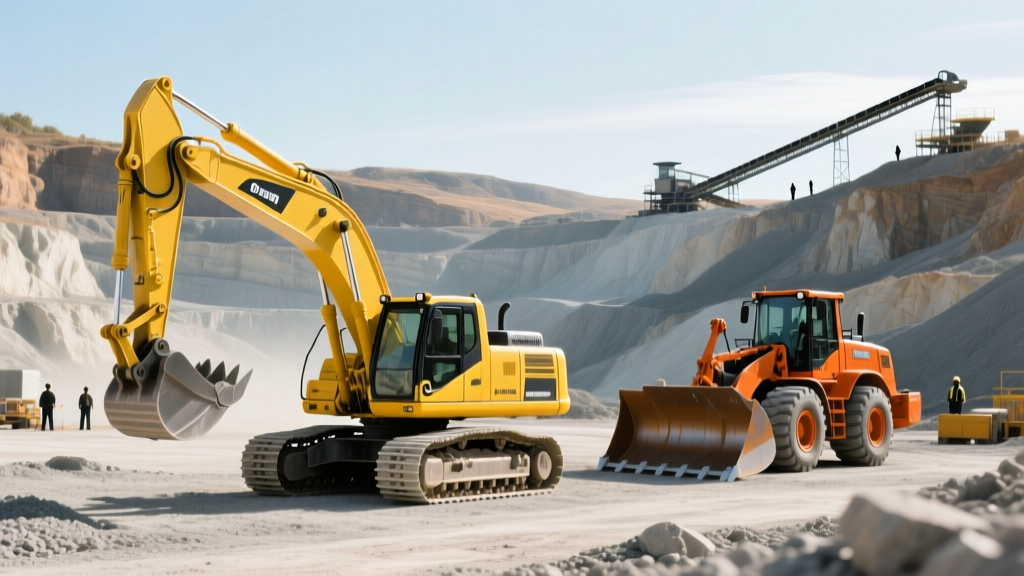
Operating heavy machinery in a quarry or aggregate processing plant requires a distinct skill set that differs vastly from general earthmoving. The environment is characterized by abrasive silica dust, uneven blasted rock faces, and continuous high-cycle loading. When new operators learn to run heavy equipment in this sector, the margin for error is slim: a single mistake can result in a sheared toggle plate on a jaw crusher, a severed L5 tire sidewall, or a catastrophic rollover on a steep haul ramp.
This article examines a 2025-2026 case study of a mid-sized limestone operation in Central Texas to illustrate the modern methodology for training aggregate equipment operators. By shifting from traditional 'seat-time' shadowing to a structured, simulator-integrated progression, the operation reduced first-year equipment damage by 38% while accelerating operator certification.
Core Aggregate Fleet: Technical Baselines for Trainees
Before an operator can master the quarry face, they must understand the specific mechanical tolerances of the primary processing fleet. Training programs now mandate technical familiarization with the exact models deployed on-site.
Metso Lokotrack LT120 Mobile Jaw Crusher
Role: Primary crushing of blasted shot-rock.
Key Trainee Focus: Maintaining the Closed Side Setting (CSS) and monitoring the hopper level. Operators must learn to regulate the excavator feed rate to prevent 'bridging' (where rocks interlock and block the jaw chamber) while avoiding starvation, which causes excessive manganese wear on the jaw dies.
Critical Metric: Target throughput of 450-550 tons per hour (TPH) at a 120mm CSS.
Caterpillar 980M Wheel Loader
Role: Load-and-carry from the primary stockpile to the secondary hopper or railcars.
Key Trainee Focus: Bucket curl timing and transmission lock-up. The 980M features a Z-bar linkage; trainees must learn to rack the bucket back precisely at the point of breakout to maximize the 7.3 cubic-yard fill factor without spilling aggregate over the cab guard.
Critical Metric: Cycle times under 45 seconds in a 150-foot load-and-carry application.
Case Study: Vulcan-Inspired Simulator Integration
In late 2024, a 2.5 million ton-per-year limestone quarry faced a severe labor shortage and an aging operator workforce. The traditional method of teaching new hires—placing them in a $650,000 wheel loader with a veteran operator shouting over the cab noise—was yielding poor results. Fuel consumption during training was spiking, and minor undercarriage damage on tracked units was costing $18,000 annually in premature track chain replacements.
The site management adopted a phased simulator training protocol, leveraging Caterpillar Simulator Training modules specifically designed for wheel loaders and articulated trucks.
Phase 1: Virtual Seat Time (Weeks 1-2)
Trainees spent 40 hours in the simulator. The software replicated the exact physics of the Cat 980M, including the hydrostatic transmission feel and the specific pivot-steering articulation angles. Instructors used the simulator's telemetry to track 'implement abuse'—specifically, slamming the bucket into the virtual pile at full throttle, which translates to drivetrain shock loads in real life.
Phase 2: Controlled Live-Fire (Weeks 3-4)
Operators transitioned to a designated, flat 'sandbox' area of the quarry, away from the active highwall. Here, they practiced tire management. A major focus was navigating over blasted limestone windrows without sidewall contact. Trainees learned to read the terrain and maintain momentum to prevent the 29.5R25 L5 tires (costing upwards of $6,500 each) from suffering rock-cuts.
Phase 3: Active Face Integration (Weeks 5-8)
Only after passing a rigorous MSHA-compliant practical exam did operators join the active production cycle, starting on the secondary screening plant (operating a Sandvik QE442 Scalper) before graduating to the primary crusher feed.
Cost vs. ROI: Traditional vs. Simulator Training Matrix
The financial argument for modernizing how operators learn to run heavy equipment is undeniable when analyzing the hidden costs of traditional methods.
| Cost Factor | Traditional 'Sit-and-Watch' | Simulator-Integrated Protocol |
|---|---|---|
| Fuel Burn (First 100 Hours) | ~$4,200 (Inefficient throttle use) | $0 (Simulator) + $1,200 (Controlled sandbox) |
| Tire / Undercarriage Wear | $8,500 (Premature cuts/tears) | $1,100 (Controlled environment) |
| Machine Downtime for Training | 120 Hours ($18,000 lost revenue) | 0 Hours (Simulator used off-shift) |
| Trainer Productivity Loss | 100% (Veteran cannot produce) | 10% (Only active face supervision) |
| Estimated Net Cost per Trainee | ~$30,700 | ~$2,300 (Post-simulator amortization) |
Common Rookie Mistakes in Aggregate Processing
Even with simulator training, the transition to the physical quarry face introduces sensory variables that software cannot perfectly replicate. Instructors at the Texas site documented the most frequent errors made by novices during their first 30 days of live production.
Warning: The Over-Greasing Trap
Novice operators are often taught to 'grease the pins daily.' In a limestone quarry, over-greasing the wheel loader bucket pivot pins and lift cylinder trunnions creates a sticky surface that attracts microscopic silica dust. This forms an abrasive grinding paste that destroys bushings in under 500 hours. Trainees are now taught to apply exactly three pumps per zerk fitting and immediately wipe away the purge.
Warning: Crusher Feed Mismanagement
When operating the excavator feeding the primary jaw crusher, rookies tend to dump the entire bucket load directly onto the vibrating grizzly or into the jaw chamber at once. This causes 'shock loading,' which can snap the crusher's toggle plate—a safety mechanism designed to break under extreme pressure to save the main frame. Replacing a toggle plate on a Metso LT120 takes four hours of unplanned downtime. Operators must learn to 'curl and trickle' the material, spreading the load evenly across the grizzly bars.
Regulatory Compliance and Safety Frameworks
Learning to run heavy equipment in a quarry is heavily regulated. In the United States, the Mine Safety and Health Administration (MSHA) mandates strict training protocols under 30 CFR Part 46 (for surface sand, gravel, and crushed stone operations) and Part 48 (for underground and larger surface mines).
Training programs must include:
- Site-Specific Hazard Awareness: Identifying highwall instability, blast zone exclusion perimeters, and silica dust exposure limits.
- Task Training: Documented, supervised operation of each specific machine model before independent operation is permitted.
- Annual Refresher Training: Minimum of 8 hours annually, which the National Stone, Sand & Gravel Association (NSSGA) strongly recommends supplementing with near-miss reporting and simulator refreshers.
The Sensory Gap: What Simulators Cannot Teach
While VR and motion-platform simulators excel at teaching control layouts, spatial awareness, and procedural memory, veteran quarry managers note a distinct 'sensory gap' that must be addressed during live-fire training.
'The simulator doesn't teach you the sound of a hydraulic pump cavitating when you try to curl a bucket full of wet, compacted clay. It doesn't vibrate the seat when the articulation joint binds on a 12% grade. An operator truly learns to run heavy equipment only when they learn to listen to the machine's mechanical feedback.'
— Site Superintendent, Central Texas Limestone Operation
To bridge this gap, modern training protocols require the instructor to ride in the cab (or communicate via noise-canceling radio headsets) during the first 50 hours of live operation, specifically calling out auditory and haptic cues that the trainee should be feeling, such as the exact RPM drop that indicates the torque converter is stalling during a pile penetration.
Frequently Asked Questions
How long does it take to become a certified quarry loader operator?
While MSHA requires a minimum of 8 hours of initial task training for new tasks, industry standards dictate 80 to 120 hours of supervised seat time to achieve proficiency in high-cycle load-and-carry applications without excessive tire wear or fuel burn.
Can simulator training replace MSHA task training requirements?
No. Simulators are excellent for procedural familiarization and safety scenario testing, but MSHA regulations require task training to be conducted on the actual equipment or a highly accurate physical mock-up in the actual work environment under the supervision of a competent person.
What is the most expensive mistake a rookie can make on a mobile screening plant?
Failing to properly tension the screen media (polyurethane or wire mesh) during daily walkarounds. Loose screen media allows aggregate to bypass the sizing apertures, resulting in out-of-spec product that must be re-crushed, wasting thousands of dollars in fuel and manganese wear, while also causing the screen deck itself to fatigue and crack under the uneven harmonic vibration.