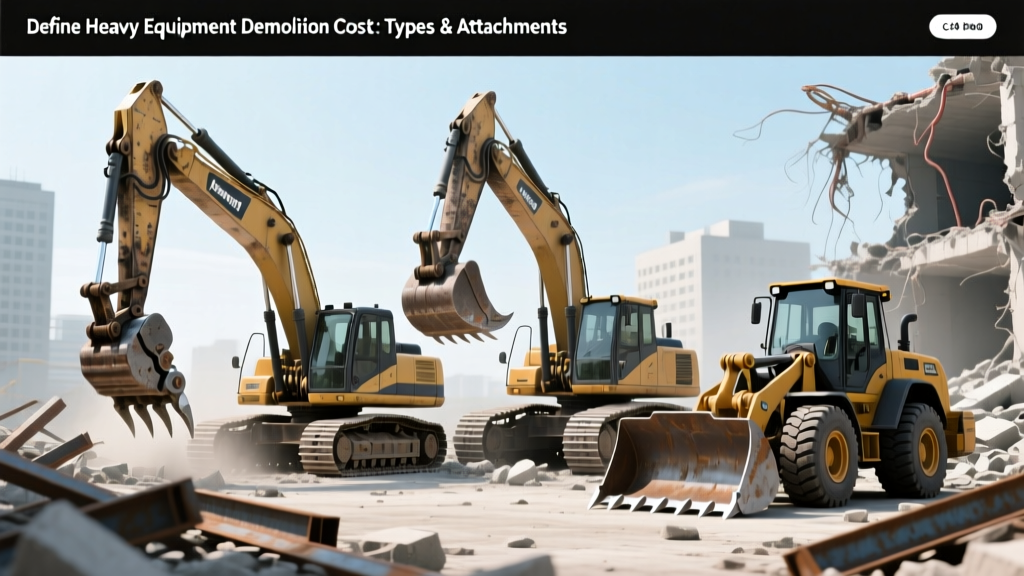
Define Heavy Equipment Demolition Costs: Types & Attachments
Learn how to define heavy equipment demolition budgets. Compare excavator attachments, breaker costs, and rental rates for precise project cost analysis.
When financial analysts and project estimators define heavy equipment assets for structural teardowns, the margin between profit and loss hinges on matching carrier hydraulics to specific attachment demands. Demolition is not merely an exercise in brute force; it is a highly calculated operation where cost-per-ton processing, hydraulic efficiency, and consumable wear rates dictate the final budget. In the 2026 contracting environment, with Tier 5 emission standards tightening and high-tensile steel prices fluctuating, precision in budget planning is non-negotiable.
Budgeting Baseline: A standard 30-to-40-ton demolition setup (carrier + primary attachment + quick coupler) requires a capital expenditure (CapEx) ranging from $340,000 to $485,000, or an operational expenditure (OpEx) rental rate of $1,800 to $2,800 per day, excluding fuel and operator labor.Core Demolition Carriers: Base Machine Cost Analysis
The foundation of any demolition fleet is the 30-to-40-ton class excavator. This weight class provides the optimal balance between lifting capacity, hydraulic flow output, and transportability without requiring specialized oversized load permits. When you define heavy equipment allocations for a site, the base carrier must be spec'd for high-flow auxiliary hydraulics.
| Carrier Model | Operating Weight | Auxiliary Flow (LPM) | 2026 Est. Base Price | Fuel Burn (Gal/Hr) |
|---|---|---|---|---|
| Caterpillar 330 | 30,400 kg | Up to 450 LPM | $295,000 - $320,000 | 8.5 - 10.2 |
| Komatsu PC360LC-11 | 34,500 kg | Up to 520 LPM | $310,000 - $335,000 | 9.0 - 11.5 |
| Volvo EC300E | 30,200 kg | Up to 480 LPM | $285,000 - $315,000 | 7.8 - 9.5 |
Note: Prices reflect 2026 market averages for base configurations. Adding demolition-specific guarding (FOPS/FOGS cabs, cylinder guards, and reversible cooling fans) typically adds $18,000 to $24,000 to the final invoice.
Primary Attachments: Capital vs. Operational Expenditure
Once the carrier is selected, the attachment defines the machine's actual function. Budgeting for attachments requires analyzing the specific material composition of the target structure.
1. Hydraulic Breakers (Concrete & Rock)
For primary reduction of reinforced concrete foundations, hydraulic breakers remain the industry standard. The Epiroc MB 1700 is a benchmark model for the 30-ton carrier class.
- Capital Cost: $38,000 - $44,000
- Required Flow: 250 - 420 LPM at 160-180 bar
- Impact Rate: 250 - 500 bpm
- OpEx Consideration: Moil points (chisels) cost between $650 and $900 each and require replacement every 80-120 hours depending on concrete PSI and rebar density.
2. Multi-Processor Shears (Steel & Structural)
When dismantling steel-framed buildings or processing scrap, shears offer a higher ROI than torch-cutting by eliminating fire risks and reducing labor hours. The LaBounty MSD 7500 features Hardox 500 steel jaws and a speed valve that cycles 30% faster than standard models.
- Capital Cost: $95,000 - $115,000
- Required Flow: 380 - 500 LPM
- OpEx Consideration: Blade rotation and replacement cost approximately $2,200 per set. Shears require strict daily greasing; failure to maintain the pivot bushings leads to jaw misalignment and catastrophic pin failure, a repair exceeding $8,000.
3. Pulverizers and Crushers (Secondary Reduction)
Used for separating rebar from concrete after primary breaking. Fixed and rotating pulverizers (like the Caterpillar P318) cost between $45,000 and $60,000. Rotating models command a 20% premium but reduce excavator cycle times by allowing the operator to process material without constantly repositioning the carrier.
CRITICAL BUDGET RISK: Hydraulic Flow MismatchesThe most common financial drain in demolition fleets is pairing a high-flow carrier with an under-rated attachment. If a Cat 330 pushing 450 LPM is connected to a breaker rated for a maximum of 320 LPM without properly adjusting the auxiliary hydraulic circuit, the excess flow bypasses the relief valves, generating extreme heat. This degrades the hydraulic fluid, destroys seals, and blows the nitrogen accumulator within 40 operating hours. Always budget $800 for a flow-meter diagnostic test during initial rig-out to ensure carrier and attachment synchronization.
Compliance and Hidden Operational Costs
When contractors define heavy equipment budgets, they frequently overlook regulatory compliance integration. According to OSHA demolition guidelines, controlling airborne silica dust and managing structural collapse zones are mandatory.
"Integrating on-board water suppression systems directly into the excavator's boom and attachment adds roughly $3,500 to $4,500 to the initial equipment build-out, but prevents daily work-stoppages and OSHA fines that can exceed $15,000 per violation."Furthermore, track shoe wear is an often-ignored OpEx. Standard triple-grouser pads will be destroyed by rebar and concrete rubble in under 600 hours. Budgeting for rubber street pads or specialized cast-iron demolition pads adds $6,500 to the undercarriage budget but extends track life by 40% in scrap-yard environments.
Budgeting Framework: Rent vs. Buy Decision Matrix
Deciding whether to rent or purchase demolition equipment depends on the utilization rate and the specific attachment required. Use the following framework to guide your 2026 capital allocation:
- The 40% Utilization Rule: If the specific carrier-and-attachment combination will be utilized for less than 40% of the working year (approx. 800 hours), rent the package. Current 2026 daily rental rates for a 30-ton excavator with a breaker average $1,950/day, dropping to $1,400/day on monthly contracts.
- The Niche Attachment Factor: Always rent highly specialized attachments like demolition grapples or specific-angle shears unless you have a multi-year contract with a scrap processor. Standard breakers and buckets are justified for purchase if utilization exceeds 60%.
- Depreciation vs. Maintenance: Heavy demolition use accelerates carrier depreciation. A standard earthmoving excavator retains 55% of its value after 5 years; a dedicated demolition machine with cracked welds and contaminated hydraulic fluid may retain only 30%. Factor a 15% higher annual depreciation rate into your internal accounting for demolition-dedicated assets.
Quick-Reference Consumables Budget Table
Accurate job costing requires forecasting consumable wear. The table below outlines average replacement costs and lifespans for standard demolition attachments operating in high-PSI reinforced concrete.
| Consumable Item | Unit Cost (2026) | Expected Lifespan | Cost Per Hour |
|---|---|---|---|
| Breaker Moil Point (Chisel) | $750 | 90 Hours | $8.33 |
| Breaker Diaphragm Seal Kit | $1,200 | 500 Hours | $2.40 |
| Shear Piercing Blade Set | $2,400 | 250 Hours | $9.60 |
| Quick Coupler Locking Pin | $350 | 1,200 Hours | $0.29 |
Ultimately, to accurately define heavy equipment demolition budgets, estimators must look beyond the sticker price of the iron. By mapping the exact hydraulic requirements of the carrier to the material processing demands of the attachment, and factoring in the relentless wear of consumables and compliance systems, contractors can lock in predictable margins regardless of market volatility.