Snow Removal Fleet Costs: Heavy Equipment Wash Bay Design Budgeting
Analyze 2026 snow removal heavy equipment costs and the critical ROI of heavy equipment wash bay design to prevent salt corrosion and downtime.
The True Cost of Winter Fleet Operations
Budgeting for a snow removal fleet requires looking far beyond the sticker price of the iron. Municipalities and private winter maintenance contractors face a severe, compounding financial threat: accelerated corrosion from magnesium chloride (MgCl2) brine and calcium chloride (CaCl2) pre-wetting agents. When a fleet of motor graders, wheel loaders, and skid steers operates in these highly corrosive environments, component degradation accelerates by up to 400% compared to dry-earth operations. Consequently, capital allocation for snow removal heavy equipment must inherently include the infrastructure required to decontaminate it. Integrating a specialized heavy equipment wash bay design into your facility budget is not an optional upgrade; it is a mandatory asset-protection strategy.
CRITICAL DATA POINT: Unwashed undercarriages exposed to MgCl2 brine for just 48 hours experience galvanic corrosion that pits hydraulic cylinder rods and destroys pivot pins, leading to premature failures that cost $12,000 to $45,000 per machine in replacement parts and labor.2026 Snow Removal Fleet Acquisition Baseline
Before calculating facility infrastructure costs, establish the baseline CapEx for the primary snow removal heavy equipment types deployed in commercial and municipal operations. Pricing reflects 2026 market averages for Tier 4 Final / Stage V diesel configurations equipped with winter-specific hydraulics and cold-weather cab packages.
| Equipment Type | Primary Model Example | Winter Attachment | Est. 2026 CapEx |
|---|---|---|---|
| Motor Grader | Caterpillar 14 | Henderson 14-ft Reversible Plow & Underbody Scraper | $685,000 - $740,000 |
| Wheel Loader | Volvo L120H | Sno-Way 24-ft Box Pusher | $410,000 - $465,000 |
| Skid Steer Loader | Bobcat S86 | 8-ft V-Plow & Salt Spreader | $85,000 - $105,000 |
| Dedicated Blower | Wausau-Everest EB12 | Tractor-Mounted 10-ft Snow Blower | $210,000 - $250,000 |
For a mid-sized municipality operating a 12-machine mixed fleet, the initial equipment CapEx easily exceeds $4.5 million. Protecting this investment dictates the engineering requirements of your maintenance facility.
Engineering the Heavy Equipment Wash Bay Design for Winter Fleets
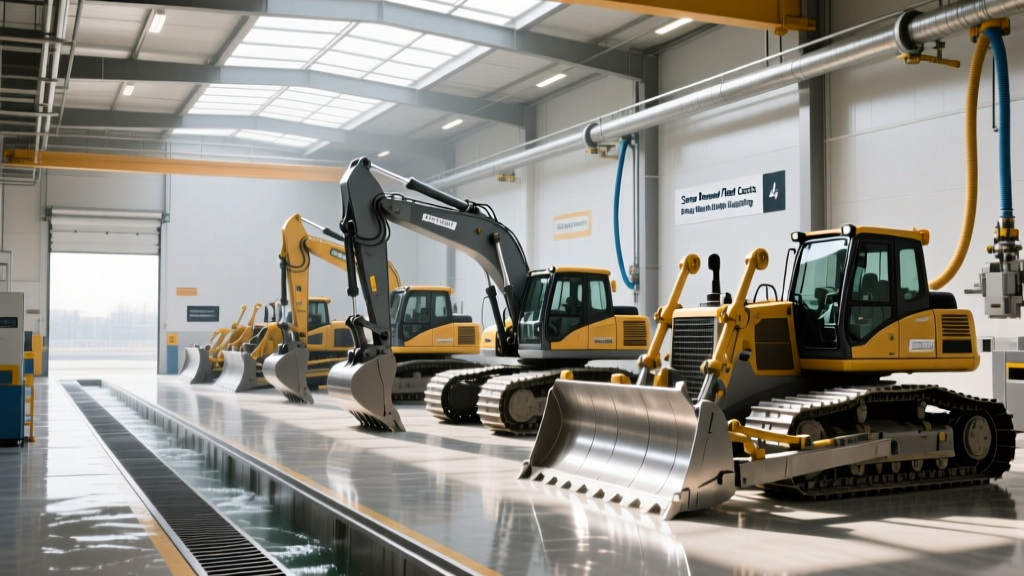
A standard summer wash pad is entirely insufficient for winter operations. Washing a grader coated in frozen brine requires high-volume hot water, enclosed environments, and specialized runoff management. When drafting your heavy equipment wash bay design, the following structural and mechanical elements must be budgeted to handle sub-zero decontamination.
1. Hydronic Radiant Floor Heating
Wash bays in northern climates must feature embedded PEX tubing hydronic heating systems within a 6-inch, 5,000-PSI reinforced concrete slab. This prevents the bay floor from turning into an ice sheet when 65°F wash water hits a -10°F concrete surface, mitigating severe slip hazards and allowing immediate undercarriage access.
2. High-Capacity Oil/Water Separators and Chloride Management
Winter wash water is a toxic cocktail of heavy metals, hydraulic fluid sheen, and extreme chloride concentrations. Standard trench drains will violate local municipal codes. Your design requires a multi-stage clarifier system. According to the EPA National Pollutant Discharge Elimination System (NPDES) guidelines, industrial wash water containing chlorides and petroleum must be aggressively separated and, in many jurisdictions, routed to a closed-loop reclamation system rather than a sanitary sewer.
3. 1500-PSI Hot Water Undercarriage Wands
Brine bakes onto the inside of loader bucket linkages and grader circle gears. High-temperature (180°F) pressure washing is required to dissolve the crystalline salt structures without relying on harsh, environmentally damaging chemical descalers.
CapEx Breakdown: Wash Bay Infrastructure Matrix
The following matrix contrasts a basic outdoor wash pad with an engineered, winter-ready wash facility. Budget planners must recognize that the 'Engineered' column represents the true cost of compliance and asset protection.
| Infrastructure Component | Basic Wash Pad (Summer Only) | Engineered Winter Wash Bay Design |
|---|---|---|
| Footprint & Slab (40' x 25') | $28,000 (Standard Pour) | $65,000 (Heated, Fiber-Mesh, Sloped) |
| Enclosure & Insulation | $0 (Open Air) | $85,000 (Pre-engineered steel, R-30 walls) |
| Drainage & Separation | $12,000 (Basic Trench/Gravel Pit) | $54,000 (3-Phase Clarifier, 10k Gal Tank) |
| Heating & Wash Equipment | $8,500 (Cold Water Electric) | $42,000 (Diesel Fired 180°F, 1500 PSI) |
| Total Estimated CapEx | $48,500 | $246,000 |
Operational Expenditure (OpEx): The 100-Day Winter Cycle
Budgeting does not stop at construction. Operating an enclosed, heated wash bay for a 12-machine fleet over a 100-day winter season incurs specific utility and labor costs. Proper Federal Highway Administration (FHWA) Winter Maintenance Guidelines suggest equipment should be decontaminated after every major deployment to prevent salt crystallization in electrical harnesses.
- Water Reclamation Savings: A closed-loop system recycles 85% of wash water. For a fleet requiring 4,000 gallons of wash water per week, municipal water and sewer discharge fees drop from $1,800/month to $270/month.
- Heating Fuel: Maintaining a 50°F ambient bay temperature in a 1,000 sq ft insulated structure during a Midwest winter requires approximately 180 gallons of propane per week, costing roughly $450/week.
- Labor Allocation: A dedicated wash technician operating at $24/hour takes 45 minutes per machine (including undercarriage and engine bay degreasing). Daily post-storm washing for 12 machines equals 9 labor hours ($216/day).
Failure Modes: What Happens When You Skip the Wash Bay Budget?
Fleet managers who reduce CapEx by omitting a proper wash bay design inevitably face catastrophic maintenance budget overruns by Year 3 of the equipment lifecycle. The specific failure modes driven by winter abrasives include:
- Electrical Harness Degradation: MgCl2 brine wicks into Deutsch connectors and ECU wiring looms. The resulting copper oxidation causes phantom electrical faults, leading to $8,000+ diagnostic and rewiring bills per machine.
- Articulation Point Seizure: Wheel loaders rely on massive center-pivot articulation pins. Brine penetrates the grease barriers, creating an abrasive grinding paste that elongates the pin bores. Line-boring and sleeving an articulation joint requires 40+ hours of machine shop labor.
- Hydraulic Cylinder Scoring: Microscopic salt crystals adhere to exposed chrome cylinder rods. When the rod retracts, these crystals tear the polyurethane wiper seals, leading to internal hydraulic fluid bypass and total cylinder rebuilds.
Strategic Budget Allocation Framework
When presenting your winter operations budget to municipal boards or corporate stakeholders, frame the heavy equipment wash bay design not as a facility expense, but as an insurance policy on the powertrain and hydraulic assets. Allocate exactly 4.5% to 6% of your total fleet acquisition CapEx toward winter-specific decontamination infrastructure. This ratio ensures you can afford the necessary hydronic heating, enclosed pre-engineered steel structures, and EPA-compliant water reclamation systems required to push heavy machinery past its 10,000-hour operational lifecycle in severe winter climates.