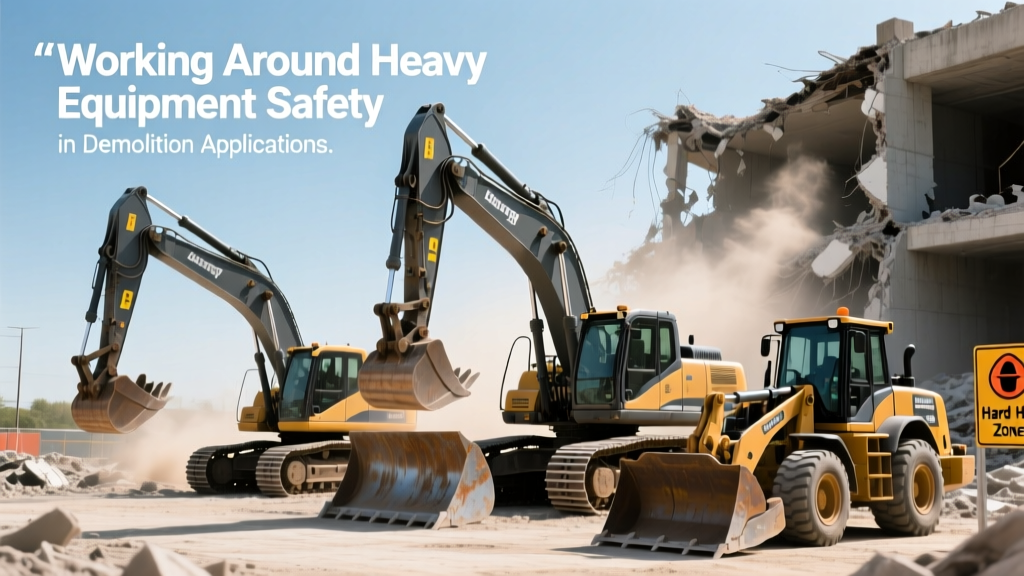
Working Around Heavy Equipment Safety in Demolition Applications
Explore demolition equipment types and attachments through case studies, focusing on working around heavy equipment safety and exclusion zone protocols.
The Kinetic Hazard Zone: Profiling Demolition Equipment
Demolition represents the highest-risk phase of the construction lifecycle. Unlike earthmoving or lifting, demolition involves the controlled destruction of mass, generating unpredictable kinetic energy, flying spall, and shifting center-of-gravity loads. When site managers evaluate working around heavy equipment safety, the primary variable is the attachment. An excavator’s base carrier is secondary to the hazard profile introduced by a 12,000-pound hydraulic shear or a 10,000-foot-pound impact breaker.
Modern demolition relies on specialized carrier-attachment pairings. High-reach excavators, such as the Caterpillar 352 UHD (Ultra High Demolition), operate with working heights exceeding 100 feet. At these elevations, a dropped 2,000-pound concrete chunk reaches terminal velocities capable of penetrating standard reinforced barricades. Similarly, skid-steer mounted breakers like the Atlas Copco (Epiroc) MB 1200 generate localized seismic vibrations and eject debris radially at speeds up to 150 mph. Understanding the specific physics of these attachments is mandatory for establishing accurate ground-worker exclusion zones.
⚠️ CRITICAL SAFETY DIRECTIVE: According to OSHA's demolition safety guidelines, no personnel may enter the swing radius of a demolition excavator without positive visual or electronic communication with the operator. Standard high-visibility vests are insufficient for high-decibel, high-dust demolition environments.Case Study 1: High-Rise Teardown and the 1.5x Exclusion Rule
In a recent urban hospital decommissioning project, contractors utilized a CAT 352 UHD equipped with a Genesis GXP 600 hydraulic shear. The structure stood 110 feet tall. The primary challenge was working around heavy equipment safety while maintaining adjacent pedestrian traffic flow on a public sidewalk located 90 feet from the drop zone.
Calculating the Debris Trajectory
Site engineers applied the 1.5x Drop Height Rule, an industry standard derived from NIOSH struck-by hazards research. For a 110-foot shear height, the theoretical maximum debris ejection radius is 165 feet. Because the sidewalk fell within this zone, traditional hard barricades were inadequate against secondary ricochets from severed rebar and pulverized masonry.
Site Adaptation: The contractor deployed a Tier-3 engineered catchment system—a 40-foot-tall scaffolding structure draped with 22-ounce PVC-coated polyester debris netting. Furthermore, ground personnel were equipped with Triax Spot-R wearable proximity sensors. These Ultra-Wideband (UWB) tags communicated directly with the excavator’s cab monitor, automatically triggering a hydraulic flow lockout if a worker breached the 50-foot inner exclusion perimeter.
Attachment-Specific Hazard and Exclusion Matrix
Establishing safe perimeters requires matching the exclusion zone to the specific attachment's failure mode and kinetic output. The matrix below details minimum safe distances for standard 2026 site configurations.
| Attachment Type | Primary Kinetic Hazard | Min. Exclusion Zone (Flat Ground) | Required PPE / Mitigation |
|---|---|---|---|
| Hydraulic Breaker (e.g., Epiroc HB 10000) |
Radial spall ejection, localized ground vibration, airborne silica. | 75 feet minimum; 100 feet if breaking high-strength reinforced concrete. | Heavy-duty face shields, dual-hearing protection, water suppression rigs. |
| Concrete Pulverizer (e.g., NPK H-40XA) |
Dropped mass, rebar whip (tension release), hydraulic hose burst. | 1.5x the maximum drop height of the carrier boom. | Overhead FOPS (Falling Object Protective Structure) cabs, whip-checks on all auxiliary hydraulics. |
| Hydraulic Shear (e.g., Genesis GXP 600) |
Severed structural steel drop, stored tension release in I-beams. | 100 feet minimum, plus engineered catchment for adjacent structures. | Tagline protocols for guided lowering, AI-assisted cab cameras for blind spot monitoring. |
| Demolition Grapple (e.g., LaBounty MSD 7500) |
Slippage of irregular loads, swinging counterweight crush hazards. | Swing radius + 20 feet buffer. Must be physically barricaded. | Proximity radar (e.g., Brigade Backeye®360), dedicated ground spotter with radio. |
Case Study 2: Confined Space Dismantling with Demolition Robots
While high-reach excavators dominate exterior teardowns, interior industrial dismantling presents a different safety paradigm. In a chemical plant decommissioning project, space constraints and toxic residue made traditional cab-operated machinery lethal. The contractor deployed a Brokk 500 remote-controlled demolition robot equipped with a breaker and crusher attachment.
Eliminating the Operator from the Hazard Zone
The Brokk 500 weighs approximately 11,400 pounds and operates via a ruggedized remote control with a 1,000-foot line-of-sight range. By removing the operator from the machine, the site entirely eliminated the traditional blind spots associated with working around heavy equipment safety in confined corridors. The operator could stand 50 feet back, maintaining a direct line of sight to the attachment while remaining outside the structural collapse envelope.
However, remote operation introduces new hazards for ground workers who might assume the machine is unoccupied and approach it during automated pauses. To mitigate this, the site implemented a "tethered-zone" protocol: the robot's remote control was physically linked to a localized strobe and siren system that activated whenever the hydraulic PTO was engaged, providing an audible 115dB warning that the attachment was live.
💡 2026 Tech Integration Note: Modern demolition robots now feature integrated LiDAR mapping. This allows the remote operator to see a real-time 3D point cloud of the structure's stress points on their control tablet, predicting secondary collapses before they occur and allowing ground crews to evacuate the trajectory path in advance.Actionable Framework for Site Supervisors
To systematically manage demolition equipment hazards, site safety officers should implement the following sequential protocol before any attachment is pinned to a carrier:
- Attachment Kinetic Audit: Calculate the maximum potential energy of the heaviest piece of debris the attachment can grip or break. Multiply the drop height by 1.5 to establish the baseline exclusion radius.
- Hydraulic Integrity Check: Inspect all auxiliary hydraulic lines for micro-abrasions. A burst line at 5,000 PSI can inject fluid through skin (hydraulic injection injury) or cause an attachment to drop unexpectedly. Mandate Kevlar-wrapped hose sleeves on all demolition rigs.
- Swing Radius Hard-Locking: Do not rely on caution tape. Use water-filled barricades or concrete Jersey barriers to physically block the excavator’s rear counterweight swing path. The counterweight of a 50-ton demolition excavator extends up to 14 feet past the tracks and exerts over 100,000 pounds of crushing force.
- Electronic Geofencing: Calibrate UWB proximity sensors on all ground personnel. Set the warning zone at 30 feet and the automatic hydraulic lockout zone at 15 feet from the carrier's tracks.
Mastering demolition safety requires moving beyond generic site rules and addressing the specific mechanical realities of the equipment in use. By aligning exclusion zones with attachment physics and leveraging remote or sensor-based interventions, contractors can neutralize the kinetic hazards inherent in structural teardowns.