Heavy Equipment Injuries to Workers NYC: Rail Maintenance Guide
Discover how selecting advanced railroad maintenance equipment reduces heavy equipment injuries to workers NYC transit crews face. Safety-first buying guide.
The Anatomy of Urban Rail Yard Equipment Hazards
Procurement officers for urban transit authorities and regional rail contractors operate under a unique matrix of spatial and electrical constraints. In dense metropolitan corridors, standard construction machinery is inherently lethal. Procurement officers searching for solutions to heavy equipment injuries to workers NYC transit environments present must look beyond standard OSHA compliance and focus on engineered spatial awareness. When safety boards investigate incidents in confined rail yards, tunnel approaches, and active mainlines, the data points to three primary hazard multipliers: blind-spot crush incidents, third-rail electrocution, and acoustic masking.
CRITICAL HAZARD WARNING: The standard 600V DC third rail used by the MTA and regional operators can arc up to 12 inches in humid tunnel environments. Standard heavy equipment grounding protocols are insufficient. Any equipment procured for NYC rail corridors must feature isolated, non-conductive hi-rail gear and strict lateral clearance limiters.As of 2026, the shift toward predictive maintenance and automated track inspection has changed the buying landscape. Fleet managers are no longer just buying iron; they are buying integrated sensor ecosystems designed to physically prevent machine-to-human contact. This guide outlines the technical specifications, safety technologies, and procurement frameworks mandatory for purchasing railroad maintenance equipment in high-density urban rail environments.
Hi-Rail Excavators: Specifying for Zero-Tail-Swing and Proximity
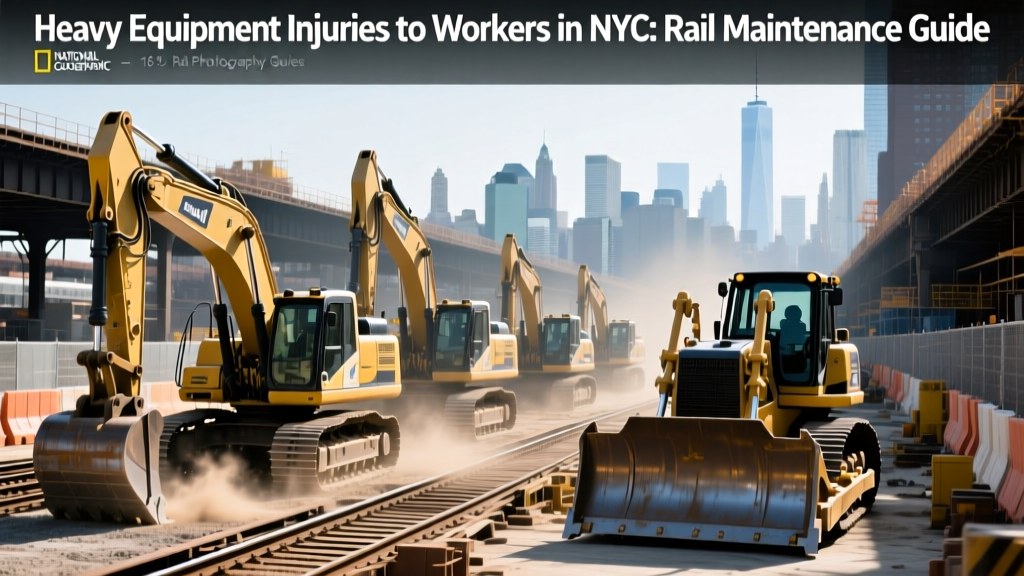
The backbone of urban rail maintenance is the hi-rail excavator. However, deploying a standard long-tail swing excavator in environments like the East River tunnel crossings or the Penn Station approach corridors guarantees a struck-by incident. Procurement specs must mandate Zero-Tail-Swing (ZTS) or Short-Tail-Swing (STS) configurations paired with advanced machine control.
Technical Procurement Specifications
- Base Models: Caterpillar 320F RR (Rail Runner) or Volvo EWR150E. These models offer the necessary hydraulic flow for rail-specific attachments while maintaining a compact footprint.
- Hi-Rail Gear: Mitchell or Railrunner fully-insulated, self-locking hi-rail systems. The gear must include a derailment prevention lock that physically prevents the road wheels from dropping if the rail wheels lose contact.
- Clearance Limiters: Software-locked hydraulic limiters (e.g., Caterpillar's e-Fence) that prevent the boom from swinging into the adjacent active track or reaching the third-rail zone.
- Cost Expectation: $480,000 to $650,000 per unit, fully equipped with hi-rail gear and 3D machine control.
By enforcing e-Fence technology, buyers eliminate the reliance on operator judgment in low-light, high-fatigue night shifts. If the operator attempts to swing the bucket toward an active adjacent track or the third rail, the hydraulic system simply ceases movement in that vector.
Automated Track Geometry and Inspection Vehicles
The most effective way to eliminate track-worker injuries is to remove the worker from the track entirely. Legacy track inspection required crews to walk the line with manual gauges, exposing them to moving rolling stock. Modern procurement budgets must prioritize automated Track Geometry Cars (TGCs) and hi-rail inspection trucks equipped with LiDAR and high-speed photogrammetry.
Key Technologies to Specify
- LiDAR Tunnel Profiling: Systems like the ENSCO M-series or similar Class 1 inspection vehicles use 3D LiDAR to map tunnel clearances to the millimeter, identifying encroaching infrastructure without requiring a track-walking crew.
- Ultrasonic Rail Flaw Detection: Integrated wheel-probe systems that scan for internal transverse defects at speeds up to 45 mph, replacing the slow, dangerous manual walking inspections.
- Automated Exception Reporting: The software must automatically flag defects and transmit GPS coordinates to the dispatch center, ensuring maintenance crews are only deployed to exact, verified locations rather than conducting broad, hazardous searches.
Collision Avoidance and Worker Tagging Mandates
Acoustic masking is a fatal reality in NYC rail yards. The ambient noise of ballast tampers, jackhammers, and idling locomotives easily drowns out standard 107-decibel equipment backup alarms. Relying on auditory warnings is a failed safety paradigm. Equipment purchased in 2026 and beyond must include active, wearable collision avoidance systems (CAS).
'Procuring heavy machinery without integrated Ultra-Wideband (UWB) worker detection is no longer acceptable for urban transit contracts. The technology to create an invisible, impenetrable safety bubble around the machine exists, and it must be written into the RFP.' — Transit Safety Engineering Consortium, 2025 Urban Rail Report
The UWB RFID Framework:
Specify equipment retrofitted with UWB CAS (such as the Hexagon Mining or similar rail-adapted systems). Every roadway worker on the site wears a ruggedized RFID tag on their hardhat or vest. When a worker enters the predefined 30-foot warning zone of a hi-rail excavator or ballast regulator, the operator receives a visual and haptic cab alert. If the worker breaches the 10-foot critical zone, the machine's ECU automatically cuts travel and swing hydraulics, forcing a safe stop. Unlike GPS or standard RFID, UWB penetrates the heavy steel and concrete of urban tunnels without signal degradation.
Procurement Matrix: Equipment vs. Urban Hazard Mitigation
| Equipment Type | Primary NYC Hazard | Mandatory Safety Tech | Est. Capital Cost |
|---|---|---|---|
| ZTS Hi-Rail Excavator | Blind-spot crush, Third-rail arc | e-Fence limiters, UWB CAS, Insulated hi-rail gear | $480k - $650k |
| Ballast Regulator | Caught-between, Silica dust | Enclosed pressurized cabs (HEPA), Automated sweep locks | $750k - $900k |
| Track Geometry Car | Struck-by rolling stock | LiDAR profiling, Automated defect transmission | $2.1M - $3.5M |
| Undercutter | Vibration injury, Tunnel clearance | Active noise cancellation headsets, Low-profile boom | $1.2M - $1.8M |
Vendor Evaluation and Regulatory Compliance
When drafting the Request for Proposal (RFP), buyers must explicitly tie equipment acceptance to compliance with the Federal Railroad Administration (FRA) Roadway Worker Protection rules. Vendors must provide documentation that their machine control software can be geofenced to specific track warrants, preventing the machine from being operated outside the authorized work block.
Furthermore, procurement teams should reference OSHA's Railway Safety Guidelines regarding the specific requirements for cab visibility and ROPS/FOPS (Roll-Over and Falling Object Protective Structures) in tunnel environments. Vendors must supply acoustic dampening certificates proving that cab noise levels do not exceed 75 dBA, allowing operators to hear radio dispatch warnings over the machine's internal engine noise.
The 2026 Procurement Checklist for Urban Rail Fleets
- Insulation Certification: Has the hi-rail gear been tested to withstand a 600V DC arc flash without transferring current to the machine chassis?
- Software Interlocks: Can the machine's ECU be hard-locked to prevent travel if the hi-rail gear is not fully deployed and pinned?
- UWB Integration: Does the OEM support open-API integration for third-party UWB worker tagging systems?
- Emergency Egress: In the event of a third-rail fire or tunnel incident, do the cab doors feature mechanical quick-release mechanisms that do not rely on the machine's electrical system?
By shifting the procurement focus from raw digging force and lifting capacity to spatial awareness, electrical isolation, and automated human-machine separation, transit authorities can systematically engineer out the root causes of urban rail maintenance fatalities and severe injuries.