Heavy Equipment Operation: Compact vs Full-Size Tech Selection Guide
Discover how 2026 tech trends impact heavy equipment operation. Compare compact vs full-size machinery selection using telematics, automation, and ROI data.
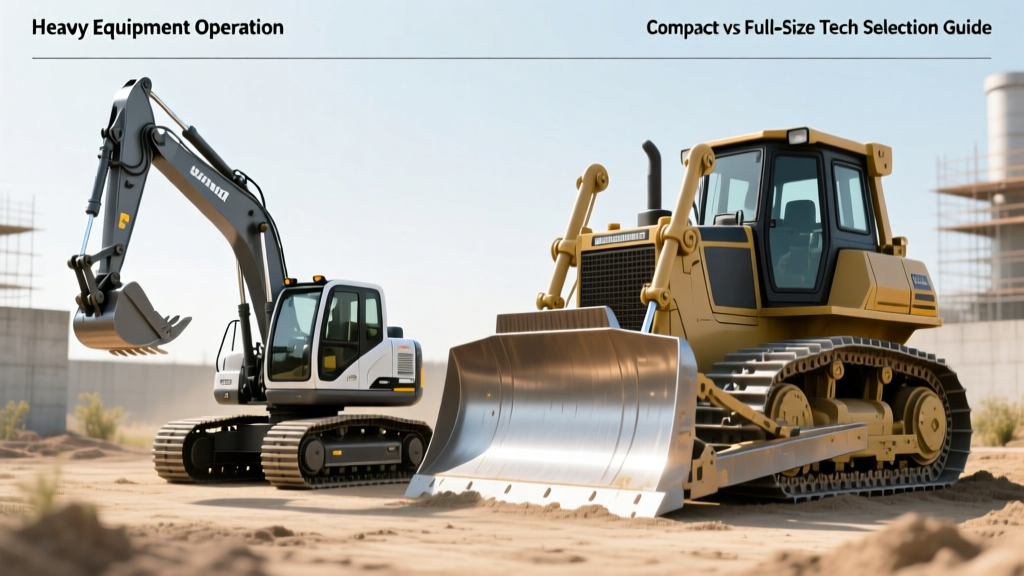
The paradigm of heavy equipment operation has fundamentally shifted from mechanical leverage to software-defined precision. In 2026, selecting between compact and full-size machinery is no longer just about bucket capacity or physical footprint; it is a complex calculation involving telematics integration, automation readiness, and powertrain architecture. As job sites become more digitized, the technology gap between a 3-ton mini excavator and a 25-ton crawler excavator dictates entirely different operational workflows.
2026 Market Shift: According to the Association of Equipment Manufacturers (AEM), compact equipment with integrated 3D grade-control telematics has seen a 34% year-over-year adoption rate in urban sectors, outpacing full-size machine tech upgrades by a factor of two.The Telematics Divide: Data-Driven Sizing Decisions
Modern heavy equipment operation relies heavily on real-time data, but the way compact and full-size machines handle this data differs vastly due to their operating environments. Full-size machines, such as the Komatsu PC210LCi-11, are designed for open-earthmoving and rely on cloud-based fleet management systems. They utilize high-bandwidth cellular connections to transmit volumetric payload data, fuel consumption metrics, and predictive maintenance algorithms to centralized dashboards like Cat's VisionLink or John Deere's JDLink.
Conversely, compact machines like the Bobcat E165 often operate in dense urban environments, basements, or underground utilities where cellular signals degrade. Consequently, compact heavy equipment operation leans on localized mesh networks and edge computing. The machine processes LiDAR and 3D grade data locally on-board, syncing only batch-processed utilization reports when the machine returns to a Wi-Fi enabled staging area. Selecting the wrong class for your connectivity environment results in blind spots in your fleet utilization data.
Tech Spec & Capability Matrix: Compact vs. Full-Size
| Feature / Capability | Compact Class (< 5 Tons) | Full-Size Class (20+ Tons) |
|---|---|---|
| Grade Control Automation | 2D laser-guided; localized edge processing | 3D GNSS/RTK; cloud-synced topographical mapping |
| Telematics Architecture | Bluetooth/Wi-Fi mesh; batch data syncing | 5G/LTE-M; continuous real-time streaming |
| Primary Powertrain Trend | Full Battery Electric (BEV) / 48V-96V systems | Tier 4 Final Diesel / Hydrogen-Hybrid assists |
| Remote Op Latency Tolerance | < 15ms (Confined space precision) | < 50ms (Open pit/autonomous hauling) |
| Approx. Base Pricing (2026) | $45,000 - $75,000 | $220,000 - $310,000 |
Remote Control and Latency in Heavy Equipment Operation
Remote operation is no longer a novelty; it is a critical safety and efficiency mandate, particularly in hazardous demolition and mining. However, the physics of remote heavy equipment operation dictates strict latency thresholds governed by standards like OSHA construction safety guidelines and ISO 23728 (Earth-moving machinery — Remote operator control systems).
When operating a full-size 25-ton excavator remotely, the mass of the attachment and the hydraulic flow rates mean that a 40-millisecond (ms) latency is generally acceptable for bulk trenching. The operator's brain compensates for the slight visual-motor delay. However, in compact heavy equipment operation—such as using a 3.5-ton remote-controlled mini excavator to dismantle interior concrete foundations—a 40ms delay can result in over-travel, striking load-bearing pillars or utility lines. Compact remote systems in 2026 demand localized 5G private networks or Wi-Fi 6E direct links to guarantee sub-15ms latency, requiring a completely different site IT infrastructure than full-size earthmoving fleets.
"The biggest mistake contractors make is applying full-size remote operation protocols to compact indoor demolition. The lower inertia of compact attachments requires ultra-low latency networks; otherwise, the micro-corrections required for precision work become impossible, leading to severe structural damage." — Dr. Aris Thorne, Heavy Machinery Robotics Institute
Electrification Realities: Battery Density vs. Hydraulic Demands
The most glaring technological divergence between compact and full-size equipment lies in electrification. The push for zero-emission job sites has made Battery Electric Vehicles (BEVs) the standard for compact equipment, while full-size machines remain tethered to internal combustion or complex hybrid systems.
The Physics of Energy Density
Consider the Volvo ECR25 Electric, a staple in the compact class. It requires roughly 40 to 50 kWh of battery storage to complete an 8-hour shift of intermittent light trenching and lifting. Utilizing current Lithium-Ion NMC (Nickel Manganese Cobalt) battery packs with an energy density of approximately 250 Wh/kg, the battery array weighs around 200 kg. This is easily integrated into a 5-ton machine without compromising the center of gravity or payload capacity.
Now, apply this to a full-size Caterpillar 320 excavator. A 160kW (215 hp) diesel engine operating at a 60% load factor for 8 hours consumes roughly 750 kWh of energy. To replicate this with current battery technology, the machine would require a 3,000 kg (6,600 lb) battery pack. This massive weight penalty destroys the machine's lifting capacity, alters its stability profile, and requires a reinforced undercarriage, effectively negating the efficiency gains. Therefore, heavy equipment operation in the full-size class relies on advanced hydraulic regenerative systems (like Kawasaki's KERS) and hydrogen fuel-cell range extenders rather than pure BEV architectures.
Hydraulic vs. Electric Actuator Response Times
A hidden factor in equipment selection is the shift from traditional hydraulic pumps to electro-hydraulic and fully electric actuators. Compact machines are rapidly adopting fully electric linear actuators for boom and stick movements. These systems offer instantaneous torque delivery and eliminate hydraulic fluid leaks—a critical requirement for indoor heavy equipment operation or work near municipal water supplies.
Full-size machines, however, still require the sheer sheer-force and shock-absorption properties of hydraulic fluid to break bedrock and handle multi-ton boulders. The technology trend here is not full electrification, but rather electro-hydraulic valve control. By replacing mechanical pilot valves with electronic joysticks and proportional solenoid valves, full-size machines achieve millimeter precision, but they still rely on hydraulic fluid for the actual work group actuation.
Decision Framework: Choosing the Right Tech Class
Do not select equipment based solely on the volume of dirt to be moved. Use this step-by-step framework to align your heavy equipment operation needs with the correct technology class:
- Audit Site Connectivity: If your site lacks reliable 5G/LTE-M coverage and you require real-time telematics for billing or compliance, lean toward compact machines with edge-computing capabilities, or invest heavily in site-wide Wi-Fi mesh networks for full-size fleets.
- Calculate Energy Density Requirements: If your operational mandate requires zero local emissions (e.g., inside a hospital expansion or underground transit hub), you are restricted to the compact BEV class. For full-size outdoor earthmoving, specify machines with Tier 4 Final engines paired with hydraulic regenerative swing systems.
- Evaluate Automation ROI: Full-size 3D GNSS machine control pays for itself (typically a $45,000 upgrade) on sites moving over 10,000 cubic yards of material by eliminating grade-checkers and reducing rework. For sites under 2,000 cubic yards, compact 2D laser-guided systems ($8,000 upgrade) offer a faster ROI.
Real-World TCO: Factoring in Software Subscriptions
When calculating the Total Cost of Ownership (TCO) in 2026, the hardware is only half the equation. Heavy equipment operation now includes mandatory software subscriptions for machine control and telematics. A full-size machine utilizing a proprietary 3D grade control system may require a $3,500 annual software license and base-station correction network fee. Compact machines utilizing open-source RTK networks or localized 2D lasers often bypass these recurring costs. Always factor a 5-year software licensing model into your procurement spreadsheets before finalizing your fleet mix.
Ultimately, the choice between compact and full-size machinery is a choice between two distinct technological ecosystems. Compact equipment offers agility, full electrification, and edge-computed precision for confined spaces. Full-size equipment delivers cloud-integrated fleet analytics, massive hydraulic force, and GNSS-driven automation for open terrain. Aligning your heavy equipment operation strategy with these underlying tech architectures is the only way to secure a competitive edge in modern construction.