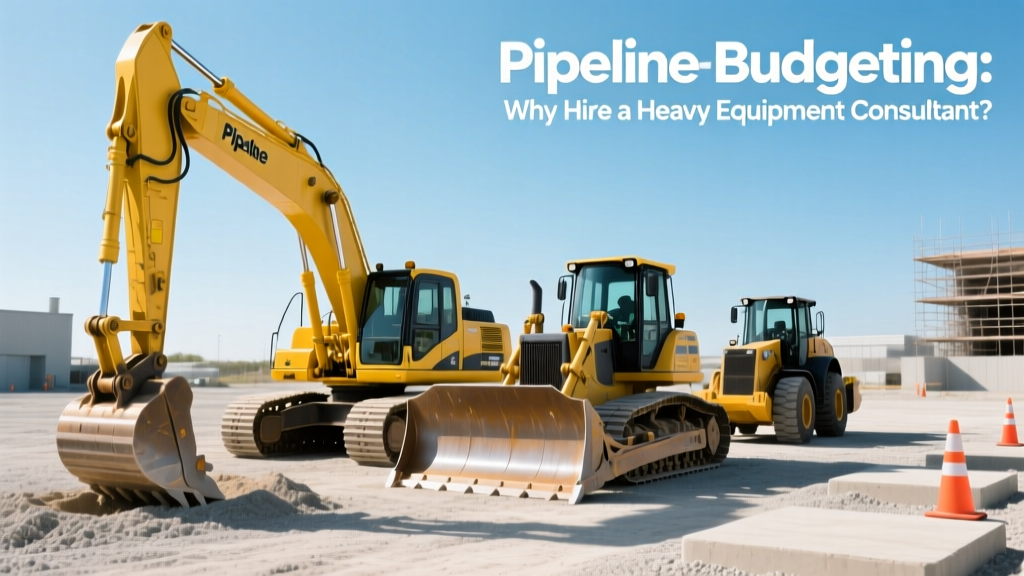
Pipeline Budgeting: Why Hire a Heavy Equipment Consultant?
Discover how a heavy equipment consultant optimizes pipeline and utility fleet budgets, reducing equipment lifecycle costs and preventing ROW overruns.
The Financial Reality of Pipeline Fleet Acquisition
Utility and pipeline construction operates on unforgiving margins. A delayed pipe-stringing operation or an undercarriage failure on a remote Right-of-Way (ROW) can cascade into tens of thousands of dollars in daily liquidated damages. Unlike general earthmoving, pipeline projects demand highly specialized machinery—from sideboom pipelayers to automated bending rigs—where the capital expenditure (CapEx) and operational expenditure (OpEx) profiles are notoriously difficult to forecast. This is precisely where a heavy equipment consultant transitions from a luxury to a financial necessity.
Fleet managers often default to historical purchasing habits, but the 2026 equipment market is defined by volatile interest rates, extended OEM lead times for specialized pipeline attachments, and stringent emissions compliance. A specialized consultant bridges the gap between engineering requirements and financial reality, utilizing lifecycle cost analysis to prevent capital bleed.
Executive Summary: Engaging a heavy equipment consultant for utility and pipeline projects typically yields a 12% to 18% reduction in total fleet lifecycle costs by optimizing the rent-versus-buy matrix, minimizing ROW mobilization expenses, and integrating predictive telematics.Capital Allocation: The Purchase vs. Rental Matrix
The foundational step in pipeline budgeting is determining asset acquisition strategy. General contractors frequently over-purchase specialized equipment that sits idle between pipeline contracts, or conversely, over-rent standard excavators when dedicated pipelayers would offer superior production rates. Below is a 2026 baseline cost matrix for core pipeline machinery.
| Equipment Type | Model Benchmark | Est. Purchase Price | Est. Daily Rental | Mobilization (per 100mi) |
|---|---|---|---|---|
| Sideboom Pipelayer | Cat 583T | $680,000 - $740,000 | $1,800 - $2,400 | $8,500 (Lowboy/Permits) |
| Ride-On Trencher | Vermeer RTX600 | $185,000 - $210,000 | $650 - $850 | $2,200 |
| Vacuum Excavator | Ditch Witch FX65 | $220,000 - $245,000 | $900 - $1,100 | $1,500 |
| Pipe Bending Machine | CRC-Evans 36in | $850,000+ | $3,500+ | $12,000+ |
A heavy equipment consultant uses this matrix not just to compare daily rates, but to model the mobilization burden. Moving a 95,000-pound Cat 583T pipelayer requires specialized lowboy trailers, overweight permits, and route surveys. If a project requires relocating the spread every three weeks across mountainous terrain, the mobilization costs can eclipse the rental savings, making localized short-term rentals or strategic sub-leasing the mathematically superior choice.
Equipment Selection: Dedicated Pipelayers vs. Modified Excavators
One of the most common budget leaks in utility construction is the misuse of modified excavators for heavy pipe-laying. While outfitting a standard 30-ton excavator (like a Cat 330) with a side-boom attachment and extra counterweight saves roughly $400,000 in upfront CapEx compared to a dedicated pipelayer, it introduces severe operational liabilities.
The Break-Even Analysis
- Under 16-Inch Pipe Diameter: Modified excavators are highly cost-effective. Their versatility allows them to trench, lift, and backfill, maximizing utilization rates on smaller utility distribution lines.
- 16-Inch to 24-Inch Pipe: The break-even zone. Excavators suffer accelerated slew-ring wear and hydraulic pump degradation when constantly lifting near their maximum tip-capacity. Maintenance OpEx increases by up to 22%.
- Over 24-Inch Pipe (Transmission Lines): Dedicated pipelayers (e.g., Cat 583T or 587T) are mandatory. They feature hydrostatic transmissions, specialized counterweight management systems, and boom geometries designed for continuous lateral loads. Using an excavator here risks catastrophic load-drop failures and violates most pipeline owner specifications.
Using a standard excavator for continuous side-loading (pipe lowering-in) causes asymmetric wear on the swing bearing. A heavy equipment consultant will mandate ultrasonic thickness testing on the slew ring every 500 hours for modified machines, a maintenance line item often omitted from standard budgets until a $35,000 failure occurs.
Right-of-Way (ROW) Logistics and Undercarriage Budgeting
Pipeline routes rarely accommodate standard machine logistics. A consultant's value is deeply rooted in forecasting undercarriage wear based on geological ROW data. Standard flat-track shoes will disintegrate within 400 hours on rocky, abrasive shale formations common in Appalachian or Permian Basin pipeline routes.
Instead of absorbing a $45,000 undercarriage replacement mid-project, a consultant will specify Extreme Duty (XD) or rock-guard track chains during the initial OEM order. While this adds approximately 8% to the initial purchase price, it extends undercarriage life by up to 60% in abrasive environments, drastically lowering the cost-per-hour of operation. Furthermore, consultants factor in the cost of track tensioning adjustments; improper tension on a pipelayer navigating a 15-degree side-slope can snap a track chain, resulting in a 48-hour work stoppage while waiting for specialized rigging to re-track the machine in a muddy trench.
Compliance, Safety, and Trenching Budgets
Budgeting for safety is not optional; it is a rigid regulatory requirement that directly impacts equipment selection. According to OSHA's trenching and excavation standards, protective systems are mandatory for trenches deeper than 5 feet. For deep utility installations, the choice between sloping (which requires massive excavators and high earthmoving costs) and trench shielding (which requires cranes or large excavators to place steel boxes) dictates the entire fleet makeup.
Additionally, the Pipeline and Hazardous Materials Safety Administration (PHMSA) enforces strict integrity management rules. Consultants ensure that equipment budgets include the necessary non-destructive testing (NDT) gear, automated welding rigs, and proximity detection sensors. Failing to budget for OEM-installed 360-degree camera systems and radar proximity alerts on pipelayers can result in failed site inspections by the pipeline owner, halting production entirely.
Telematics and Predictive Maintenance Integration
Modern fleet budgeting relies on data, not guesswork. The Bureau of Labor Statistics Producer Price Index consistently tracks the rising costs of heavy machinery parts and repair labor. To combat this, consultants integrate OEM telematics (such as Cat Connect or Volvo CareTrack) into the project's financial forecasting model.
By monitoring hydraulic main pump pressures and engine load factors in real-time, consultants can predict component failures before they happen. For example, if a vacuum excavator's debris tank door hydraulic cylinder shows a 15% pressure drop over a week, the consultant schedules a $400 seal replacement during a planned weekend downtime, avoiding a $4,000 emergency field repair and a lost day of production. This data-driven approach shifts the maintenance budget from reactive emergency spending to planned, predictable OpEx.
The ROI of Specialized Fleet Advisory
Utility and pipeline construction leaves zero room for equipment inefficiencies. The capital required to mobilize a pipeline spread is immense, and the penalties for downtime are severe. By leveraging a heavy equipment consultant, project executives ensure that every machine on the ROW is precisely matched to the soil conditions, pipe specifications, and logistical realities of the route. The result is a optimized fleet that protects profit margins, ensures regulatory compliance, and delivers the project on schedule.