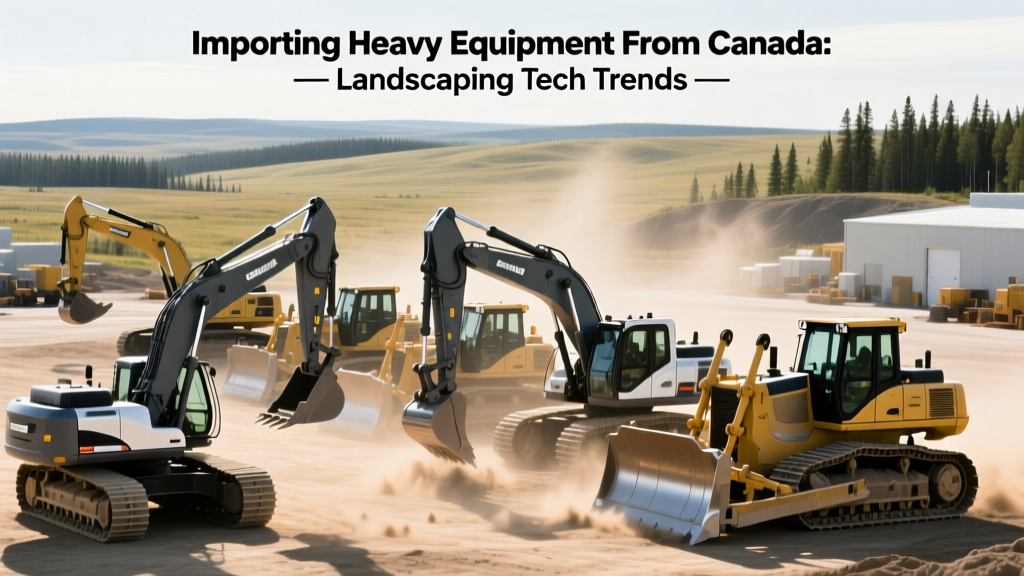
Importing Heavy Equipment From Canada: Landscaping Tech Trends
Discover the 2026 technology trends driving US buyers toward importing heavy equipment from Canada for landscaping fleets, including EV specs and USMCA rules.
The Cross-Border Arbitrage: Why Source Landscaping Tech from Canada?
For US-based landscaping contractors and fleet managers, the decision of importing heavy equipment from Canada is no longer just about chasing favorable currency exchange rates. In 2026, the primary driver is technology divergence. Canada’s extreme climate variations and aggressive municipal zero-emission mandates have forced OEMs to spec landscaping machinery with advanced thermal management systems, heavy-duty undercarriages, and early-adoption electric powertrains that are often optional—or entirely unavailable—on standard US-bound models.
When contractors in the northern US, mountain west, or high-altitude regions require machines that can withstand sub-zero starts while maintaining precise hydraulic tolerances for grading and hardscaping, Canadian-spec equipment offers a distinct operational advantage. Furthermore, the robust secondary market in provinces like Alberta and Ontario frequently yields late-model, tech-heavy landscaping assets at a 10% to 18% discount compared to US dealer inventories, even after factoring in cross-border freight and customs brokerage.
Market Insight: According to cross-border trade data, heavy machinery movements under the USMCA framework have surged, with compact landscaping equipment representing one of the fastest-growing import categories by volume. The ability to leverage Canadian-surplus electric and GPS-equipped machines provides a massive ROI for US landscaping firms bidding on municipal contracts.Core Landscaping Equipment Categories & 2026 Tech Specs
Landscaping heavy equipment spans several distinct categories, each undergoing rapid technological evolution. When importing from Canada, buyers must understand the specific tech packages attached to these models.
1. Compact Track Loaders (CTLs): The Grading Workhorses
CTLs are the backbone of modern commercial landscaping, handling everything from rough grading to precise hardscape material placement. The Bobcat T86 and Caterpillar 299D3 XE dominate this space. Canadian-spec CTLs frequently come factory-equipped with integrated 3D GPS machine control (such as Trimble Earthworks or Topcon), a feature often stripped from base US models to lower entry pricing.
- Hydraulic Flow: Canadian-spec high-flow packages routinely push 45 to 50 GPM, necessary for driving heavy forestry mulchers and snowblowers in winter landscaping/maintenance contracts.
- Cold-Weather Tech: Factory-installed block heaters, -40°F rated hydraulic hoses, and heated, pressurized HVAC cabs with telematics-enabled remote pre-start capabilities.
- Pricing Delta: A 2024-2025 model Cat 299D3 XE with 3D grade control retails for roughly $115,000 USD in the US. Sourcing a surplus Canadian unit with identical specs often lands between $92,000 and $98,000 USD before freight.
2. Electric Mini Excavators: Urban Landscaping & Trenching
Canadian cities like Vancouver and Toronto have enacted strict zero-emission zones for municipal landscaping and utility work. This has created a massive influx of electric mini excavators, such as the Volvo ECR25 Electric and Bobcat E32e. As Canadian fleets upgrade to newer 2026 models, lightly used EV excavators are entering the export market.
The critical technology differentiator here is the Battery Thermal Management System (BTMS). Canadian-spec EV excavators feature aggressive battery preconditioning protocols and insulated battery enclosures designed to maintain optimal lithium-ion cell temperatures in freezing weather. US-spec models, often destined for the Sunbelt, may lack these robust heating circuits, leading to severe range degradation and sluggish hydraulic response when operated in cold US climates.
3. Skid Steer Loaders (SSLs) & Multi-Terrain Loaders
For tight-access residential landscaping, wheeled skid steers like the John Deere 333 P-Tier remain essential. Canadian imports in this category are highly sought after for their advanced telematics integration. JDLink™ telematics on Canadian models are often spec'd with satellite fallback capabilities to maintain GPS tracking and diagnostic data transmission in remote, heavily forested areas of British Columbia and Northern Ontario—a feature that proves invaluable for US contractors working in rural or mountainous terrain where cellular coverage is spotty.
Tech Divergence: Canadian-Spec vs. US-Spec Landscaping Fleets
Understanding the exact technological differences is crucial when evaluating an import. Below is a comparison matrix of standard landscaping equipment configurations.
| Technology Feature | Standard US-Spec Model | Standard Canadian-Spec Model | Impact on Landscaping Operations |
|---|---|---|---|
| Machine Control (GPS) | Optional dealer-add ($15k+) | Factory-integrated 3D (OEM) | Reduces grading rework by up to 40%; essential for precise drainage slopes. |
| EV Battery Thermal Mgmt | Passive cooling / basic heating | Active liquid heating & insulation | Prevents 30%+ battery range loss during cold-weather hardscaping. |
| Hydraulic Hose Ratings | Standard (-20°F minimum) | Arctic-rated (-50°F minimum) | Eliminates catastrophic hose blowouts during early morning winter starts. |
| Telematics Connectivity | Cellular-only (4G/5G) | Cellular + Satellite fallback | Ensures continuous geofencing and idle-time tracking in rural sites. |
Regulatory Hurdles: EPA, CARB, and USMCA Compliance
Importing heavy equipment from Canada requires strict adherence to environmental and trade regulations. The technology that makes Canadian machines desirable also complicates the import process if not properly documented.
Compliance Warning: Do not assume a machine legally operated in Canada is automatically legal to import into the US. California Air Resources Board (CARB) regulations and US EPA Tier 4 Final emissions standards require exact engine family matching. Furthermore, Canadian-spec EV equipment must meet US Department of Transportation (DOT) and OSHA battery safety certifications.Step 1: USMCA Tariff Elimination
Under the United States-Mexico-Canada Agreement (USMCA), heavy landscaping equipment can cross the border duty-free (0% tariff), provided it meets the Rules of Origin. You must obtain a valid USMCA certification of origin from the Canadian seller. According to the US Customs and Border Protection (CBP), the equipment must be manufactured in North America to qualify. Most major OEMs (Bobcat, Cat, John Deere) manufacture their compact equipment in North American facilities, but verifying the specific VIN/Serial origin is mandatory.
Step 2: EPA Engine Certification (Form 3520-21)
For diesel-powered CTLs and excavators, the engine must comply with US EPA nonroad emissions standards. You must file EPA Form 3520-21 upon entry. Because Canada and the US share largely harmonized Tier 4 Final emissions standards, most late-model Canadian machines will have an EPA-compliant emissions label physically affixed to the engine block. If the label is missing or lists only Canadian CEPA (Canadian Environmental Protection Act) compliance, the machine may be held at the border for independent emissions testing, costing thousands in storage fees.
Step 3: Harmonized Tariff Schedule (HTS) Classification
Correctly classifying the equipment is vital for customs processing. Landscaping equipment generally falls under specific HTS codes. For example, self-propelled bulldozers, graders, and excavators typically fall under HTSUS Heading 8429, while compact skid steers and CTLs often fall under 8427 or 8429 depending on exact weight and track configuration. Misclassification can trigger unnecessary agricultural or off-road vehicle taxes.
Financial Framework: Calculating the True Landed Cost
To determine if importing a tech-heavy landscaping machine from Canada is financially viable, fleet managers must calculate the true landed cost. Use this framework to evaluate potential purchases:
- Base Purchase Price: The negotiated CAD price converted to USD (factor in current bank wire exchange rates, typically 1.5% to 2% spread).
- Freight & Rigging: Transporting a 10,000 lb CTL from Alberta to the US border via flatbed runs approximately $1,800 to $2,500 USD. Border drayage and final delivery to your US yard adds another $800 to $1,500.
- Customs Brokerage & Bond: A licensed customs broker will charge $150 to $300 for entry filing. You will also need a single-entry or continuous customs bond (approx. $250 to $500 annually).
- Tech Recalibration & Software Licensing: This is the hidden cost of importing tech. Factory-installed 3D GPS machine control systems often require regional software unlocking or base-station recalibration to function on US correction networks (like RTX or VRS). Budget $1,500 to $3,500 for an authorized OEM technician to flash the regional firmware and transfer the telematics subscription to your US corporate account.
- Cleanout & Agricultural Inspection: The USDA requires all imported heavy equipment to be steam-cleaned and free of Canadian soil to prevent the spread of invasive pests. Professional border-wash services cost $200 to $400 per machine.
'The margin for error when importing tech-enabled landscaping equipment is razor-thin. A $15,000 discount on a Canadian-spec Bobcat T86 is instantly wiped out if you fail to verify that the Trimble Earthworks software license is transferable across the border and compatible with US RTK base stations.' — Fleet Procurement Director, Regional Landscaping Conglomerate
Strategic Takeaways for 2026 Fleet Expansion
Importing heavy equipment from Canada offers US landscaping contractors a unique pathway to acquire premium, cold-weather resilient, and technologically advanced machinery at a discount. The key to success lies in rigorous due diligence. Prioritize Canadian-spec electric mini excavators with active thermal management for urban municipal bids, and target factory-equipped 3D CTLs for high-volume grading operations. By mastering the USMCA documentation and EPA engine verification processes, contractors can turn cross-border sourcing into a significant competitive advantage in the 2026 landscaping market.