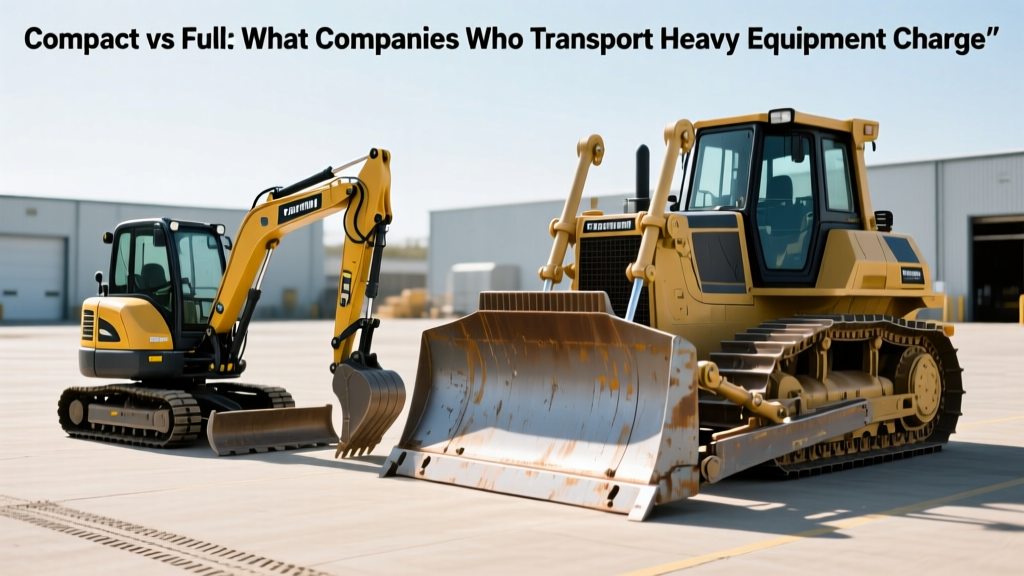
Compact vs Full: What Companies Who Transport Heavy Equipment Charge
Discover how compact vs full-size equipment selection impacts logistics. Learn what companies who transport heavy equipment charge for moves.
The Hidden Variable in Equipment Selection: Logistics and Transport
Selecting between compact and full-size construction equipment usually revolves around digging depth, breakout force, and lift capacity. However, a massive hidden variable dictates true return on investment: logistics. When you factor in what companies who transport heavy equipment charge to move your iron from the yard to the job site, the financial advantage of compact machinery often becomes the deciding factor for mid-sized contractors and specialty fleets.
The purchase price or monthly lease of a 75,000-pound excavator is only the beginning of its cost basis. If a project requires moving the machine across state lines or through congested urban corridors, transport costs can easily eclipse the machine's monthly depreciation. Understanding the exact weight thresholds, trailer requirements, and regulatory hurdles is mandatory for accurate project bidding.
The Weight Thresholds: Where Transport Costs Skyrocket
Transport pricing is not linear; it operates on strict regulatory cliffs dictated by the Department of Transportation (DOT). The moment your equipment and trailer combination crosses specific Gross Vehicle Weight Rating (GVWR) thresholds, the cost structure changes entirely.
Regulatory Warning: According to the Federal Motor Carrier Safety Administration (FMCSA), a Commercial Driver's License (CDL) is required to operate a vehicle combination with a Gross Combination Weight Rating (GCWR) of 26,001 pounds or more, provided the towed unit exceeds 10,000 pounds. Misclassifying your transport needs to avoid CDL requirements can result in severe DOT fines and impounded equipment.Tier 1: The Non-CDL / Hotshot Zone (Under 26,000 lbs GCWR)
This tier encompasses most compact track loaders (CTLs), skid steers, and mini excavators. Machines like the Kubota KX040-4 (operating weight: 7,800 lbs) or the Bobcat E35 (7,700 lbs) can be loaded onto a standard 10,000 to 14,000 lb capacity gooseneck or equipment trailer. When paired with a heavy-duty 3/4-ton or 1-ton pickup (e.g., Ford F-350 or Ram 3500), the total GCWR often stays under the 26,000 lb CDL threshold, allowing non-CDL drivers to perform local moves, drastically reducing labor costs.
Tier 2: The Standard Lowboy Zone (40,000 - 80,000 lbs)
Full-size machines like the CAT 330 (75,000 lbs) or John Deere 350 P-Tier (80,500 lbs) require specialized heavy haul trailers. Transporting these requires a Class A CDL driver, a multi-axle lowboy or Removable Gooseneck (RGN) trailer, and a dedicated heavy-duty semi-tractor. You are now paying for specialized labor, higher fuel surcharges, and commercial fleet insurance.
Tier 3: The Oversize / Superload Zone (80,000+ lbs)
Machines like the CAT 390F (90,000+ lbs) or large mining shovels cross standard legal weight limits. Moving these requires oversize load permits, route surveys, escort vehicles (pilot cars), and occasionally infrastructure modifications like lifting power lines or securing bridge crossings.
Cost Matrix: What Transport Companies Actually Charge
The following matrix outlines the baseline market rates charged by heavy haul logistics providers for compact versus full-size equipment moves. Rates fluctuate based on diesel prices and regional capacity, but these baselines remain consistent for budgeting.
| Cost Factor | Compact Equipment (Hotshot/Flatbed) | Full-Size Equipment (Lowboy/RGN) |
|---|---|---|
| Base Mileage Rate | $2.50 - $4.00 per mile | $5.00 - $9.00+ per mile |
| Minimum Hookup Fee | $150 - $250 | $400 - $750 |
| Oversize Permits | Rarely required (Width < 8.5 ft) | $50 - $300+ per state/axle |
| Pilot / Escort Cars | Not required | $1.50 - $2.50 per mile (per car) |
| Driver Labor Class | Non-CDL or Class B (Local) | Class A CDL (Heavy Haul Endorsement) |
Hidden Surcharges and Edge Cases in Heavy Haul
When requesting quotes from transport companies, the base mileage rate is only half the equation. Contractors frequently encounter budget overruns due to unanticipated surcharges that disproportionately affect full-size equipment.
- Track Cleaning Fees: If a full-size excavator arrives at a transport yard with caked mud or concrete debris on its tracks, carriers will charge a $150 to $400 cleaning fee. DOT regulations prohibit debris from falling onto highways, and carriers will not risk fines.
- Detention and Waiting Time: Heavy haul drivers are strictly regulated by Hours of Service (HOS) mandates. If your site crew takes more than 2 hours to load and secure an 80,000 lb machine, expect detention fees of $75 to $125 per hour. Compact machines, which can be driven onto a tilt-bed trailer in 10 minutes, rarely incur these fees.
- The Federal Bridge Formula: According to the Federal Highway Administration (FHWA), axle spacing dictates legal weight limits on bridges. A full-size wheel loader might require the carrier to extend their RGN trailer to 53 feet to distribute the axle weight properly. If the carrier must use a longer trailer, the per-mile rate increases due to reduced maneuverability and fuel efficiency.
"Contractors bidding on multi-site municipal projects often lose their profit margin to inter-site mobilization. Moving a fleet of five compact track loaders between sites costs roughly 60% less than moving two large wheel loaders with the equivalent total lifting capacity, simply due to the elimination of lowboy trailers and oversize permits."
The 5-Point Site Logistics Decision Framework
Use this framework to determine whether the higher production rate of full-size equipment justifies the transport logistics, or if a fleet of compact machines is the superior financial choice.
- Calculate the Move Frequency: If the machine will remain on a single site for 6+ months, transport costs are amortized and negligible; choose full-size for maximum production. If the machine moves weekly (e.g., utility trenching, landscaping), the $600+ per-move cost of lowboy transport will destroy margins. Choose compact.
- Audit Site Access and Egress: Full-size equipment requires wide, stabilized staging areas for lowboy ramps. If the site features steep grades, soft soil, or tight urban alleyways, the carrier may refuse to drop the load, forcing you to pay for a specialized crane offload ($1,500+). Compact equipment can be offloaded via standard tilt-beds almost anywhere.
- Evaluate the CDL Labor Pool: If you intend to transport the equipment using your own fleet, assess your labor pool. Hiring and retaining Class A CDL heavy-haul drivers commands a premium wage ($32-$45/hour). If you only have non-CDL operators, you are restricted to compact equipment under the 26,000 lb GCWR limit.
- Factor in Attachment Swaps: A single 33,000 lb compact excavator can often match the total daily material moved of a larger machine if equipped with specialized attachments (tiltrotators, hydraulic breakers) and moved via hotshot. Calculate the transport savings against the cost of the attachment.
- Check Municipal Road Restrictions: Many suburban and urban municipalities enforce seasonal weight restrictions (spring thaw) or permanent bridge weight limits that prohibit 80,000 lb lowboy combinations. Compact equipment bypasses these routing nightmares entirely.
Final Procurement Directive
Do not evaluate equipment solely on the manufacturer's spec sheet for bucket capacity or hydraulic flow. Run a 12-month logistics simulation. Multiply your estimated annual moves by the carrier rates outlined above. For contractors operating in fragmented, multi-site environments, the capital saved by avoiding heavy-haul lowboy logistics frequently outweighs the raw earthmoving speed of full-size iron.