Compact vs Full-Size Grader Heavy Equipment: Specs & Selection
Compare compact vs full-size grader heavy equipment. Explore technical specs, blade widths, horsepower, and selection frameworks for site grading.
Selecting the correct grader heavy equipment for earthmoving and road construction requires a precise understanding of material dynamics, site constraints, and machine geometry. The operational divide between compact motor graders and full-size production graders is not merely a matter of physical footprint; it is a fundamental difference in drawbar pull, moldboard down-pressure, and volumetric displacement capacity. Misallocating a 55,000-pound full-size grader to a tight urban utility trench, or sending a 24,000-pound compact grader to cut virgin clay sub-base, results in severe efficiency losses, accelerated component wear, and failed compaction tests.
Site Selection Decision Matrix
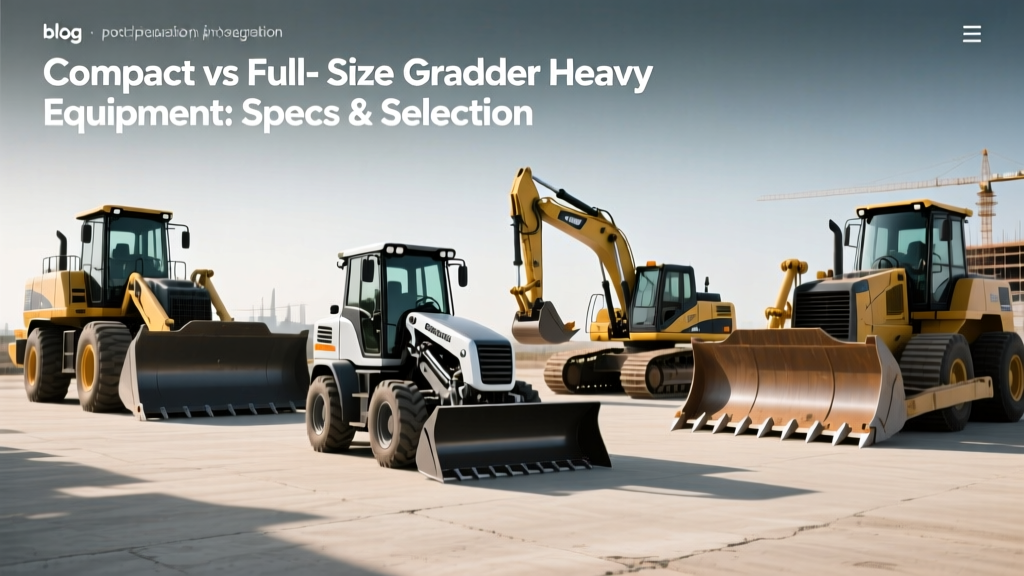
- Deploy Compact Graders (12ft blade, <30,000 lbs): Urban infill, parking lot fine-grading, trench backfill leveling, and rural driveway maintenance where turning radii are under 25 feet and material is pre-loosened.
- Deploy Full-Size Graders (14ft-16ft blade, 40,000+ lbs): Highway sub-base construction, heavy clay displacement, mine haul road maintenance, and large-scale agricultural land leveling requiring high draft loads and continuous 3D GPS tolerance.
Core Technical Specifications Matrix
The following matrix contrasts the baseline engineering specifications across three distinct classes of grader heavy equipment, utilizing current industry benchmarks from manufacturers like LeeBoy, Caterpillar, and John Deere.
| Specification | Compact (e.g., LeeBoy 8520) | Mid-Size Full (e.g., CAT 140) | Large Full-Size (e.g., Deere 872) |
|---|---|---|---|
| Engine Horsepower | 130 HP | 185 HP | 235 HP |
| Operating Weight | 24,500 lbs | 41,200 lbs | 54,000 lbs |
| Standard Blade Width | 12 ft | 14 ft | 16 ft |
| Circle Diameter | 42 inches | 60 inches | 72 inches |
| Max Down-Pressure | 8,500 lbs | 18,200 lbs | 24,500 lbs |
| Turning Radius | 19 ft | 25.5 ft | 29 ft |
Powertrain Mechanics and Rimpull Dynamics
The method by which engine power is translated to the cutting edge dictates the machine's ability to maintain momentum under heavy draft loads. Compact grader heavy equipment typically utilizes a hydrostatic drive or a basic power-shift transmission. While hydrostatic systems offer infinite speed control and excellent inching capabilities for fine-grading around utilities, they suffer from lower mechanical efficiency and higher heat generation when pushing heavy windrows of material over long distances.
Lock-Up Torque Converters in Full-Size Models
Full-size production graders employ advanced lock-up torque converters paired with planetary power-shift transmissions. When cutting hardpan or compacted gravel, the torque converter multiplies engine torque by a factor of 2.5 to 3.0 at stall, providing the massive rimpull required to penetrate the ground. Once the machine reaches transport or light-cutting speeds, the lock-up clutch engages, creating a direct mechanical link between the engine and transmission. This eliminates slip, reduces fuel consumption by up to 15%, and prevents the transmission oil from overheating during sustained high-speed roading.
Moldboard, Circle Gear, and Down-Pressure
The moldboard assembly is the functional core of any grader. The structural integrity of the circle gear—the large toothed ring that allows the blade to rotate 360 degrees—is a primary differentiator between compact and full-size classes.
When side-shifting a moldboard into a heavy clay windrow, the lateral draft load exerts immense twisting force on the circle gear. A compact grader's 42-inch circle will experience accelerated gear tooth wear and binding under these loads, whereas a full-size grader's 72-inch circle distributes the mechanical stress over a wider lever arm, ensuring smooth rotation even under maximum down-pressure.
Furthermore, down-pressure is a function of machine weight and hydraulic cylinder geometry. According to soil mechanics principles documented by Penn State Extension, achieving proper soil density and a smooth finish requires the blade to maintain constant ground contact without bouncing. A full-size grader's 24,000+ lbs of down-pressure forces the cutting edge through frost heaves and embedded rocks, whereas a compact grader will simply ride up and over the obstruction, leaving an uneven surface that requires secondary passes.
Machine Control and 3D Grading Integration
Modern grading relies heavily on 3D machine control systems (such as Leica iCON or Topcon Earthworks) to achieve sub-inch tolerances. The integration of these systems varies drastically by equipment size.
- Full-Size Integration: Production graders feature factory-integrated IMU (Inertial Measurement Unit) sensors on the blade, mainframe, and articulation joint. The GNSS receivers are mounted on tall masts or integrated into the cab roof. The machine's hydraulic valves are electronically controlled (EHVs), allowing the system to automatically adjust blade pitch, tilt, and side-shift in real-time based on the digital terrain model (DTM).
- Compact Integration: Compact graders often rely on retrofitted 2D laser receivers or basic 1D sonic trackers for depth control. While aftermarket 3D kits exist, the lack of factory-calibrated articulation sensors means the system must compensate for frame twist, which can introduce a 0.1 to 0.2-inch error margin when the machine is articulated sharply in tight corridors.
Total Cost of Ownership (TCO) and Hidden Variables
Acquisition cost is only the entry point. Evaluating grader heavy equipment requires a 5-year TCO analysis encompassing fuel, ground engaging tools (GET), and logistics.
TCO Breakdown: 2,000 Annual Operating Hours
- Fuel Consumption: A compact grader burns approximately 3.5 to 5.0 gallons per hour (GPH). A full-size 16-foot grader burns 10.0 to 14.0 GPH under load. At $4.00/gallon, the annual fuel delta exceeds $50,000.
- Tire Replacement: Full-size graders utilize 14.00R24 or 17.5R25 radial tires, costing upwards of $1,400 per tire. Compact graders use 17.5-25 bias or radials at roughly $650 per tire.
- Transport Logistics: Moving a 54,000 lb full-size grader requires a lowboy trailer and a commercial driver's license (CDL) with specific weight endorsements, often necessitating a dedicated haul truck. A compact grader can sometimes be transported on a standard 10-ton equipment trailer behind a heavy-duty pickup, drastically reducing mobilization costs for multi-site municipal contractors.
Operator Safety and Work Zone Dynamics
The physical size of the grader dictates its safety profile in active work zones. The NIOSH Highway Work Zone Safety guidelines emphasize the critical nature of operator visibility and blind spot management. Full-size graders possess massive engine enclosures and rear-mounted rippers that create significant blind spots directly behind the machine, necessitating proximity detection systems and dedicated spotters when reversing. Compact graders offer superior rearward visibility and a smaller tail-swing radius, making them inherently safer for pedestrian-heavy areas and active intersection modifications.
Frequently Asked Questions
Can a compact grader handle scarified asphalt milling?
While a compact grader can windrow loose asphalt millings, it lacks the weight and hydraulic down-pressure to effectively spread and compact the material in a single pass. The moldboard will tend to float over the dense millings, requiring multiple passes and resulting in uneven material distribution. Full-size graders are required for high-production milling paving operations.
Does the articulation joint on a full-size grader affect blade accuracy?
Yes. When a full-size articulated grader turns, the front frame shifts relative to the rear frame. If the machine control system does not have an articulation angle sensor to compensate for this shift, the blade will cut outside the intended design line. Modern systems use dual-antenna GNSS and articulation encoders to mathematically correct the blade position in real-time.
What is the role of the rear ripper on full-size models?
The rear ripper (or scarifier) is used to break up compacted soil, old asphalt, or frost heaves ahead of the moldboard. According to the Federal Highway Administration (FHWA), proper scarification ensures uniform pavement bonding and prevents subsurface delamination. Compact graders rarely feature rear rippers due to weight and hydraulic flow limitations, relying instead on dedicated cold planers or dozers for preliminary ripping.